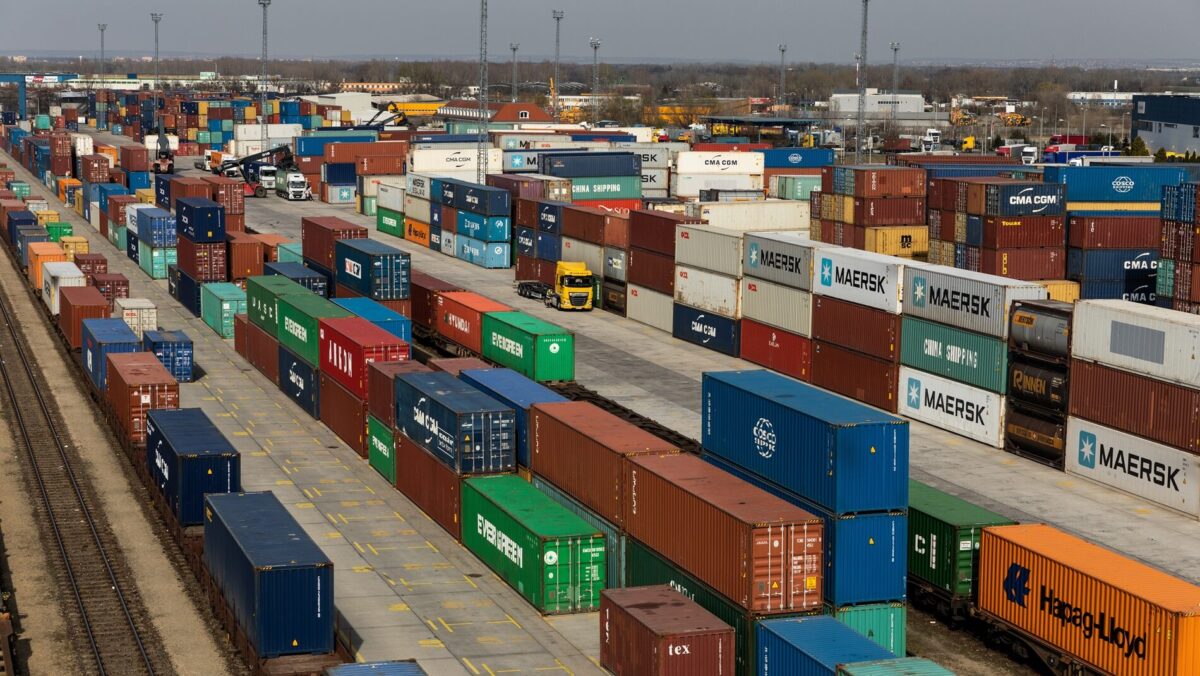


RheinCargo Supports Dyckerhoff in Reactivating the Rail Connection
12. November 2020Parcel Association BIEK Files Urgent Procedure Against Approval of Postal Rates
12. November 2020Digital and automatic: This is how modern coupling in rail freight transport will work. The pilot project commissioned by the Federal Ministry of Transport and Digital Infrastructure (BMVI) for the demonstration, testing, and approval of the Digital Automatic Coupling (DAK) for rail freight transport started in June and is now in the testing phase.
(Berlin/Görlitz) Currently, tests are taking place in Görlitz, where the couplings are being put to the test. Numerous coupling trials are being conducted with different wagon loads and speeds in various track radii. Ulrich Meuser, project manager: “We are right on schedule. We can only test the proper functioning of the couplings through extensive tests under real conditions. However, it has already been shown that the DAK significantly accelerates the assembly of freight trains and thus creates more capacity on the tracks.” Thus, the DAK plays a crucial role in the success of the transport transition. In addition, the DAK relieves railway employees from physical labor, as manual screw couplings will be a thing of the past.
In rail freight transport in Europe, screw couplings have been used almost exclusively for more than 100 years. They are completely manually coupled and uncoupled. To connect the wagons, a bracket weighing around 20 kg is placed on the hook of the next wagon.
Screw Couplings by Hand
The coupling is then tightened by turning a screw thread behind the bracket. A DAK connects two freight wagons automatically. It establishes a mechanical connection between the wagons without manual labor from the shunting staff. DB Cargo alone couples about 54,000 wagons and trains per day in Germany. The entire European rail freight transport even accounts for about 400,000 coupling operations per day.
Digital Automatic Coupling Strengthens Single Wagon Traffic
For the technical testing, twelve freight wagons have been equipped with coupling types from four manufacturers. After conducting technical tests, a DAK type will be selected by a European committee. A test train with 24 wagons equipped with the selected DAK type will then travel for several months through Germany, Austria, and Switzerland, as well as through other EU countries. The DAK will be tested, among other things, in daily operations at shunting yards – their capacity can increase by up to 40 percent. In summary, the DAK is an important building block to increase the transport performance in rail freight transport by around 70 percent or more.
A New Era of Rail Freight Transport
In Europe, there have been several attempts to introduce a standardized automatic coupling, most recently in the 1990s. The focus was solely on pure mechanical coupling and the connection of the air line. This approach was not economically viable enough. In contrast, the DAK significantly expands the operational application spectrum through the use of power and data lines. The DAK leads to the broad digitalization of freight transport, which is why the benefits and economic potential are much greater.
The research project, which runs until the end of 2022, was commissioned by the Federal Ministry of Transport and Digital Infrastructure (BMVI) and is funded by the BMVI with 13 million euros. It involves a consortium of six companies – in addition to DB and its subsidiary DB Cargo, these are the Swiss and Austrian freight railways SBB Cargo and Rail Cargo Austria, as well as the wagon keepers Ermewa, GATX Rail Europe, and VTG. Within DB, the project is classified as a joint system association project of DB AG and DB Cargo in the corporate program Technical Excellence (TecEX).
Introduction to be Completed by 2030
The opportunity for the Europe-wide introduction of the DAK has never been greater than now. Because the introduction is to be largely completed by 2030 – the process will take six to eight years – the introduction phase is to begin no later than 2023/2024. According to a study commissioned by the Federal Ministry of Transport and Digital Infrastructure (BMVI), this is a real mammoth task: in the 27 EU countries as well as in Great Britain, Switzerland, and Norway, up to 490,000 freight wagons and 17,000 locomotives need to be retrofitted.
Photo: © DB AG, Oliver Lang