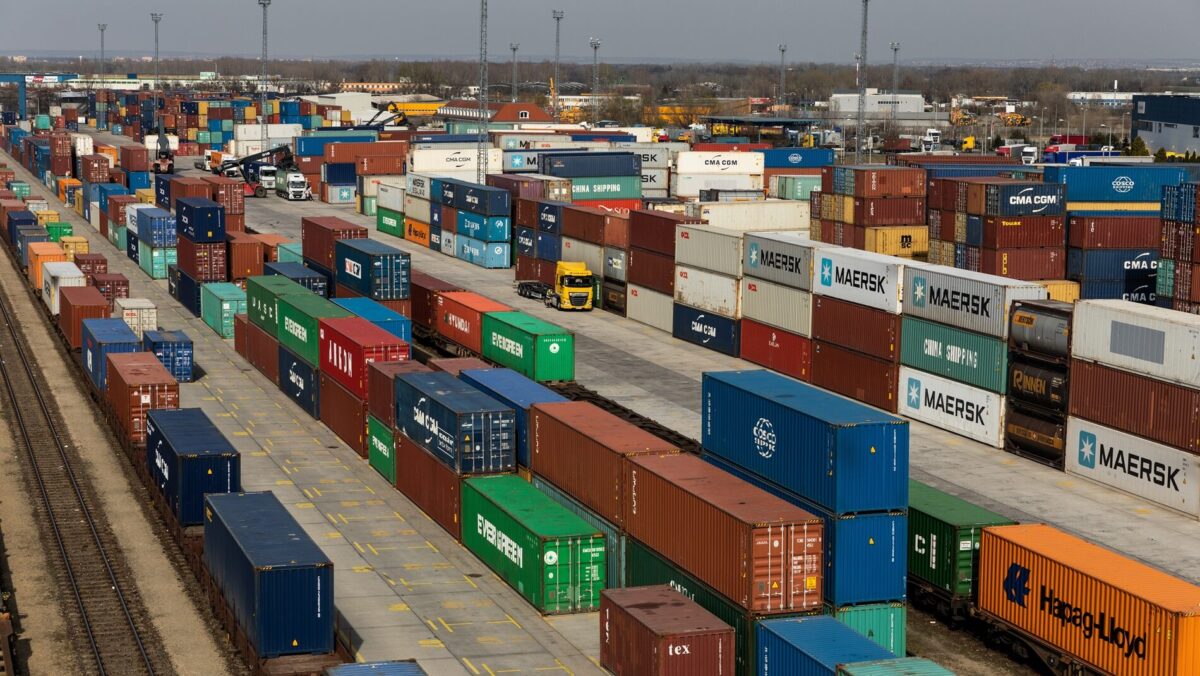
Swissterminal Launches New Inland Shipping Service to Rotterdam and Antwerp
25. November 2020Brewery Feldschlösschen Receives Electric Truck from Renault
25. November 2020The intralogistics provider Jungheinrich is pursuing ambitious goals with its 2025+ strategy. In addition to increased profitability, the company aims to become more efficient and sustainable. Topics such as automation, digitalization, and forward-looking energy systems play a significant role in this. Growth is also expected to be supported by intensified M&A activities in the triple-digit million range.
(Hamburg) Jungheinrich is focusing on increasing profitability, efficiency, and sustainability in the coming years. The company announced this during the presentation of its new 2025+ strategy today in Hamburg. After the group had already achieved its strategic growth target for 2020 a year earlier than planned, Jungheinrich aims to create even stronger and sustainable value for its stakeholders – customers, employees, shareholders, business partners, and society – with its new strategy in the coming years.
Automation and Digitalization
Technologically, Jungheinrich is focusing on innovation topics such as automation, digitalization, and forward-looking energy systems. As part of the already initiated digital transformation of the company, the implementation of customer-centric and more efficient processes is being advanced. The group places particular emphasis on expanding its presence in the markets of Europe, China, and North America. The foundation of all activities will be a holistic understanding of sustainability that equally considers economic, ecological, and social aspects.
The corporate strategy 2025+ is divided into 12 sub-strategies, which in turn are implemented through around 100 concrete initiatives within the company. All corporate areas are involved in the implementation with clearly defined roles and responsibilities. The strategy is intended to be dynamically continued beyond the year 2025.
Value Creation through Future Solutions
“We want to be the first choice for our customers permanently and provide them with added value through forward-looking solutions and technologies. At the same time, we want to shape economic, ecological, and social developments as a corporation and thus create sustainable value for all our stakeholders. To achieve this, we are positioning Jungheinrich to be more profitable, efficient, and sustainable,” explains Dr. Lars Brzoska, CEO of Jungheinrich AG. “With the 2025+ strategy, we have fully charged our batteries in every respect, bundled ideas and forces, and set the right course for a ‘yellow future’ in intralogistics.”
Based on the 2025+ strategy, Jungheinrich aims for a revenue of over 5 billion euros for the fiscal year 2025. For targeted acquisitions and strategic partnerships, Jungheinrich has allocated a mid to high triple-digit million euro amount. Organic revenue is expected to exceed 4.6 billion euros, based on an annual growth of at least 5 percent. The EBIT-ROS is to be improved to over 8 percent, and the EBT-ROS to over 7.5 percent. By 2025, EBT per employee is to exceed 17,500 euros. The goal is to increase the cash flow from operating activities to 8 to 10 percent. The share of non-European revenue is to be expanded to over 20 percent.
Foundation for Long-Term Success
Dr. Volker Hues, CFO: “With our 2025+ strategy, we are laying the foundation for the long-term success of our group. Jungheinrich already has a very solid balance sheet and a high liquidity reserve today. With our focus on returns and operating cash flow, we secure financial leeway. This way, even in economically challenging times, we are always able to implement the necessary strategic measures and ensure the financial independence of the group. At the same time, we remain committed to our policy of continuous dividend payments.”
More Information on the 2025+ Strategy
In its 2025+ strategy, Jungheinrich anchors the automation of intralogistics as a central future and growth field for the group. Jungheinrich expects an annual market growth of 7 to 10 percent in this area. Against this backdrop, the company is advancing the expansion of its automation portfolio – particularly in the areas of driverless transport systems, automated warehouses, software, and robotics. The goal is to open up new markets and achieve an even stronger market position, especially in e-commerce. To strengthen its own market position, the company will deepen collaborations with partners from various industries and pursue targeted acquisitions. At the same time, the group is intensifying its activities in the field of digitalization and is pushing the development of new product and business models in this area. The priority is on the consistent further development of the “digital warehouse” using artificial intelligence and big data. “Intralogistics is a pioneer in automation and digitalization and thus a driving force for the profound changes that industry, transport, and trade are currently experiencing. Jungheinrich has long been a driver of innovation in this area. From this position, we will consistently leverage the growth potential in this segment,” explains Brzoska. Jungheinrich is expanding its offering of digital products in the areas of warehouse, fleet, and battery management systems and plans to expand its portfolio in safety and assistance systems.
One Million Electric Vehicles
Today, Jungheinrich is already number 1 in energy efficiency in warehouses and holds a leading position in the development of innovative energy systems within the industry. Currently, over 1,000,000 electric vehicles from Jungheinrich are in operation worldwide. No other company in intralogistics relies so consistently on lithium-ion batteries. Jungheinrich aims to further expand its leading industry position in this technology. The company’s goal is to achieve a lithium-ion equipment ratio of more than 70 percent of its sold vehicles by 2025. To this end, further vehicle models with fully integrated lithium-ion technology will be launched in the coming years. Jungheinrich also sees significant growth potential in the area of powertrain solutions. Here, the company offers its expertise in energy systems to other manufacturers, including those from the construction and agricultural machinery industries, thus promoting electromobility across industries. Brzoska states: “Driven by our decades of experience as a provider of electric vehicles, we are moving the future – even beyond intralogistics. Our customers and the environment alike benefit from our expertise in efficient and climate-friendly lithium-ion technology.”
Focus on Europe, China, and North America
To expand its global presence, Jungheinrich will focus particularly on its activities in the markets of Europe, China, and North America. Together, these account for about 80 percent of the global market in intralogistics. The company plans to increase the share of its revenue outside Europe to over 20 percent. For targeted acquisitions and strategic partnerships, Jungheinrich has allocated a mid to high triple-digit million euro amount in its 2025+ strategy. “For us, strategic partnerships and acquisitions will be an important lever to achieve our goals in the future. We are planning a significant investment volume for this and want to focus primarily on growth markets,” says Dr. Lars Brzoska.
Efficiency
With the 2025+ strategy, Jungheinrich is also accelerating its own digital transformation. The goal is to consistently increase efficiency within the group. All processes and structures of the company will be reviewed and optimized in this context to enhance Jungheinrich’s profitability and effectiveness. In particular, ongoing projects DEEP (Digital End-to-End Processes) and N-Ex-T (Network Excellence Technology) will be further advanced. “Efficient processes help save resources and simultaneously increase competitiveness. By doing the right things better, we permanently increase our profitability,” says Brzoska.
Sustainability
Jungheinrich understands sustainability in its 2025+ strategy in a holistic manner, considering its economic, ecological, and social dimensions. Brzoska explains: “Taking on entrepreneurial responsibility means for Jungheinrich, as a family-owned company, to combine social and ecological aspects with profitable growth. This understanding drives us to shape the future of our industry.” Within the machinery industry, Jungheinrich is already among the most sustainable two percent of companies today. With the 2025+ strategy, the topic of sustainability will now be even more firmly anchored in the company and equipped with ambitious goals. In this context, Jungheinrich has joined the initiative “50 Sustainability & Climate Leaders” to advance the fight against climate change together with other international corporations. In this context, Jungheinrich has set itself the goal of achieving CO2 neutrality. By implementing a systematic sustainability management approach along the entire supply chain, the group defines clear responsibilities and creates transparency for greater sustainability. Furthermore, Jungheinrich aims to position itself as an employer of choice in the coming years. The proportion of women among executives is to be significantly increased.
Photo: © Jungheinrich