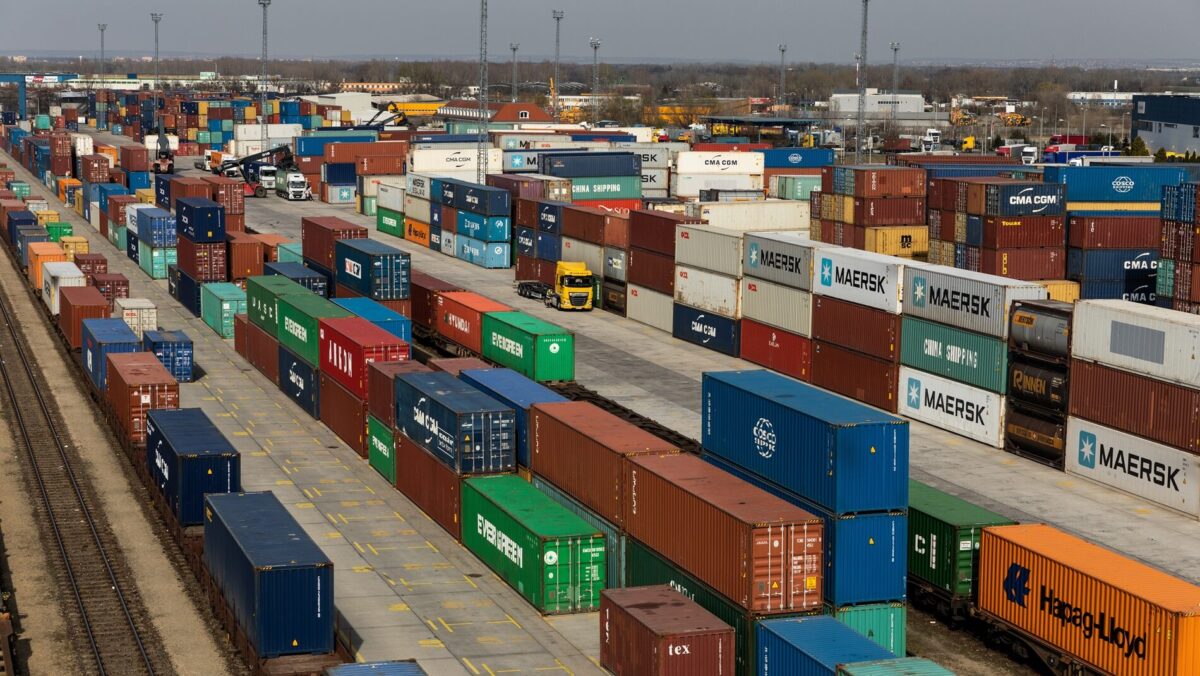
DB Cargo Launches the Fast Scandinavian Rail Shuttle
16. December 2020Logivest Analyzes the German Logistics Real Estate Market 2020
16. December 2020Daimler Truck AG, IVECO, OMV, Shell, and the Volvo Group aim to jointly promote hydrogen-powered trucks across Europe through their new interest group H2Accelerate (H2A). The primary goals are to expand production and the refueling station network.
(Stuttgart) The background is that more and more countries and companies are committing to emission-free transport, with hydrogen playing a crucial role as a central element in the complete decarbonization of the trucking sector.
The introduction of hydrogen-powered trucks in large numbers could mean the emergence of new industrial sectors: CO2-free hydrogen production facilities, large hydrogen distribution systems, a high-capacity refueling station network for liquid and gaseous hydrogen, and the production of hydrogen-powered trucks. Industry-wide synchronized investments in the 2020s, according to the companies involved in H2A, will support the large-scale introduction of hydrogen-powered heavy trucks. This, in their view, is a prerequisite for achieving the European goal of emission-free transport by 2050.
Building a network in clusters
The widespread introduction of hydrogen-powered trucks will take about a decade. Customers who are already committed to this technology and want to deploy corresponding trucks will lead the way. The trucks will initially operate in regional clusters and along European transport routes with high utilization and good hydrogen refueling station coverage. Over the course of the decade, these clusters can then be interconnected to create a Europe-wide network.
FIRST PHASE |
SECOND PHASE |
| FIRST REFUELING STATIONS AND TRUCKS | EUROPEAN COVERAGE |
| § Hundreds of trucks
§ > 20 high-capacity refueling stations § Feasibility proof for high-capacity refueling station concepts § Selected locations/clusters |
§ Second half of the 2020s: four-digit production numbers per year
§ Rapid volume increase > 10,000 trucks § European coverage of key transport routes § High-capacity and reliable refueling stations |
Public funding will be necessary for the establishment of hydrogen-powered trucks. The participants in H2Accelerate aim to jointly acquire funding for early pre-series projects in a first phase. At the same time, they will collaborate with policymakers and regulatory authorities. The goal: to create an appropriate environment that favors the further establishment of series production of hydrogen-powered trucks and a Europe-wide refueling network for CO2-free hydrogen.
Quotes from representatives of the participating companies
“Climate change is the challenge of our generation, and we are fully committed to the Paris Climate Agreement and thus to the decarbonization of road freight transport. In the future, transport will be based on a combination of battery-electric and fuel cell-based electric vehicles, as well as, to a certain extent, other renewable fuels. The collaboration within H2Accelerate represents an important step towards a more livable world,” said Martin Lundstedt, President and CEO of the Volvo Group.
“It is clear: For a significant increase in the number of hydrogen-powered trucks sold, vehicle and operating costs must be comparable to those of today’s diesel trucks. This means that truck customers must have the option to purchase a completely emission-free vehicle that is comparable in refueling time, range, and cost to vehicles currently in use. To achieve this goal, a clear regulatory framework is required that coordinates hydrogen supply, hydrogen-powered trucks, refueling infrastructure, and customer incentives,” said Elisabeth Brinton, Executive Vice President for New Energies at Shell.
Martin Daum, Chairman of the Board of Daimler Truck AG and Member of the Board of Daimler AG: “The companies involved in H2Accelerate agree that hydrogen-powered trucks are the key to CO2-neutral transport in the future. This unprecedented collaboration is an important milestone in creating and advancing the necessary framework conditions for a broad market for hydrogen-based trucks. It is also a call to action for policymakers, other stakeholders, and society.”
Angelika Zartl-Klik, OMV SVP HSSE & New Energy Solutions: “H2Accelerate is taking a pioneering role, and OMV is making an important contribution here. To achieve climate goals, we will need every CO2-reducing technology. Hydrogen is an option for climate-friendly mobility in the future.”
Gerrit Marx, President Commercial & Specialty Vehicles at CNH Industrial: “The widespread introduction of hydrogen-based fuel cell technology in heavy-duty transport depends on the necessary infrastructure. Moreover, concrete projects in collaboration with freight forwarders and other industry stakeholders are needed to demonstrate that this solution is financially viable and suitable for practical use. The groundbreaking collaboration within H2Accelerate will create the conditions for this and accelerate the transition to emission-free transport.”
Goals of the H2Accelerate interest group
- Acquisition of public funds to finance early pre-series projects to activate the market
- Information on the technical and economic feasibility of hydrogen-powered trucks
- Dialogue with policymakers and regulatory authorities to ensure that political measures secure sustainable and rapid market readiness for emission-free long-distance trucks
About the participating companies and their activities with hydrogen
Shell New Energies NL B.V.
The Royal Dutch Shell Group is working to support the development of a global hydrogen market. To this end, it creates a comprehensive offering that ranges from solar and wind energy to hydrogen production. The group supplies a growing number of customers in transport, heavy industry, and other hard-to-decarbonize sectors.
Daimler Truck AG
In September 2020, Daimler Truck AG celebrated the world premiere of the fuel cell concept truck Mercedes-Benz GenH2 Truck. This truck is designed with liquid hydrogen for flexible and demanding long-distance applications with ranges of up to 1,000 kilometers or more on a single tank in the series version. Daimler Truck AG plans to begin customer testing of the GenH2 Truck in 2023, with series production expected to follow in the second half of the decade. In November, the Volvo Group and Daimler Truck AG signed a binding agreement to establish a joint venture. The goal is the series-ready development, production, and marketing of fuel cell systems.
IVECO
IVECO develops, produces, and markets a wide range of light, medium, and heavy commercial vehicles, off-road trucks, and special vehicles for off-road applications. IVECO invests in electric and hydrogen technology with the drive specialist FPT Industrial, which is also part of CNH Industrial, and through its partnership with Nikola Corporation.
OMV Aktiengesellschaft
OMV explores and markets oil and gas, innovative energy solutions, and high-quality petrochemical products – in a responsible manner. Sustainability is an integral part of OMV’s corporate strategy. OMV supports the transition to a lower CO2 economy and has set measurable targets for reducing CO2 intensity and introducing new energy and petrochemical solutions.
Volvo Group and hydrogen
The goal of the Volvo Group is that 100 percent of its products can be operated free of fossil fuels by 2040. There will be a gradual transition to electric vehicles; both battery and fuel cell electric vehicles. For applications with heavier loads or longer distances, hydrogen-powered fuel cells will be an important technology. The two technologies complement each other, and both are needed to build the sustainable transport system of tomorrow. In November, the Volvo Group and Daimler Truck AG signed a binding agreement for a joint venture to develop, produce, and market fuel cell systems.
Photo: © Daimler Truck