Amber Beverage with Automated Storage System from Jungheinrich
13. March 2021KION Group’s Trainee Program Enters the Next Round
15. March 2021The cargo bike, also known as the cargobike, is making its way into the city. It is increasingly shaping the image of urban areas. To realize economic viability, more and more municipalities are providing corresponding funding. Micro-depots also allow for low effort in handling. However, there is still much room for improvement. Tobias Breyer, COO of Swobbee, outlines in this report the current status, what still needs to be done, and where the opportunities for improvement lie.
by Tobias Breyer
Increasing traffic pressure, lack of parking spaces, expensive vehicles, rising fuel prices, stricter environmental regulations, and an increasingly difficult search for drivers – these are just some of the numerous challenges faced by the KEP industry and other companies in the fields of transport and delivery in urban areas. New logistics concepts based on e-cargo bikes, possibly in conjunction with micro-depots, offer a sustainable solution. Urban mobility is significantly simplified and made cheaper with a cargobike. Additionally, there is the positive external effect that electric cargo bikes generate. But what is actually preventing city logistics providers from switching to e-cargo bikes? The reasons are diverse, and a recent study highlights the importance of adequate charging infrastructure.
The RWI – Leibniz Institute for Economic Research recently investigated how strong the influence of a powerful charging infrastructure is on the willingness to buy an electric car. The results are clear: Additional charging points significantly increase the demand for e-cars, especially in densely populated areas. It was also shown that the effect can be up to four times greater when it comes to particularly powerful charging infrastructure. There is good reason to believe that the same applies to the demand for electric cargo bikes. Because: Professional users need suitable charging solutions. This seemingly simple realization is actually the key point in transitioning to an economically viable bike-based cargo transport.
Professional users are usually poorly served with standard charging solutions
An e-cargobike cannot always replace a diesel transporter. But in many cases, it can. Modern e-cargo bikes can transport up to 200 kilograms, thanks to electric pedal assistance, even in hilly environments, without tiring the riders. Experts estimate that at least 20 percent of urban delivery traffic can be carried out with cargo bikes and e-heavy cargo bikes. This is a significant share, especially in light of the steadily increasing volume of delivery traffic. However, simply replacing the vehicle is not enough. In order for cargo pedelecs and cargo trailers with electric drive assistance to be meaningfully integrated into tightly scheduled supply chains, they must meet all aspects of the requirements for a professional operation. This concerns not only the selection of the appropriate vehicle but also a demand-oriented charging infrastructure and possibly a transshipment point for last-mile supply at logistics service providers.
The micro-depot concept also fulfills the ecological, economic, and social sustainability goals of municipalities, KEP services, and trade from the perspective of the Federal Association of Parcel and Express Logistics (BIEK). In addition to regulatory and location issues when setting up such micro-depots, an intelligent, flexible charging solution is particularly emphasized as the bottleneck for the use of e-cargo bikes, as repeatedly highlighted in discussions by companies. Because establishing a company-owned charging infrastructure is labor-intensive and costly. Larger fleets and tightly scheduled operations also require intelligent deployment and charging management to minimize downtime due to charging. While the establishment of a charging infrastructure for e-cars is currently being strongly advanced, adequate supply solutions for the changing urban logistics are not equally in the public focus – despite undeniable relevance for the (urban) public.
Battery-as-a-Service as a Future Model
There are promising solutions. Battery swapping stations for electric small vehicles represent an interesting alternative to traditional charging points. Modern battery swapping systems offer the advantage that a charged battery is always available, and the e-cargo bike is thus always ready for use, as charging-related downtime is completely eliminated. The battery swap takes only a few seconds. The sensitive batteries are charged and stored in the intelligent swapping stations under ideal conditions, which increases the lifespan of the batteries. This approach also allows for the use of smaller, cheaper batteries in the vehicles, as range no longer plays a decisive role.
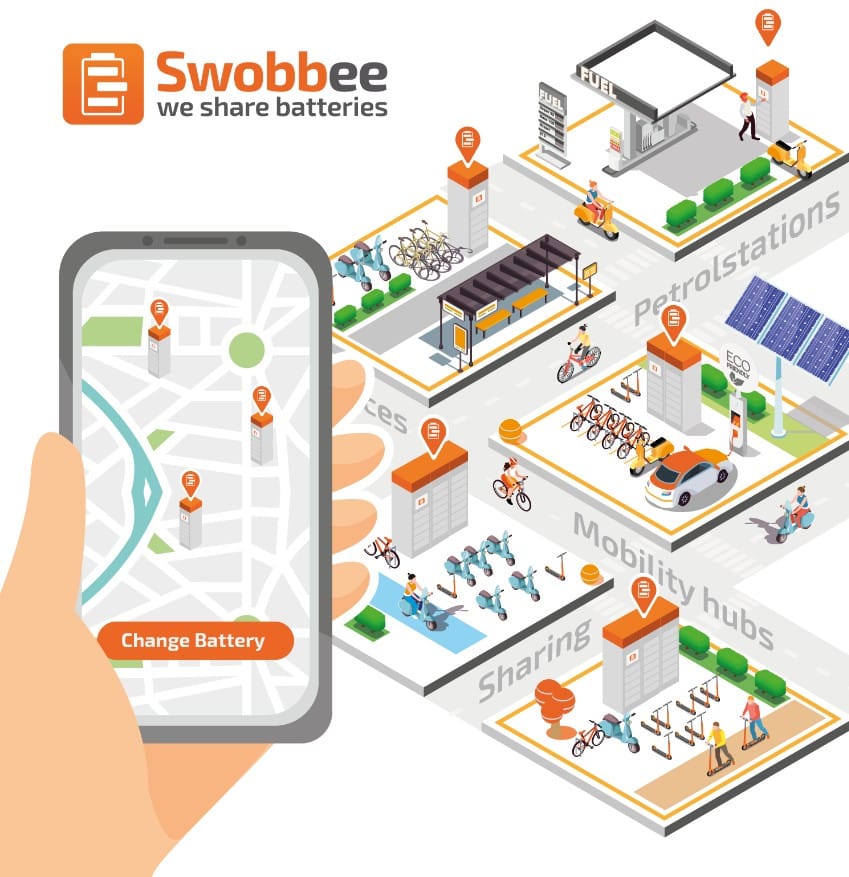
Battery-as-a-Service (© Swobbee)
In addition, intelligent battery swapping stations offer another crucial advantage for companies: they can be shared with other users, for example, within cooperatively used micro-depots, which further improves the economic balance. There are many potential users in an urban environment, and the number of those switching to electric small vehicles will rise steeply in the coming years. Additionally, the possible expansion of operating models is noteworthy. While until now, each company has generally been responsible for its energy carriers and their supply, battery swapping and swapping stations open up a new model, the basic idea of which is already common in many other industries: Battery-as-a-Service. In this operating model, users rent the batteries and pay, depending on the tariff, for example, only for the actual number of swaps. Thus, energy supply becomes a clear, efficient service again, as with conventional vehicles, keyword gas station, and companies are relieved of the labor-intensive and business-irrelevant task of establishing and managing their own charging infrastructure. Looking ahead to the future, the sensibility of a (semi-)public supply infrastructure with battery swapping stations cannot be denied – even if larger companies will hardly want to do without their own battery swapping stations.
E-Cargo Bikes and Micro-Depots are Now Being Funded
For city logistics providers, the transition has recently been facilitated by new funding measures from the federal government. The Federal Ministry for the Environment has established two attractive funding programs with the micro-depot guideline and the e-cargo bike guideline, which came into effect on March 1, 2021. Fundable cargo bikes or cargo trailers must have a payload of at least 120 kilograms. Eligible to apply are companies, traders, and freelancers as well as associations and organizations that can apply for a grant of 25 percent of the acquisition costs, up to a maximum of 2,500 euros. The micro-depot guideline is aimed at logistics service providers, delivery and transport services, hardware stores, or even furniture stores, promoting infrastructure measures for the establishment, utilization, and securing of micro-depots and explicitly welcoming cooperative usage approaches. The possible funding amount here is up to 40 percent of the eligible expenses.
These funding measures will give logistics on the last mile a boost towards sustainable mobility in the coming years. Additionally, there is optimization potential that an intelligent charging and swapping infrastructure opens up. This is already being successfully implemented in pioneering pilot projects today.
Title photo: © DPD
Tobias Breyer is Chief Operating Officer (COO) of the Berlin-based GreenTech startup Swobbee. Swobbee GmbH, as a leading Battery-as-a-Service (BaaS) provider, supports companies in the field of micromobility in realizing an efficient and sustainable energy infrastructure. Swobbee is committed to establishing a mobile and sustainable energy network to actively shape the energy and mobility transition. In addition to comprehensive BaaS services, Swobbee offers its Battery Swapping System (BSS), the world’s first manufacturer-open battery sharing system with an intermodal approach for micromobility. www.swobbee.de