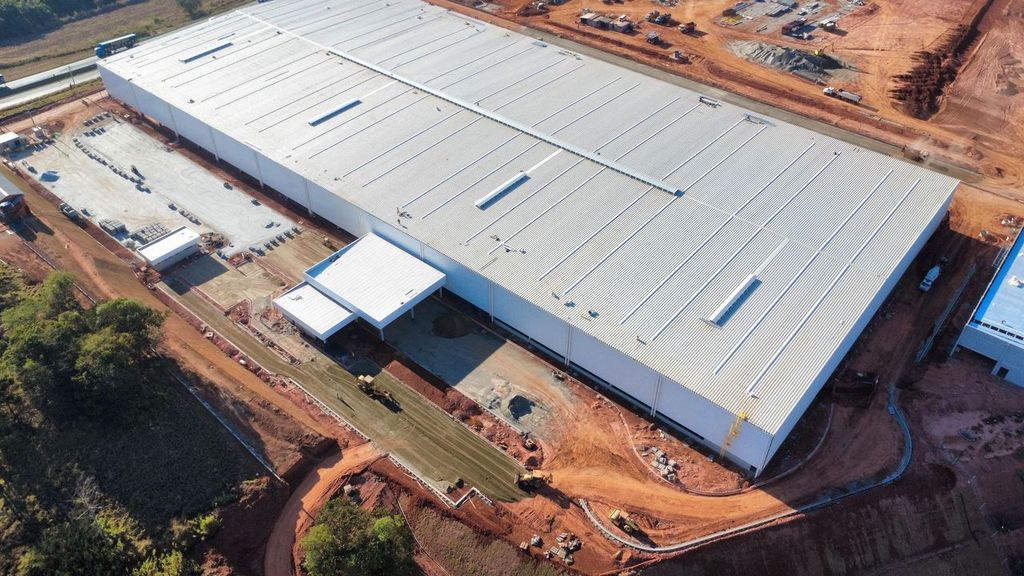
Med-X-Press Breaks Ground on New Controlled Substances Warehouse in Goslar
29. April 2021New Silk Road Successfully Established Between Hamburg and Xuzhou
1. May 2021Paul Leimgruber AG specializes in road transport. Recently, the Basel-based company has also turned to rail for container transport – positioning itself as a pioneer. Sebastian Furrer, head of container logistics at Leimgruber, explains in a conversation with SBB Cargo why combined transport can also make sense over short distances.
(Basel/Pratteln) In November 2020, Paul Leimgruber AG made headlines with a short-distance offer in combined transport in Switzerland. The route Basel – Oensingen is, in principle, too short for this type of transport at 55 km. SBB Cargo spoke with Sebastian Furrer, head of container logistics at Leimgruber, about this:
In November 2020, Leimgruber shifted part of its transport to rail. What were the reasons for this decision?
Furrer: One reason is the planned container terminal Gateway Basel Nord. This will also play an important role for us, and we want to position ourselves accordingly today. Additionally, we are committed to promoting sustainable transport solutions. We notice that the acceptance and demand for sustainable transport options are steadily growing among our customers. Finally, we want to offer our customers a variety of transport solutions – including rail transport. This way, we can find the best solution together.
The distance Basel – Oensingen is relatively short at around 55 kilometers. What still speaks for rail?
We need a certain transport volume in the immediate vicinity of a KV terminal to operate regular services. Many of our customers are located around Oensingen, as well as several distribution centers of larger retailers like Coop, Migros, Dosenbach, and Conforama. This allows us to handle the last mile on the road. Furthermore, the container terminals in Basel are reaching their capacity limits: Our drivers often have to wait, and waiting times, as we know, incur costs. Since Basel – Oensingen is a heavily trafficked axis, it benefits us to cover this route by rail.
So, in your view, rail is not a “competitor”?
No, we are interested in a profitable partnership with SBB Cargo. We are truckers, not freight forwarders. And SBB Cargo needs a truck driver for certain transports to deliver to customers who do not have their own rail connection. This benefits both sides.
How is the collaboration with SBB Cargo going?

Sebastian Furrer
So far, the experiences have been very positive; it has settled in well. However, in mid-January 2021, certain import transports collapsed due to a backlog in the North Sea ports caused by heavy snowfall. Additionally, some ships could not operate as planned due to high water levels on the Rhine. Accordingly, we had to suspend some of our transports. It is difficult to say how things will proceed. The economic situation surrounding the Corona pandemic is hard to predict. However, as soon as we can operate again at normal levels – meaning with the usual volumes – we will resume transports with SBB Cargo.
Does this mean that Leimgruber will bring more transports to rail?
Let’s put it this way: It is definitely part of our strategy and our stated goal. Depending on the situation, yes, gladly. (laughs)
When a road transport company turns to rail, it is a statement. What do you want to show the industry with this?
We want to send a signal to the industry and be pioneers. As part of the Planzer Group, we are represented throughout Switzerland and have our own trucks at all KV terminals. Our goal is to handle the last mile from these terminals. Additionally, the collaboration with rail has a tradition at Planzer. We now want to expand this to container transport.
Photo and interview: © SBB Cargo
Sebastian Furrer, Head of Container Logistics