Mercedes-Benz Trucks and Shell Test Digital Payment Processes
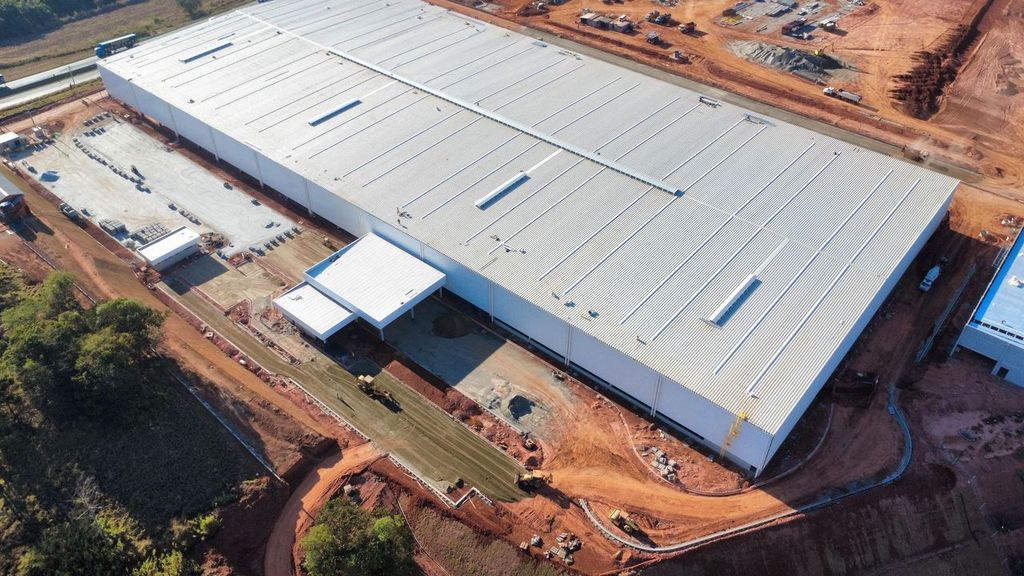
12. May 2021Panattoni develops modern industrial park in the Ruhr area
16. May 2021The GS1 Smart Box from GS1 Germany is going into series production. The series production and delivery of 100,000 standardized reusable transport containers has started after a successful testing phase. Other companies from industry and trade can join in. Companies from industry and trade have agreed on common standards with the GS1 Smart Box.
(Cologne) The GS1 Smart Box has passed an important hurdle with the test run between industry and trade and is now ready for series production, which started a few days ago at Georg Utz GmbH. The first of the 100,000 blue series containers were delivered at the end of April. With dimensions of 600x400x211 mm, they form the basis for the later container family. These dimensions are chosen to fully utilize the EUL loading heights of 1.20 m and 2.40 m, thereby enabling optimal transport and storage utilization for fewer transports and, not least, lower CO2 emissions. The distribution of the plastic reusable box, designed for a circular economy, is handled by the company IPP as a pooling partner. “With the start of series production, the GS1 Smart Box project has reached another important milestone towards more efficient and sustainable supply networks,” says Leonard Thomas, Head of Customer Logistics, Henkel Beauty Care, Supply Chain Retail Germany.
Go-Live in the Supply Chain Network between Industry and Trade
In the test run, the gray-colored prototype, the so-called 0-series, was tested for performance in automated processes as well as for smooth identification via applied GS1 barcodes. Industry and trade sent a total of 500 containers through their production and packaging processes. For example, they scrutinized the process in the distribution center. On the industry side, Beiersdorf, Cosnova, Henkel, Kao, L’Oréal, and Procter & Gamble participated. From the trade side, dm-drogerie markt, Edeka, Müller, and Rossmann tested it. “Even during the use of the test container, it was able to demonstrate many of its advantages for trade logistics, such as increased efficiency and better environmental compatibility. This includes, for example, reduced material usage, as the GS1 Smart Box can cover the entire logistics cycle from the supplier’s production to our stores. Therefore, we welcome that with the series production, the standardized reusable container is now being put into regular operation,” explains Boris Haltof, Head of Small Order Picking, dm-drogerie markt.

GS1 Calls for Further Companies to Participate
Initially, the GS1 Smart Box will be used in the drugstore segment. Later, it is also intended to accompany other consumer goods – such as clothing or confectionery – in a product-, environmentally-friendly, and process-friendly manner from production to the point of sale, thus enabling more automation in the supply networks. The goal is to offer the container in an open pool to promote cross-company and later cross-country exchange. “Its first ‘foreign deployment’ has been in Austria in cooperation with GS1 Austria,” says Matthias Haubenreißer, Senior Manager Competence Center Supply Chain Management/ CC Reusable Transport Packaging at GS1 Germany. To structure the open pooling based on a set of rules and GS1 standards, the project group is developing a new GS1 recommendation. “Even in the current phase, companies are called upon and invited to participate right now at the start and commissioning of the real logistics processes of the GS1 Smart Box and to benefit from it,” explains Haubenreißer.
Common Standard for a Functioning Circular Economy
Today, many products are delivered in cartons to the central warehouses of trade, repacked into internal reusable containers immediately after receipt of goods. Due to increasing automation and modern picking processes, trade is increasingly relying on reusable containers, especially for small items. But industry also uses them in internal cycles, for example, to support co-packing processes. Until now, each company has used its own proprietary container systems. A circular economy between suppliers and central trade warehouses has not existed until today. Therefore, companies from industry and trade have agreed on common standards for the supply chain between production and central trade warehouses with the GS1 Smart Box.