LOXXESS Supports Growth at WACKER with Expansion in Haiming
13. July 2021FUSO Launches ‘eTruck Ready’ App in Key European Markets
14. July 2021The DZSF (German Center for Rail Transport Research) is establishing an Open Digital Test Field for rail transport research. The introduction of technological, operational, and transport innovations for the rail transport system into practice is significantly promoted through testing in real operations. This also applies to freight transport. The Open Digital Test Field was inaugurated on July 13, 2021, in Cottbus.
(Berlin/Cottbus) With the establishment of the test field, the DZSF fills a gap in the European research landscape. While existing test facilities are primarily needed for the approval processes of the industry, the Open Digital Test Field creates special new testing opportunities and capacities for rail transport research. This allows for the exploration of questions that cannot be addressed using existing test facilities.
The Open Digital Test Field is being developed in the rail network between Halle (Saale) – Cottbus – Niesky. Here, new technologies and further innovations can be tested under real conditions. This applies, for example, to noise protection, environmental and climate protection, or automated driving.
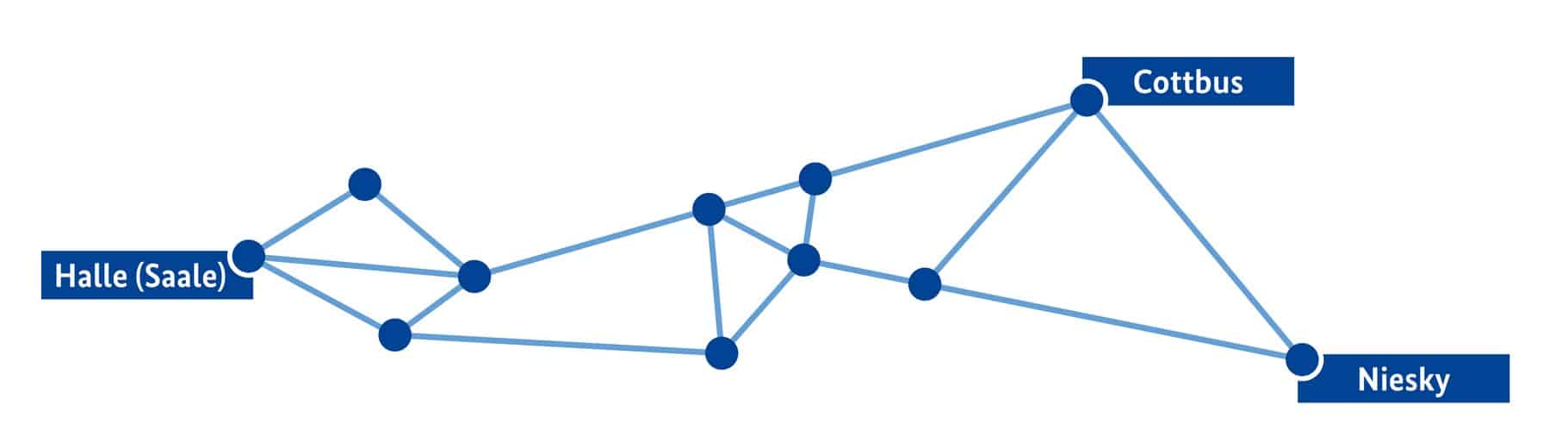
Digital Test Field for Rail Traffic between Cottbus, Niesky, and Halle (Saale)
The Open Digital Test Field was inaugurated on July 13, 2021, in Cottbus. The basic principles of future collaboration between the Federal Ministry of Transport and Digital Infrastructure, Deutsche Bahn AG, and the Federal Railway Authority were outlined in a Memorandum of Understanding.
Location in the Network
Located in the federal states of Saxony-Anhalt, Brandenburg, and Saxony between Halle (Saale), Cottbus, and Niesky, the test field utilizes approximately 350 km of main lines of DB Netz AG. Due to the versatility of the rail network and the surrounding area, extensive testing conditions can be provided. In addition, there is a potential supplementary network, covering nearly the entire range of railway operational and infrastructural conditions.
Through universities in Cottbus, Dresden, Halle, Leipzig, Merseburg, and Senftenberg, there is a direct connection to the research landscape. Furthermore, numerous companies and research institutes in the rail sector are located in the region.
NoiseLab 21
A fixed component of the Open Digital Test Field is the NoiseLab 21, where research is conducted to effectively reduce sound and vibrations. The NoiseLab 21 offers the opportunity to test and further develop innovative techniques, such as new geometric shapes, special materials for noise barriers, or damping measures against vibrations.
The goal is to increase the number of ready-to-use measures for noise and vibration protection. In addition to technical testing under realistic conditions, an intensive dialogue with manufacturers, science, and society will support research for noise and vibration protection. This way, innovation and migration barriers can be identified early, and the acceptance of measures can be increased.
Independent Platform for Science and Industry
The Open Digital Test Field is designed as an independent platform. The collaboration of industry, research institutions, infrastructure operators, railway companies, and authorities in developing innovative solutions for rail transport is thus promoted in the long term. The Open Digital Test Field also serves the DZSF as a research space for its diverse work in departmental research and for carrying out projects within the framework of contract research. The DZSF coordinates the research activities in the test field and is the central point of contact for third parties.
Testing
The Open Digital Test Field provides the space and conditions for the entire spectrum of rail transport research. The following examples illustrate the potential:
- Testing of innovations in the areas of vehicle, drive, and control technology,
- Monitoring of operational, traffic, and maintenance processes for the introduction and optimization of digital innovations,
- Automation and digitization of passenger and freight transport,
- Promotion of environmental, climate, and species protection,
- Research on noise protection for infrastructure and vehicles as well as vibration protection,
- Improvement of the interconnection of transport modes, further development and testing of intermodal, cross-modal mobility offers,
- Involvement of users, customers, and residents.
The test field connects individual research areas within the railway system and with other transport modes.
Title photo: © European Union, Copernicus Land Monitoring Service 2018