Gebrüder Weiss Engages in Hyperloop Project
3. August 2021Safely Through the Desert with Goldhofer Heavy Load Modules
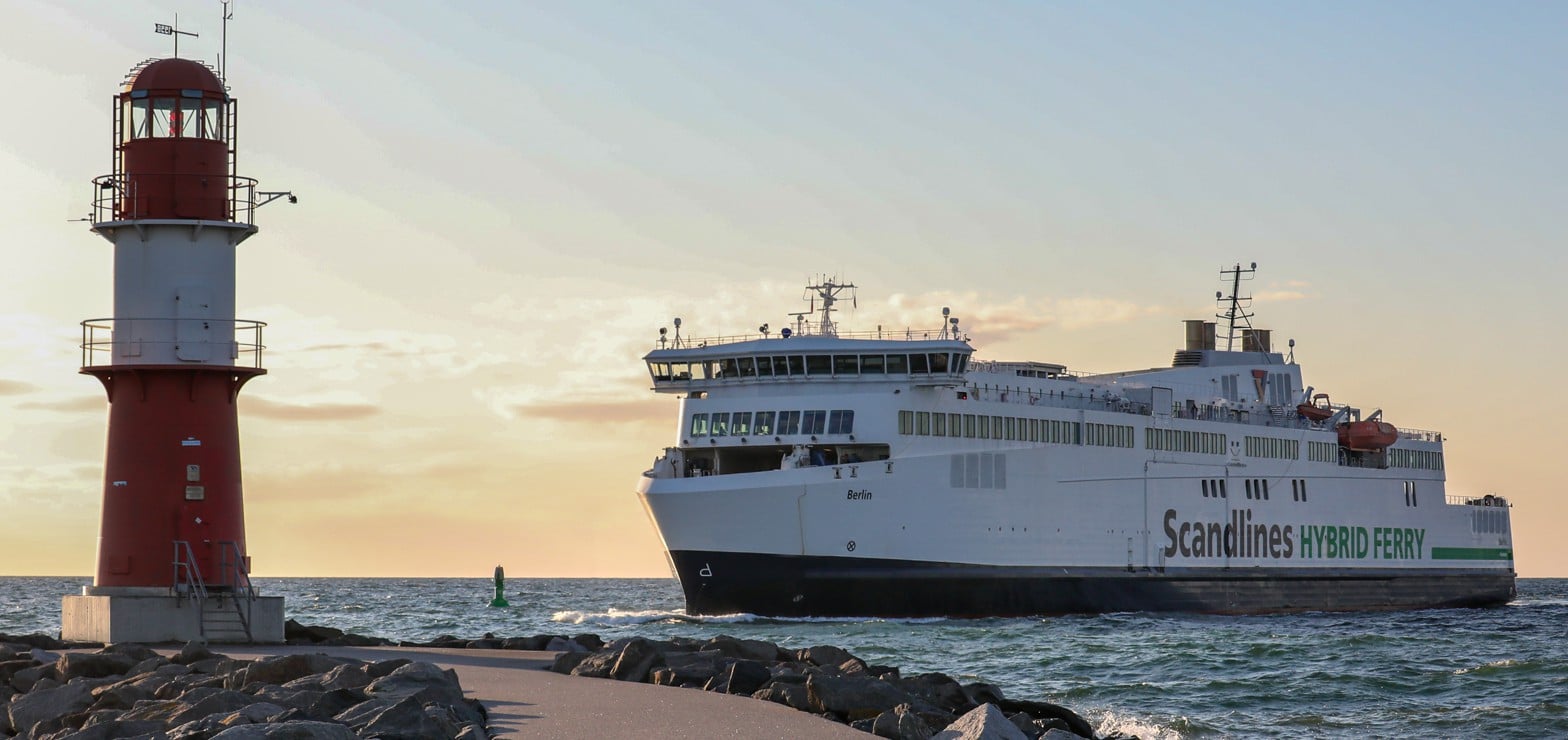
3. August 2021For the 30th anniversary of the Rostock Hanse Sail, more than a hundred tall ships are registered. The German-Danish ferry company Scandlines adds a special touch to the anniversary event: At nearly 170 meters in length and about 25 meters in width, the hybrid ferry ‘Copenhagen’ is the largest ship with a sail that will be seen during the Hanse Sail – its rotor sail rises proudly 30 meters in a cylindrical shape into the sky.
(Hamburg/Rostock) Since May 2020, the rotor sail, which from a distance resembles a chimney, has been installed on the Copenhagen – and it appears quite the opposite: The rotor sail from the Finnish company Norsepower significantly reduces the CO2 emissions of the hybrid ferry by a whole four to five percent on the route between Rostock and Gedser.
After almost 100 years, the Flettner rotor returns to Northern Germany
The innovative sailing technology of the rotor sail is based on the nearly 100-year-old concept of Flettner rotor technology: When the wind hits the rotating cylinder, it is accelerated on one side and slowed down on the other side of the body. The difference in wind speed leads to a pressure difference that generates a force perpendicular to the wind – the so-called Magnus effect. This effect helps to move the ship forward in side winds.
Engineer Anton Flettner began testing his invention of the Flettner rotor as early as 1924: In Kiel, he converted ships into rotor sailing vessels and conducted countless, even international trial and demonstration voyages. Unfortunately, these did not catch on at the time, as they were unsuitable as the sole propulsion in calm winds. Thus, this technology was displaced by steam engines and diesel engines and fell into oblivion.
Scandlines is now relying on the efficiency of Flettner’s ingenuity after nearly a century: The Norsepower rotor sail is a ready-to-use maritime wind technology, for which optimal wind conditions prevail on the Scandlines route, making the commercial benefit clear.
With Rotor Sail and Hybrid Drive Towards Green Ferry Shipping
The largest “sailing ship” that will be seen during the Hanse Sail not only impresses with its unique rotor sail but also with many other climate protection measures: Its hybrid system includes, as with other Scandlines ships, in addition to the diesel generators, an electric drive. A battery pack complements the drive and can store excess energy directly on board and use it for propulsion at the appropriate time. By switching from traditional diesel ferries to state-of-the-art hybrid ships, fuel consumption on the ferry line has been significantly reduced, and thus CO2 emissions have been lowered. Compared to the old ships, only about one-third of the fuel is now needed for the ferry per transported car.
Additionally, the ferry uses energy-saving but also quiet thrusters that generate less underwater noise. This way, marine wildlife is less disturbed – which is particularly appreciated by the increasingly common porpoises in the Baltic Sea.
Free Charging Stations at the BorderShop
For a sustainable future, Scandlines is focusing on many other large and small projects aimed at environmental and climate protection: The shipping company supports, among other things, the UN’s sustainability goals. The most recent example is the recently published sustainability report. Furthermore, the company works closely with NABU e.V.: Together, they transformed the port area of Puttgarden into a “Green Port” to promote biodiversity in the area.
In cooperation with E.ON, Scandlines is initially providing free charging stations for electric cars at the BorderShop in Puttgarden and in Rostock – making it even easier to travel environmentally friendly to Scandinavia and back.
Photos: © Scandlines