KION and Fraunhofer IML Industrialize the ‘LoadRunner’
7. September 2021Ballard and Quantron Develop Fuel Cell Trucks
8. September 2021On September 6, 1996, the “Lugano Agreement” was signed. Germany and Switzerland committed to creating the infrastructure for an efficient railway transport system between the two countries. Yesterday, exactly 25 years later, a review was conducted at the German train station in the Swiss border metropolis of Basel, which is particularly embarrassing for German transport policy. While Switzerland has completed tunnels and routes on time, the expansion of the Rhine Valley Railway and bypasses in Germany are not progressing quickly enough. The freight railways have now articulated their expectations.
(Berlin/Basel) The Network of European Railways demands an acceleration and additional package to create additional rail capacity as quickly as possible along the European and regionally important North-South corridor along the Upper Rhine. NEE Chairman Ludolf Kerkeling warns: “The new transport minister risks a traffic collapse in the region.” Kerkeling called for the four-track expansion promised in 1996 to be prioritized by six to seven years compared to the current DB planning, aiming for completion by 2035. “The freight railways want to contribute to the transport transition and climate protection program by roughly doubling the amount transported by then compared to today. We simply cannot achieve this and the desired half-hourly service in long-distance passenger transport with the current infrastructure.”
In Basel, former Swiss Transport Minister and Federal President Adolf Ogi reminded that Switzerland had reached a compromise with the EU and neighboring countries for North-South transit traffic, which was contractually secured. This included the construction of two particularly large railway tunnels and numerous other rail routes as access points to the “New Railway Alpine Transversal (NEAT).”
Minister laments unacceptably slow expansion
Winfried Hermann, the transport minister of Baden-Württemberg, lamented the unacceptably slow expansion. This should have been realized faster, especially due to freight transport. The federal government had invested too little in the past and set the wrong priorities – from a climate protection perspective, the project must be accelerated.
25 years after the signing of the contract, two tracks are still missing on the Rhine Valley Railway over 96 of about 180 kilometers – and the others are repeatedly closed for construction work. The Rhine Valley Railway has been part of the European freight transport corridor Rhine-Alpine since 2010 and is also one of the most important connections for passenger trains in Central Europe. More than 200 trains run there daily, and demand in both freight and passenger transport is continuously increasing. Kerkeling notes: “To alleviate the significant gap between Offenburg and Schliengen south of Freiburg and to mitigate the tunnel disaster in Rastatt somewhat, we want additional measures to be addressed. For example, at least one of the two tunnel tubes in Rastatt should be passable by 2023.” Additionally, the freight railways prioritize the optimal use of the soon-to-be-installed ETCS control and safety technology, as well as the expansion of the left Rhine route between Strasbourg and Wörth. Some routes, such as the Gäubahn, must also be upgraded for the repeatedly necessary diversions. At the same time, better construction site management and more intensive cooperation among the rail infrastructure operators are necessary. Kerkeling: “The management of the freight transport corridor should be relocated to Switzerland and should ideally also control the eastern branch of the left Rhine corridor ‘North Sea-Mediterranean.'”
Criticism of a new agreement
The new agreement recently presented by the German transport minister with Switzerland is, according to Kerkeling, “not really helpful and sufficient. It is unnecessary to abandon the Lugano Agreement in favor of a contractual framework full of non-binding declarations of intent, in which there is no concrete statement regarding the Rhine Valley Railway and it states that there are no financial obligations for anyone. This gives the transport minister the license to continue the already common ‘Am I coming today or tomorrow?’ mentality, as we are already behind schedule, and with each passing day, the urgently needed relief of the bottleneck in the region is postponed.”
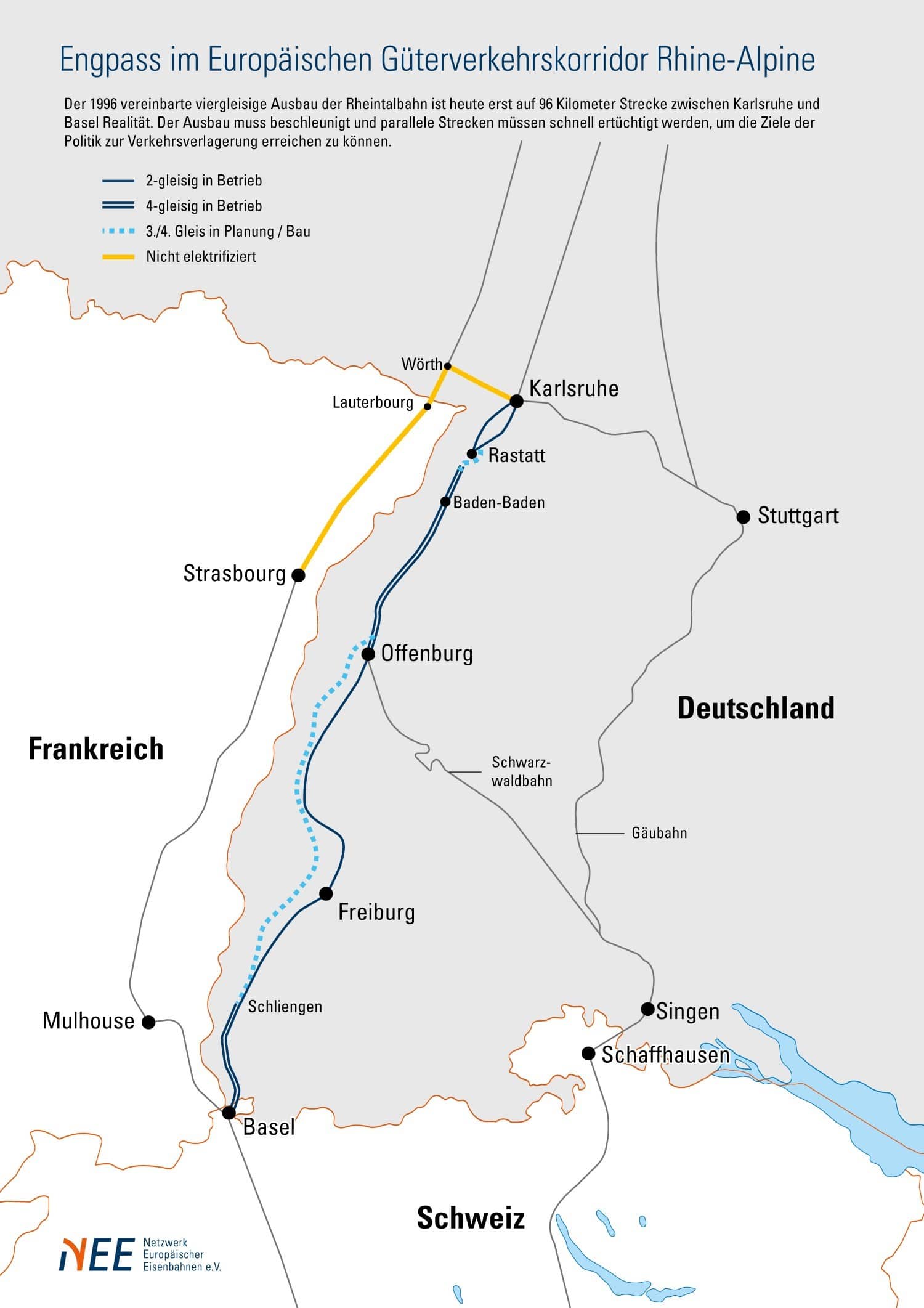
Explanation of the graphic: on the Rhine Valley Railway, the sections Karlsruhe-Rastatt and Offenburg-Schliengen are still not four-track, except for a short section in Freiburg. The route is fully electrified, unlike the diversion route Karlsruhe-Strasbourg-Basel, which is only single-track between Wörth am Rhein and Lauterbourg and is not electrified up to Strasbourg. Due to necessary locomotive changes and unnecessary language barriers among the infrastructure operators, the once significant route today does not even play a relevant role as a diversion route. In the eastern Rhine Valley, the diversion of trains via the Gäubahn is largely only possible on a single track, and infrastructure is also lacking around Singen. As a continuous relief of the Rhine Valley, it is also unusable due to limited capacities on the Swiss side at the Zurich junction.
The images from the event “Guests Among Friends” can be found here. The speeches by Winfried Hermann, the transport minister of Baden-Württemberg, Adolf Ogi, former Federal President of Switzerland, and Josef Dittli, President of the Association of Shipping Industry (VAP), will be published shortly on the same page.
Photos/Graphics: © NEE / Caption for the title photo: Former Swiss Federal Councilor Adolf Ogi spoke in Basel to the guests of the event “Guests Among Friends.”