Swissterminal Uses Green Electricity at Locations in Switzerland
15. September 2021
GEODIS with Sustainable Fuels in Air and Sea Freight Transport
15. September 2021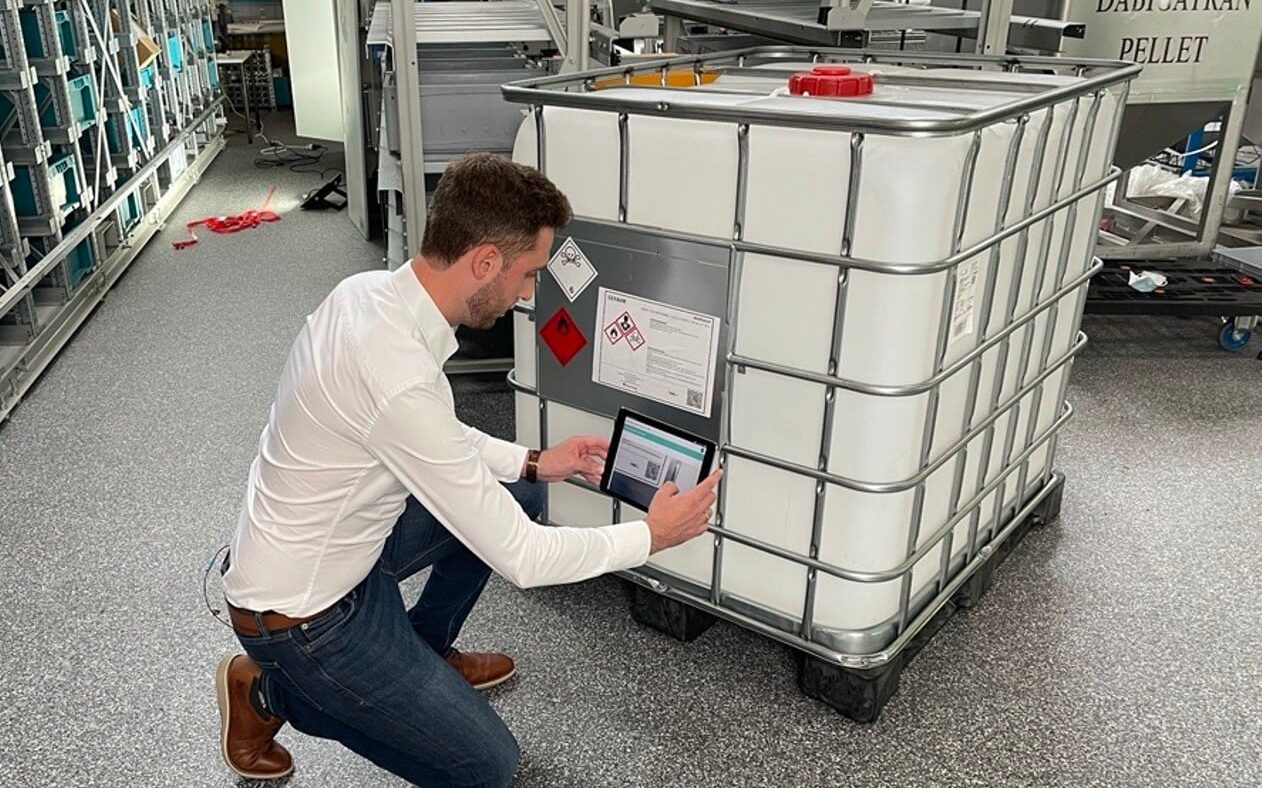
With the new blockchain device “Dragon”, hazardous goods transport can be organized in a legally compliant and tamper-proof manner – a necessary development in light of the increasing volume of hazardous goods on German roads. A prototype of the solution developed within the framework of the European Blockchain Institute was recently presented by the Fraunhofer Institute for Material Flow and Logistics IML at the “Future Congress Logistics – 39th Dortmund Talks”.
(Dortmund) Approximately 4.4 million tons of hazardous goods travel on Germany’s roads each year – a rising trend. This is primarily due to the increasing number of battery-operated household appliances and the growing share of electric vehicles in Germany. However, the accompanying documents generated for each transport are usually not available in digital form – and are certainly not stored in a tamper-proof and legally compliant manner.
The solution “Dragon” (Device for reliable dangerous goods transport), developed within the framework of the European Blockchain Institute, aims to provide relief. “With Dragon, there is for the first time a solution in the hazardous goods sector to make any mobile devices blockchain-capable. Blockchain-capable devices make an important contribution to modernizing hazardous goods management in light of the continuously increasing volume of hazardous goods. The ‘Bring your own Device’ approach makes it possible to leverage the great potential of blockchain technology in operational hazardous goods logistics,” emphasizes Prof. Michael Henke, head of the Fraunhofer IML. Especially in a heavily regulated area like hazardous goods transport, where many actors are involved from the sender to the loader, carrier, and recipient, the technology can unleash its full potential.
Automating recurring processes
With Dragon, relevant accompanying documents are to be retrieved from the blockchain, events continuously tracked, and so-called smart contracts triggered in the future. This will allow for the automation of recurring processes in hazardous goods handling and legally compliant storage. This saves a lot of time and minimizes human errors. The device will also be accompanied by an electronic transport document that aims to simplify the information exchange between the process participants, is tamper-proof, and always contains the most up-to-date information. A method for managing the digital documents is currently being developed in the sub-project “Dangerous” within the framework of the European Blockchain Institute and is intended to be made available as open source.

Prof. Michael Henke presented the new blockchain device “Dragon” at the “Future Congress Logistics – 39th Dortmund Talks” on September 14. (© Fraunhofer IML)
Prototype already in October 2020
As early as October 2020, the Fraunhofer IML presented the first prototype of a blockchain device as the first of several blockchain-based device developments made in NRW. The project to establish the European Blockchain Institute in North Rhine-Westphalia has been funded since May 2020 with around 7.6 million euros by the Ministry of Economic Affairs, Innovation, Digitalization, and Energy of the State of North Rhine-Westphalia. It is closely linked to the “Silicon Economy” project, which is funded by the Federal Ministry of Transport and Digital Infrastructure.
Title image © Fraunhofer IML / Image caption: With the new blockchain device “Dragon”, hazardous goods transport can be organized in a legally compliant and tamper-proof manner