DHL Two-Man Handling Expands Capacities in Reichenbach
29. September 2021
Gebrüder Weiss Acquires Wolf and Air System in Straubing
29. September 2021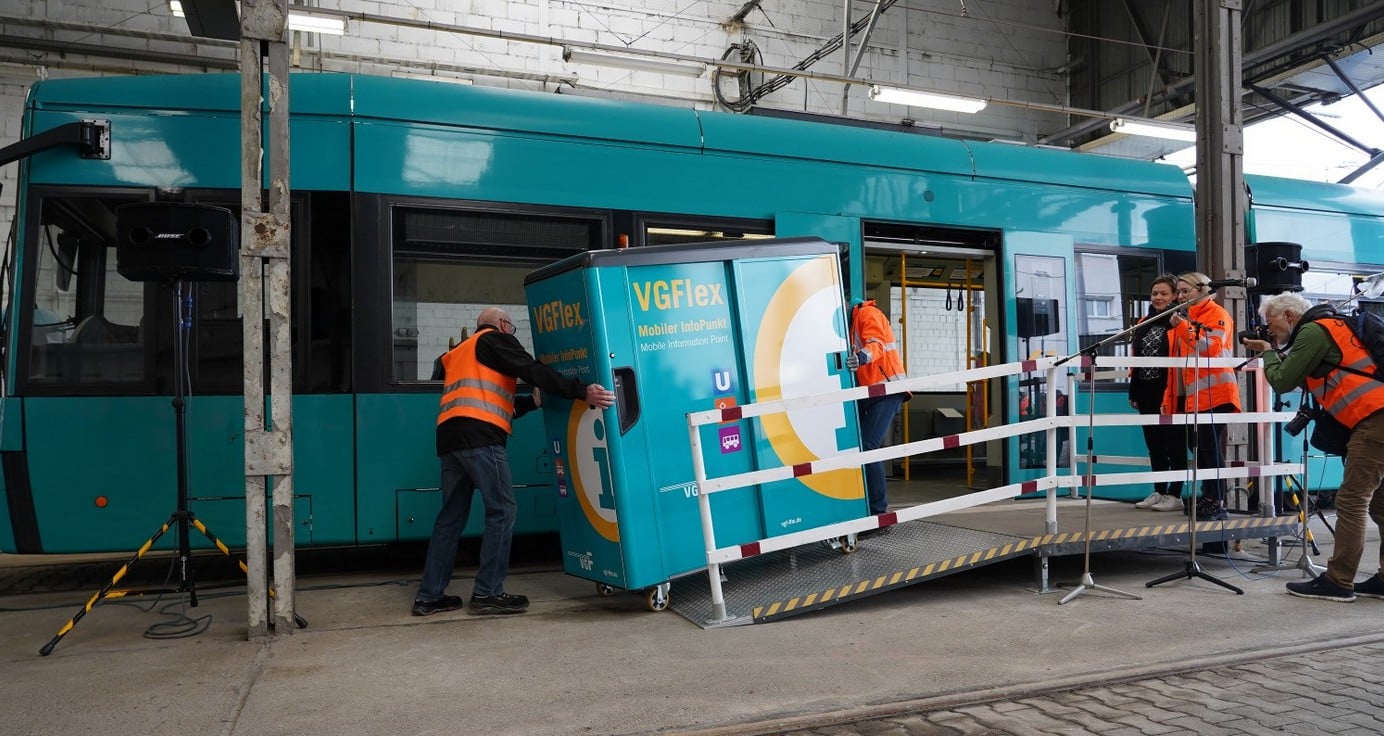
The Frankfurt am Main Transport Company (VGF) demonstrated a test ride of the freight tram with containers from the Cargobike manufacturer ONOMOTION at the Radlogistik Conference. The project has been running since 2018 and has already been tested with various partners. VGF is even exploring further applications, such as internal transport.
(Frankfurt am Main/Berlin) From road to rail: At the opening of the 2nd National Radlogistik Conference in Frankfurt am Main, the Frankfurt am Main Transport Company mbH (VGF) and ONOMOTION GmbH showcased how containerization and trams can work for emission-free city logistics. Together with VGF, the Berlin mobility service provider demonstrated how goods can be transported along the entire supply chain in standardized containers using a freight tram and the E-cargo bike ONO. The interplay of multiple transport modes on the “middle” and “last mile,” such as trams and E-cargo bikes, has great potential to become the new standard in urban logistics.
“VGF has been testing and evaluating freight tram options since 2018 with different partners. We are excited about the potential of this idea and how the project has developed technically and content-wise,” explains Michael Rüffer, Managing Director of VGF. VGF already owns its first E-cargo bike. The “VGFlex,” introduced in July 2021, is used for quick, environmentally friendly, and flexible customer service wherever it is needed on short notice. For example, to inform about construction sites and detours on-site with the ONO.
Test ride is a consistent implementation of the white paper
From ONOMOTION’s perspective, the integration of trams and cargo bikes is a consistent implementation of the white paper “Intermodal Logistics Chain in Urban Areas.” ONOMOTION published this together with partners earlier this year. The authors demonstrated using Frankfurt am Main as an example that with a combined transport system, up to 80 percent of inner-city deliveries could be realized, and CO2 emissions could be reduced by nearly 64 percent.
Partners integrate existing infrastructure in the new approach
The freight tram concept is not new. Pilot projects have already been conducted in Frankfurt and other cities a few years ago. This idea is now being taken a step further. The partners are integrating existing infrastructure such as tram tracks, tram vehicles, and the emission-free E-cargo bikes from ONOMOTION into the approach. The starting point of the test ride in Frankfurt was the VGF depot Gutleut. There, ONOMOTION demonstrated how the standardized and compact city containers can be taken off the ONO and rolled up a ramp into the tram with little effort and secured there. The containers, with a capacity of 2.1 cubic meters and a length of 1.70 meters, fit easily into the multi-purpose area of a tram. That is where strollers and wheelchairs usually fit. After a short ride to the turning loop of the Frankfurt Fair, the containers are reattached to the ONO. “The road will not solve traffic congestion in cities. With rail vehicles and integrated cargo bike delivery, we offer an ecologically and economically sensible alternative that has great potential,” says ONOMOTION Managing Director Beres Seelbach.
Two types of use for a freight tram are possible
Theoretically, two types of use for a freight tram are conceivable for public transport companies: On the one hand, mixed use of goods and passengers. In this case, companies can integrate container transport into regular operations, thus avoiding empty trips during off-peak hours in the evening and early morning. However, the area for passengers must be separated from freight transport. On the other hand, exclusive use of the tram as a freight tram. This would pick up the already commissioned containers from a depot on the outskirts and transport them to suitable stops along the inner-city routes. From there, the ONO would take over the dockable containers for fine distribution to households. This type of transport would have the advantage of flexible use of tram lines for freight transport and would guarantee a higher transport volume of up to ten containers per freight tram.
Currently, VGF is exploring further applications for the ONO
VGF is currently examining another initial application: For the internal transport of materials, tools, and smaller work equipment, transporters and trucks travel daily between the various operational sites. Mail is also distributed from the headquarters in the city center to all workshops and depots. Here, transporting the containers by tram would be advantageous. The benefit is that heavy equipment could be unloaded directly at the workshops and depots, while the remaining freight would then be transported further with the cargo bikes.
White paper “Intermodal Logistics Chain in Urban Areas”
The distribution of freight traffic across multiple transport modes has potential, as shown by global trade for decades. Standardized containers enable and accelerate these combined transports. The authors of the white paper “Intermodal Supply Chain in Urban Areas” demonstrate using Frankfurt am Main as an example, with a freight volume of 14,500 daily packages in the inner-city districts, that 80 percent, or about 11,600 packages, could be delivered by cargo tram and E-cargo bike. Only 20 percent, or about 2,900 deliveries, would need to be delivered via traditional means due to size and weight. The significant advantage of such a hybrid supply chain on the “middle” and “last mile” lies, in addition to relieving traffic on the roads, in reducing CO2 emissions. The exemplary quantity of 14,500 packages in the urban area causes only 1.1 tons of CO2 when combined with multiple transport modes using standardized containers. This corresponds to a saving of nearly 64 percent compared to a single-stage transport route.
At the same time, this method is cost-neutral at 27.62 euros per cubic meter compared to the conventional transport route. The white paper involved the Berlin Cargobike manufacturer ONOMOTION GmbH, Porsche Consulting, EIT InnoEnergy, the Hörmann Group, EURA, Hermes Germany GmbH, and the Research Lab for Urban Transport of the Frankfurt University of Applied Sciences.
Photo: © Verkehrsgesellschaft Frankfurt am Main mbH