







Advantech and NIMMSTA Intensify Partnership
14. October 2021
Lufthansa Cargo Increases Handling Performance in Frankfurt
14. October 2021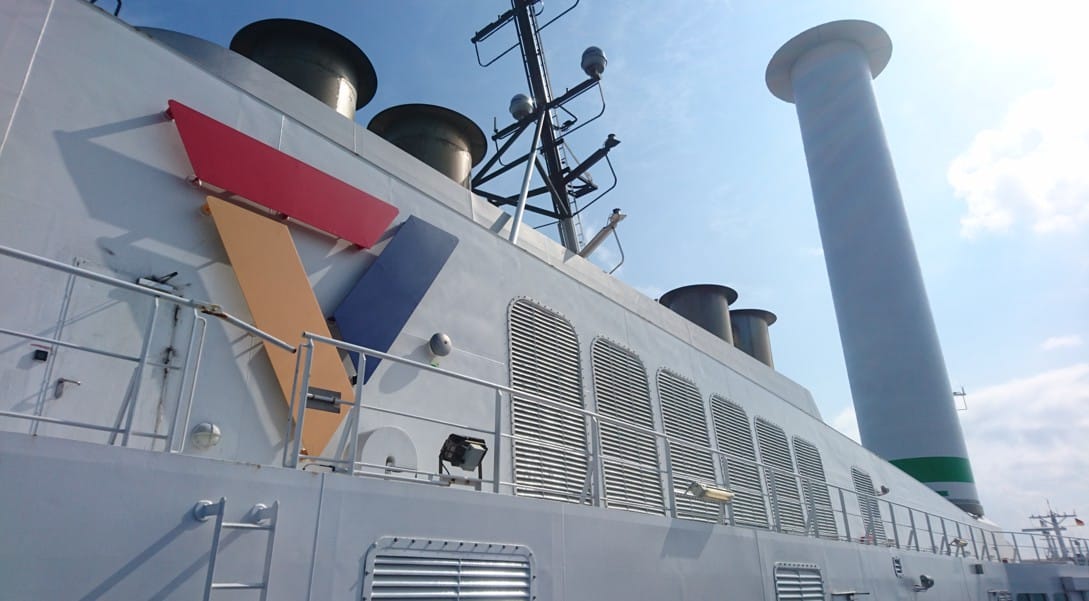
The experiences from over a year of using a rotor sail on the hybrid ferry “Copenhagen” have been so positive that Scandlines is preparing its sister ferry “Berlin” for the installation of a Norsepower rotor sail. The hybrid ferry “Berlin” also operates on the Rostock-Gedser route, but unlike the “Copenhagen,” it sails under the German flag.
(Hamburg/Rostock) When Scandlines decided in 2019 to install a Norsepower rotor sail on the hybrid ferry “Copenhagen,” the technical data from the producer Norsepower Oy Ltd, experiences from a few other shipping companies, as well as its own investigations and calculations formed the basis. The Norsepower rotor sail was installed in May 2020. Scandlines has now had about a year to collect data on how the rotor sail functions on the “Copenhagen” and what effect it has specifically on the route between Rostock in the south and Gedser in the north.
“We expected that the rotor sail on the ‘Copenhagen’ would lead to a CO2 reduction of four to five percent. This expectation was met, so we are now ready for the next step and have therefore also prepared the sister ferry ‘Berlin’ for a sail,” says Michael Guldmann Petersen, COO of Scandlines.
The “Berlin” also serves the route between Rostock and Gedser. Thanks to its perfect location, the route meets the condition for optimal sail effect on propulsion, namely that the wind hits the sail at a right angle.
Optimal Wind Conditions
“Our route over the Baltic Sea runs in a north-south direction, and the wind usually comes from the west or east. So our rotor sail has optimal conditions,” says the satisfied operations manager.
Other green measures by Scandlines on the way to emission-free ferries are not as visible from the outside because they are located below the water surface. But a rotor sail that rises 30 meters into the air is a very clear sign of a green vision.
“Overall, the interest in the rotor sail has been very high – and initially, there was also great surprise among passengers about the ‘chimney.’ Most crew members have now become masters at providing technical explanations that are easy to understand,” reports Michael Guldmann Petersen.
Commissioning in 2022
Tuomas Riski, CEO of Norsepower, says: “We are pleased that Scandlines is expanding the use of our rotor sail technology after achieving the goal of reduced CO² emissions on their first ship, the ‘Copenhagen.’ The functionality of our rotor sail would practically be applicable to about 30,000 ships in the current global fleet, and we hope that this growing confidence in wind propulsion technology is another signal to shipowners and operators.”
The preparation for the rotor sail includes, among other things, building a steel foundation on the ferry where the rotor sail will stand. The work is taking place while the “Berlin” is scheduled for its regular dry dock stay at Remontowa in Poland at the end of May. The installation of the actual rotor sail is planned for 2022.
Photo: © Scandlines


