Kühne+Nagel Takes Over Logistics for German Olympic Teams
3. November 2021
KION Group starts construction of its new plant in China
4. November 2021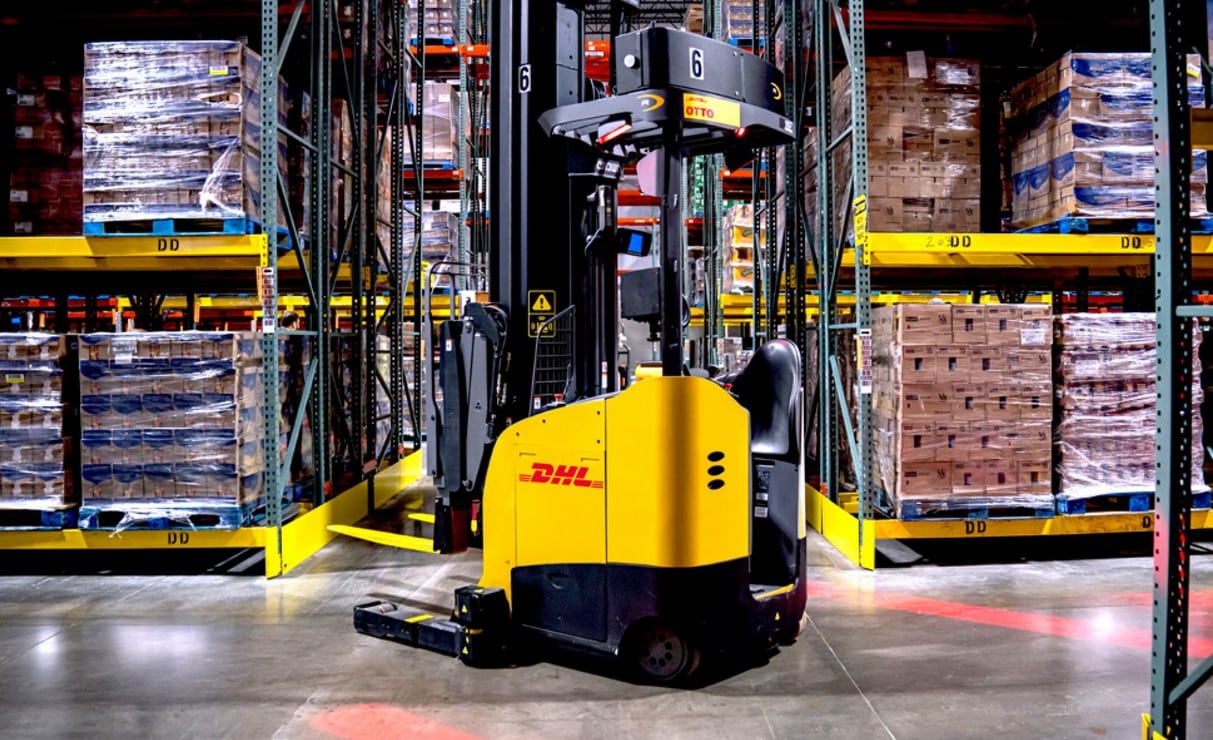
DHL Supply Chain, the contract logistics division of Deutsche Post DHL Group, is further expanding the commercial use of autonomous forklifts and pallet trucks in its more than 1,500 warehouses, focusing primarily on locations in Europe, the UK, Ireland, and North America.
(Bonn) Autonomous transport robots can perform both horizontal and vertical transportation of palletized goods. They are therefore primarily used in industries where goods are predominantly bundled on pallets, such as the consumer goods industry, retail, or the automotive industry. This deployment is part of DHL Supply Chain’s “Accelerated Digitalization” agenda, a strategy for commercializing innovative solutions and new technologies.
“A meaningful robot-assisted support for our warehouse employees is not limited to the picking processes in our booming e-commerce and fulfillment locations. For example, autonomous vehicles can improve service quality and operational processes in various ways. A major advantage of these automated transport vehicles is that they provide direct benefits for us and our customers and can theoretically be deployed in almost all locations. Because: Overall, millions of pallets are moved in our warehouses worldwide every day. A process that currently requires not only the forklift or pallet truck itself but also ties up significant personnel capacities that we could otherwise use much more effectively, especially in markets where skilled labor is scarce,” says Markus Voss, Global CIO & COO DHL Supply Chain. “We expect that by 2030, around 30% of our global fleet of industrial trucks will be automated.”
Already 65% of Human Productivity
Autonomous forklifts are already taking over the storage and distribution of pallets in DHL Supply Chain warehouses today, thereby reducing manual pallet transport. Another advantage of these solutions is that no significant changes to the warehouse infrastructure are required. The vehicles can also easily reach shelves with heights of more than 10 meters and transport all types of pallets, mesh boxes, or other unit goods.
In current operations at DHL Supply Chain, the autonomous forklifts already achieve about 65% of human productivity and move an average of 10-15 pallets per hour. Additionally, the autonomous vehicles maneuver significantly more safely and can therefore operate directly alongside warehouse employees and conventional transport devices. Such forms of collaboration between human employees and robots can be particularly helpful in markets with booming or highly fluctuating logistics activities and in regions with temporary shortages of qualified labor.
Fleet Operating 24/7 and Increased Safety
With operating times of 24/7, a fleet of just a dozen of these autonomous forklifts can already handle more than 1 million pallets per year, DHL calculates. The automated robot transport thus increases efficiency, takes over the repetitive tasks of pallet transport, and improves workplace safety. Through these optimizations, DHL Supply Chain can further enhance and streamline operational processes for customers.
Ongoing Evaluation of New Technologies
As part of its digitalization strategy, DHL Supply Chain continuously evaluates new technologies and solutions that provide immediate value for warehouse operations and can be deployed on a commercial scale. In addition to such tangible robots or the wearable devices in use, DHL Supply Chain is also increasingly focusing on software and data analysis solutions that provide real-time information about the customer’s logistics network. Access to this data and the implementation of algorithms and artificial intelligence represent a turning point in logistics and are therefore being consistently expanded.
Photo: © DHL