






nox NachtExpress Emphasizes Diversity with Diversity Charter
10. November 2021
Fiege inaugurates new mega logistics center in Gengenbach
10. November 2021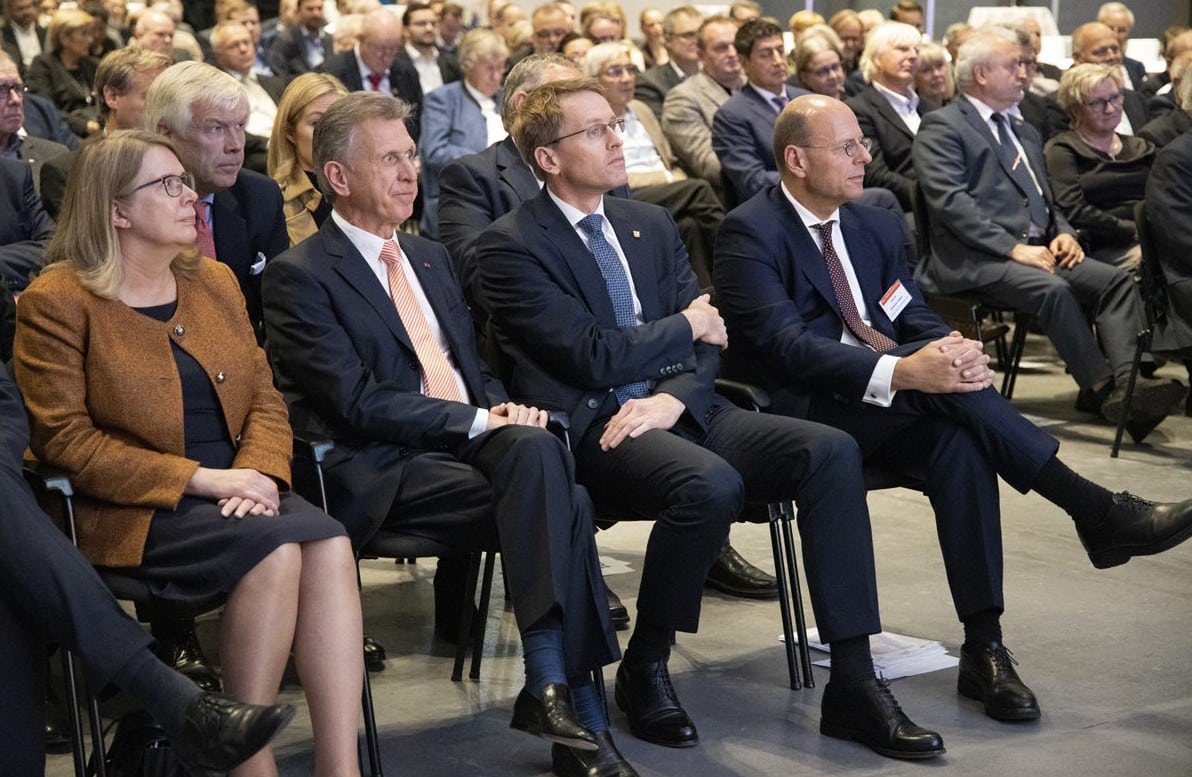
After a pandemic-related pause, the German-Finnish Port Day (DFHT) was relaunched yesterday evening in Lübeck. The hosts were Bernd Jorkisch, Honorary Consul of the Republic of Finland in Lübeck, Sebastian Jürgens, Managing Director of the Lübeck Port Company (LHG), and the Hanseatic City of Lübeck.
(Lübeck) Among the speakers was Schleswig-Holstein’s Prime Minister Daniel Günther. He recently emphasized in a government statement that Schleswig-Holstein aims to strengthen cooperation in the Baltic Sea region and views the Baltic Sea as a region of opportunity. Via video message, Finnish Minister of Transport and Communications Timo Harakka and his colleague Thomas Blomqvist, Minister for Nordic Cooperation, also spoke. Ville Haapasaari, Port Chief in Helsinki, delivered the main speech of the evening. Over 300 logistics enthusiasts accepted their invitation to the Music and Congress Hall (MuK). They engaged with contemporary topics such as sustainability in the maritime economy and European cooperation in the Baltic Sea region.
Haapasaari highlighted the traditionally strong relationships between Finnish ports and Lübeck: “Not only goods and passengers are transported, but the connections between businesses and people are also strong. This is reflected in the close cooperation between our ports, where we develop similar services, processes, and infrastructures on both sides of the Baltic Sea.”
Haapasaari also addressed the impacts of the pandemic. The main focus was on ensuring transport and port operations to keep society functioning. “I think the Baltic Sea ports have managed this quite well overall. We are much better prepared for possible future pandemics.” Regarding climate change, Haapasaari stated: “For a functioning port in the heart of the city, the support of the surrounding communities is crucial. Without this ‘social operating permit,’ ports and their traffic could be at risk. This gives companies a clear motivation to focus on these measures. We ports want to be part of the solution to climate change.”
Finland aims to be climate-neutral by 2035
Finland is driving ecological and digital transformation in the country and aims to be climate-neutral by 2035. The EU has already earmarked 2.1 billion euros from the recovery plan ‘NextGenerationEU’ for this purpose. With this, the country plans to invest in shipping, cybersecurity, digitalization, health technology, and sustainability.
The further program included panel discussions on the topics of “Sustainable Port Logistics” and “European Cooperation.” Participants included Finnish Ambassador Anne Sipiläinen, Schleswig-Holstein’s Minister of Economic Affairs and Transport Bernd Buchholz, and Lübeck’s Mayor Jan Lindenau.
Finnish Honorary Consul Bernd Jorkisch, who sees the Baltic Sea as a region of the future, pointed out the importance of German-Finnish relations: “Germany remains Finland’s most important trading partner, even though there was a pandemic-related decline with a bilateral trade volume of 17.2 billion euros in 2020. And Lübeck plays a significant role in this.” The Lübeck port serves as an important hub for goods traffic between Finland and Central Europe. Currently, eleven Finnish ports are connected to the facilities of the LHG. Up to 1,600 ship calls from Finland are counted each year.
Technology and Climate Change
Preceding the evening event was a conference with expert presentations and workshops in the morning. Under the umbrella term “Technology and Climate Change,” representatives from Siemens, Nokia, and Telekom spoke. Using case studies, they highlighted topics such as 5G technology in logistics, as well as “Digital Twin” and Artificial Intelligence. The results of the workshop were later presented at the DFHT. “The conference gains in format year by year,” said LHG Chief Sebastian Jürgens. “There we can discuss our research projects with experts and simultaneously learn from their ‘best practices.’ Some of these projects we carry out together with our Finnish partners.”
Photo: @ Christina Braune / Image Caption: (l. to r.) Anne Sipiläinen, Bernd Jorkisch, Prime Minister of Schleswig-Holstein Daniel Günther, and Sebastian Jürgens


