Jungheinrich Opens New Plant in Chomutov, Czech Republic
19. November 2021
Element Logic Installs Micro-Fulfillment Center for Peterhans
22. November 2021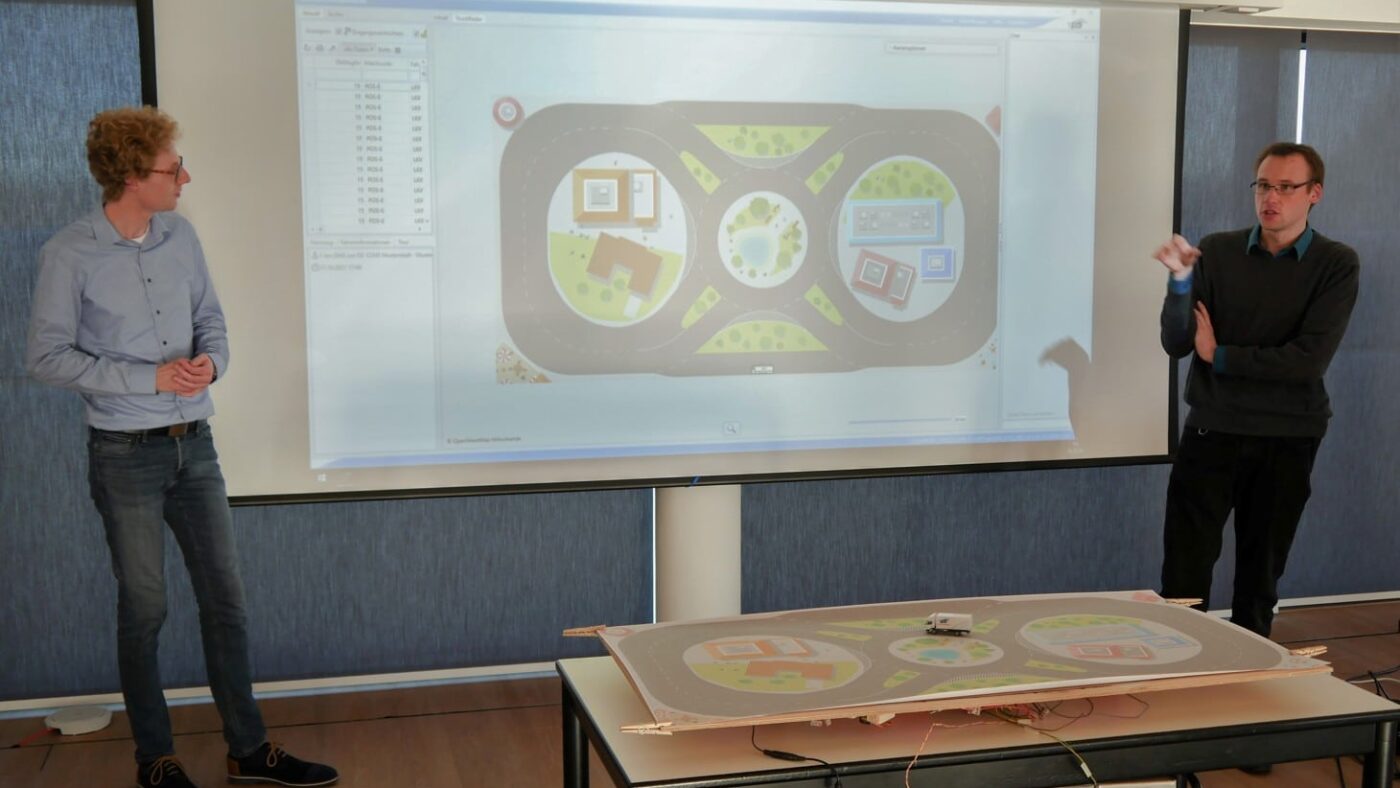
Not a playground, but a software project: Lucas Weckermann and Lukas van der Stok, two dual students of LIS Logistische Informationssysteme AG (LIS), simulated the tracking of trucks via a Transport Management System (TMS) with self-driving model trucks as part of their master’s thesis at FH Münster.
(Greven/Steinfurt) Lucas Weckermann and Lukas van der Stok, dual students of LIS, designed a miniature road map where they use magnetic strips and sensors to drive small toy vehicles while simultaneously locating them via the LIS-TMS WinSped. For the Greven software developer, this miniature course is a new way to visually present his product at trade fairs.
“The students have brilliantly implemented the task. The model to demonstrate our Transport Management System WinSped undoubtedly has the potential to enrich our trade fair stands,” says Mirko Venker, head of software development at LIS Logistische Informationssysteme AG.
To ensure that the miniature trucks powered by servo motors stop, blink, and turn at intersections, the two computer science students placed magnetic strips under the map that dictate the route. Magnetic sliders on the steering axles of the small trucks keep them on track. Additionally, there are magnetic sensors at certain points along the route. They send position data to a Raspberry Pi computer, which in turn communicates with the TMS WinSped. Lucas Weckermann: “Like in real life, the vehicles collect telematics data that is displayed in real-time on the program’s user interface.”
Multi-Month Development Phase
What appears at first glance to be a playground for children has undergone a multi-month development phase and is full of technology. Regarding the development process, Lukas van der Stok says: “We basically started from scratch. Many areas were new to us. Some components even burned out along the way.” However, this is precisely what the master’s project is about, explains Prof. Dr. Jürgen te Vrugt from the Department of Electrical Engineering and Computer Science at FH Münster, who supervised the two. “The students are meant to learn to work independently and in a team. They take full responsibility for their project, with all its ups and downs,” he says. Weckermann: “The frustration level was sometimes quite high. But it was a lot of fun to try out new things.”
The two LIS “dual students” received support from their fellow students Michael Schneider and Niklas Tasler. While Schneider developed the basis for communication between the truck and the computer, Tasler was responsible for further communication between the computer and the TMS. “The project is a prime example of the good collaboration between FH Münster and the training companies. Everyone can learn from each other and benefit,” summarizes Venker.
Photo: © LIS