proLogistik Implements WMS at MP Logistik in Emsbüren
8. December 2021
First Container Ship at the New HHLA Terminal Trieste
8. December 2021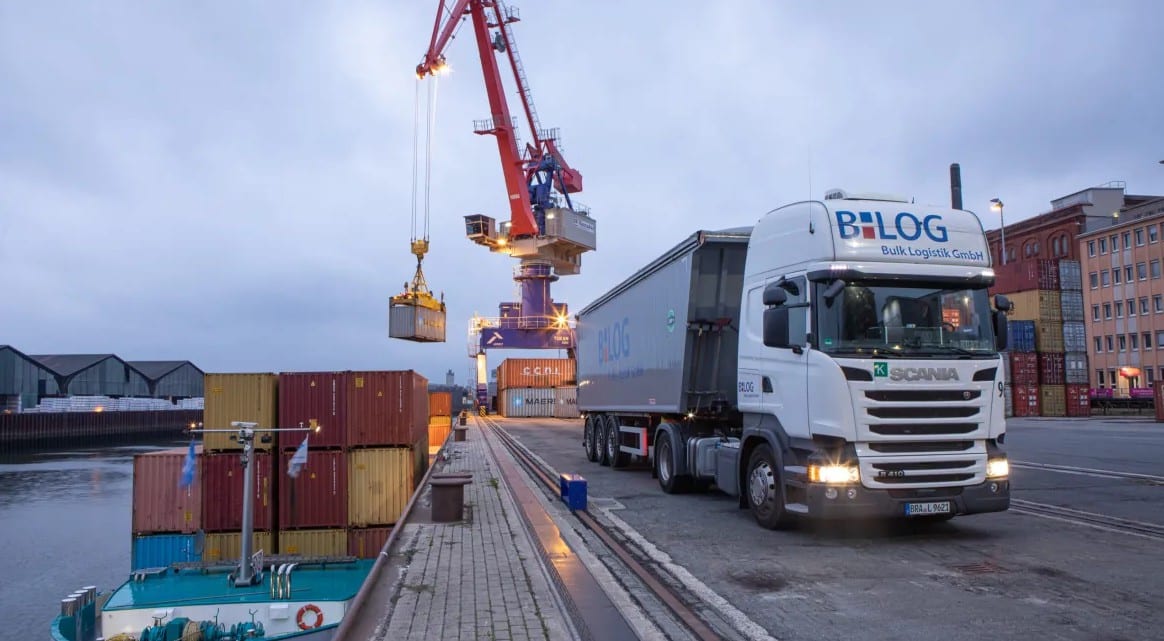
B-LOG Bulk Logistics GmbH not only took over the business operations of the container transport specialist Diedrich Meyer in March 2021, but also their transport management system Maxflex. The rental software is now being gradually integrated into the existing IT landscape.
(Brake/Nuremberg) Can our software handle this? In the age of digitalization, this question often comes to the forefront when it comes to offering additional services. B-LOG Bulk Logistics GmbH is an example of this. The company, specializing in agricultural products, bulk goods, and port services, is a joint venture of L.I.T. AG and the port logistics provider J. Müller Weser GmbH & Co. KG. In March 2021, B-LOG took over the business operations of the Bremen-based freight forwarder Diedrich Meyer, significantly expanding its container logistics sector.
Diedrich Meyer had already digitized its own business processes in 2017. “At that time, we examined various transport management systems and chose the rental solution Maxflex,” recalls Eleftherios Papoutsidis, who is now responsible for order processing at B-LOG. Previously, the trained freight forwarder and former driver worked for Diedrich Meyer for over 20 years and played a key role in advancing the software project. Since then, dispatchers have been securely guided through the processes by Maxflex, ensuring that no information is lost and customer satisfaction has increased.
“Maxflex can map all business processes in container logistics, and as a cost-effective rental software, it has saved us significant investments,” explains Papoutsidis. The rental fees are based on the number of vehicles managed with it, rather than – as is usually the case – on the number of licenses or workstations in the company. The monthly costs per truck are 5.75 EUR. If the fleet is ever reduced, the rental costs would also decrease. In addition to the fair billing, it was especially the specific functionalities for container logistics that made Maxflex appealing: “Especially the TR02 interface included in the Maxflex add-on module and the automatic slot booking for the Port of Hamburg convinced us,” says Papoutsidis.
Automatic Customs Clearance
The TR02 interface enables the early exchange of all relevant order and container data between the carrier and terminal operator. While the terminals receive the planning data from the transport companies, they, in turn, receive all current status information about the containers. B-LOG’s dispatchers are immediately informed if one of “their” containers has been deleted. In the next step, Maxflex automatically initiates customs clearance via ATLAS, allowing the container to be picked up by the driver about ten minutes later. The driver only needs to authenticate with a five-digit PIN code generated via TR02.
Slot booking is also automated with Maxflex: Since 2017, binding time slots for the pickup of containers must be reserved at the terminals of the Port of Hamburg. This makes truck trips to the terminals more evenly distributed throughout the day, avoiding congestion and increasing the efficiency of the facilities. The automatic slot booking is, like the TR02 interface, an integrated part of Maxflex. The solution can independently book, process, and display the current status of all containers in real-time on an interactive dispatch plan.
Custom Programming Would Be Too Complex
After B-LOG’s takeover of Diedrich Meyer, Maxflex was still put to the test. After all, B-LOG already has FreightLutions, a freight forwarding software that is successfully used throughout the group. “The solution developed by L.I.T. was, of course, not specifically designed for container logistics. Features like slot booking are not provided here and would be very complex as a subsequent custom programming,” reports Papoutsidis.
Moreover, container dispatch is becoming increasingly complex due to new requirements from terminal operators, so that every automation helps ensure quality and avoid errors. As an example, the native Greek mentions the new 48-hour rule for export containers at the Port of Hamburg. According to this rule, containers may be delivered no earlier than 48 hours before the ship’s arrival. Specialized software providers like Maxflex can consider such changes more quickly because many customers and users have the same requirements. “With Maxflex, we always encounter high expertise and understanding regarding our requests, so we don’t have to explain much,” confirms Papoutsidis.
Against this backdrop, B-LOG is now relying on a hybrid solution of FreightLutions and Maxflex, especially since the rental software is already a familiar acquaintance for the joint venture partner L.I.T. In 2019, L.I.T. had already taken over another Maxflex customer, Hölkemeier Spedition based in Minden, and decided to continue using the solution there.
“Hybrid software solutions continue to enable us to maintain a central master data and customer management,” emphasizes Papoutsidis. The same applies to the areas of billing, accounting, and controlling, which at B-LOG will also continue to be realized through a single system – namely Maxflex.
Exchange of Master Data
At B-LOG, this goal is to be achieved through interfaces to financial accounting and FreightLutions. Already now, all orders are recorded, dispatched, and billed with Maxflex. The planned interface to FreightLutions will primarily be used for the exchange of master data. The use of the driver app is also planned, allowing drivers to operate around the clock without support from dispatch. For this reason, B-LOG has already acquired new smartphones for its approximately 22 drivers.
Conclusion: Just a few months after the takeover of a container logistics company, B-LOG is on a good path to integration. The foundations have been laid and provide the basis for further growth in the container sector.
Photo: © B-Log