Röhlig and Penske Establish Joint Venture for Contract Logistics
11. January 2022
DHL Route Planning Tool Greenplan Goes for Management Buyout
12. January 2022
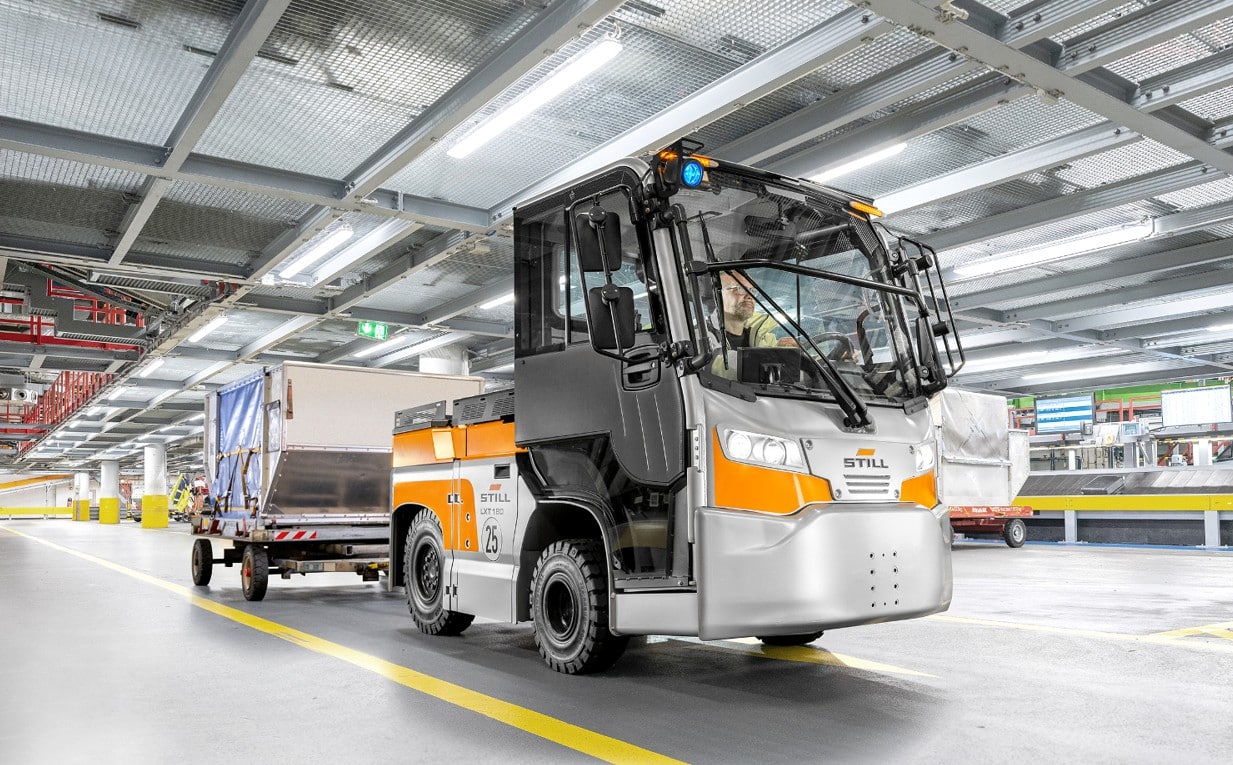
With the new series LXT 120-350 and LXW 20-30, STILL has not only modernized and expanded its product portfolio of electrically powered towing and transport vehicles but has also raised the safety level of these vehicles to a new standard. In particular, the unique assistance system Descent Speed Regulation (DSR), a load and incline angle-dependent speed regulation, ensures an increase in safety and enhanced throughput performance during ramp operations.
(Hamburg) Electric towing vehicles and transporters have become indispensable in the modern working world. Shipyards, automobile manufacturers, international airports and train stations, logistics companies, freight forwarders, and countless production facilities worldwide have relied on the qualities of STILL’s towing and transport vehicles for many years. Now, the Hamburg-based intralogistics provider has once again expanded its vehicle portfolio and oriented it towards the future. The new electric towing vehicles LXT 120-350 with trailer loads between 12 and 35 tons and the electric transporters of the LXW 20-30 series (payload on the transport area two and three tons, trailer loads six tons) offer a wide range of modular equipment options and impress with their performance. Extensive tests in various industries and in sometimes very harsh operating conditions have proven that efficiency and peak performance can be perfectly combined with these new vehicles.
Safe ramp operations
The STILL engineers are particularly proud of the assistance system Descent Speed Regulation (DSR) they developed. “An absolute world first,” as the two STILL experts Alexander Claus, product manager for towing vehicles, and Janos Poppe, product trainer for towing vehicles, emphasize. “This unique system supports the driver for a safe ride on ramps while simultaneously increasing throughput performance. With trailer loads of up to 35 tons, drivers are always adapted to the situation – and at the same time as fast as possible,” says Janos Poppe. Depending on the version, the DSR detects the exact incline and the current load weight on downhill ramps and automatically adjusts the speed through an intervention in the oil bath disc brake system to the respective conditions. In the basic version, which is installed in all vehicles, the speed when driving down a slope is manually limited via a switch to a predefined speed. In the optionally available ECO variant, the system displays the slope on the display and automatically limits the speed to a predefined value. In the premium version of the DSR, the automatic speed reduction depends on the slope and additionally on the attached load. The determination of the trailer load is done through torque measurement on the drive motors. “This very innovative method of load determination, where we essentially measure the trailer load at the coupling, is unique worldwide and only used in STILL vehicles,” reports product manager Alexander Claus with pride.
No compromises in technical equipment
The STILL developers have also come up with something special for the other technical components of the new vehicles. All vehicles feature hydraulic disc brakes on both axles, allowing for a particularly high-performance and precise braking process, are wear-free, and operate almost silently. The regenerative braking of the electric drive also enables energy recovery during braking. The parking brake also operates electrically and engages automatically.
The vehicles of the LXT/LXW series are powered by two 10.5 kW motors on the rear axle. The 80 V three-phase motors are encapsulated and maintenance-free. The intelligent motor control ensures agile driving behavior, and due to the speed-controlled drive, there are no speed losses even during extended uphill driving. The maximum speed of the LXT vehicles without load is 25 km/h, while the LXW reaches up to 23 km/h. The towing and transport vehicles can be charged quickly and easily via a fast charging socket or onboard charger without the need to open the hood.
 Much comfort for long working days
The new cabin is generously designed and offers plenty of headroom and a very spacious footwell for taller drivers. Various adjustment options for the seats ensure a comfortable workplace and provide each driver with the right position for fatigue-free working. The driver’s cabin itself is mounted on rubber buffers and is thus decoupled from the chassis, dampening vibrations. The chassis, also dampened by extra-long coil springs, provides additional driving comfort and allows for excellent road handling. Thanks to the color display STILL Easy Control, drivers always have all important information in view – for example, steering wheel position, driving direction, driving program, speed, incline angle, load display, or charge status. The new steering wheel with an optional knob allows for easy and ergonomic operation of the fully hydraulic steering. Its tactile surface also provides a good grip.
More visibility for safety
A “360-degree glazing” provides optimal visibility in the new vehicles. Compared to previous models, 23 percent more window area has been installed. The optimized visibility in all directions increases safety and prevents damage to goods. The optional rearview camera facilitates maneuvering and coupling during reverse driving. Protection against accidents and damage to goods is also provided by the optionally available Curve Speed Control system, which automatically adjusts the speed during cornering, ensuring safe cornering. The vehicles can be easily integrated into control systems such as STILL neXXt fleet, the most innovative and powerful web portal for optimizing the fleet of industrial trucks, via an optional interface. This allows users to have all relevant information for quick analyses or optimization measures bundled in just one tool. Other optionally available safety features include the STILL Flashlight, Safety Light 4Plus, FleetManager, and the intelligent acoustic warning signal, whose volume is always 10 dB higher than the ambient noise level. Passersby and other road users are always warned at the right volume by this system without creating unnecessary noise pollution for drivers and those warned.
Photos: © STILL