


TIMOCOM Transport Barometer for the Fourth Quarter of 2021
20. January 2022
Garbe Industrial purchases land in northern Duisburg
21. January 2022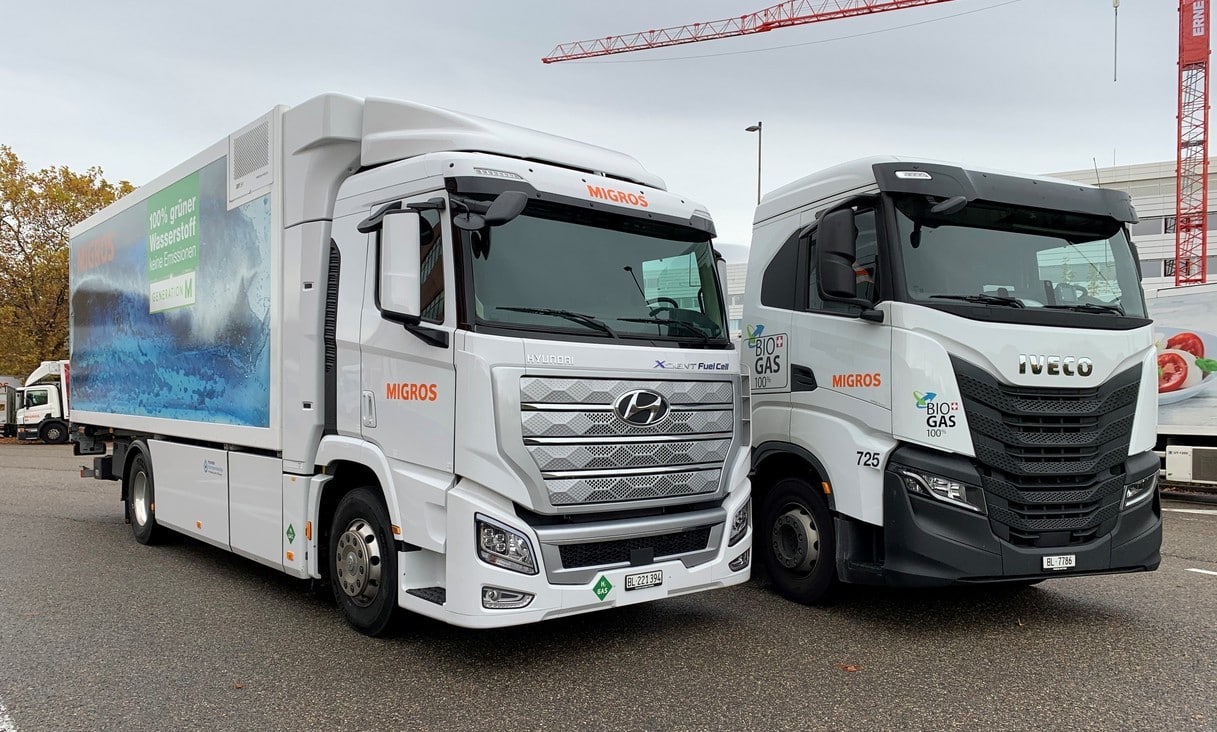
The navigation software company HERE has acquired a software tool from Migros, developed in collaboration with Empa (Swiss Federal Laboratories for Materials Science and Technology), and is making it available worldwide. The tool allows the calculation of CO2 emissions from trucks with various drive systems for any routes.
(Dübendorf/St.Gallen/Thun) The new tool can show logistics professionals worldwide on which routes hydrogen, electric, biogas, or biodiesel trucks can be used and how their CO2 emissions compare to diesel-powered trucks.
The transition of truck fleets to renewable energy is a goal for many fleet operators worldwide. This has also been recognized by the globally active navigation software manufacturer HERE (formerly Smart2Go, Map24, Navteq, Ovi Maps, and Nokia Maps); the company is a joint subsidiary of the German automotive manufacturers Audi, BMW, and Daimler. Other participants include Intel, Bosch, Continental, and the Chinese Tencent group. HERE provides mapping data for logistics companies worldwide, including for the route planning of the approximately 800 trucks of the Migros cooperative.
The software tool now acquired by HERE is based on a collaboration between Migros and Empa. As part of its decarbonization strategy, Migros sought scientific support for the transition of its truck fleet to renewable energy. Together, Migros and Empa developed software that supports the transformation of the Migros vehicle fleet to low-CO2 drives. With the help of the software, the use of trucks with alternative drives and renewable fuels such as hydrogen, electricity, biogas, and biodiesel can be analyzed in terms of performance, range, payload, and costs for individual routes, while simultaneously calculating the expected CO2 savings compared to diesel trucks. Thanks to a connection to life cycle assessment databases, synthetic fuels can also be integrated.
Test phase until March 31, 2022
The ISO and DIN certified software has been in use at Migros under the name “M Opex Tower” for several months. As the HERE Group announced at the CES technology fair in Las Vegas in early January, it will now be included in HERE’s software program under the name “CO2 Insights.” This way, Migros and Empa expertise will be available to logistics service providers worldwide. Until March 31, 2022, the software can be used and evaluated free of charge by all HERE customers.
However, the story actually began ten years ago. At a scientific conference of the “Society of Automotive Engineers” (SAE), Christian Bach, head of the Vehicle Drive Systems department, presented a study from Empa on the efficiency behavior of vehicles. He showed that the energy consumption of vehicles for any trips can be calculated using a simple mathematical function. The underlying mathematical approach is known as the “Willans approximation” and is still used worldwide in many studies in the field of energy converters. It is named after its inventor Peter Willans from England, who presented his observations on steam engines in this form in the late 19th century. Researchers at Empa had used the approach to evaluate vehicle consumption data, demonstrating that it is applicable not only to combustion or electric engines but also to entire vehicles.
From steam engine to electric car
Since then, Empa has increasingly applied this approach, for example, in the EU project “eLCAr” for investigating the life cycle assessments of electric vehicles, in a doctoral thesis at ETH Zurich for analyses of the overall vehicle fleet in Switzerland, and in a book project with the German University of Coburg and the car manufacturer Audi in the field of assessing the real climate impact and total costs of vehicles with various drives. Within the framework of the strategic collaboration between Migros and Empa in the area of decarbonization, the idea emerged to use this approach for a software-supported fleet transformation of Migros trucks to low-CO2 drives.
“The transformation of entire fleets is significantly more complex than testing individual trucks with alternative drives or fuels,” says Bach. The heterogeneity of transport tasks is high and cannot be adequately represented by average models; therefore, each individual trip must be considered separately.
Certified environmental impact
Bach explicitly praises the good collaboration with the project partner: “Migros invited the Empa team to internal meetings with the fleet managers, which was enormously important for finding solutions and ultimately led to the joint development of the software tool.” For several months, the software was tested on the Migros truck fleet, and validation measurements were conducted on diesel, biogas, electric, and hydrogen trucks. Ultimately, the tool was certified according to the standards DIN EN 16258 and ISO 14040, as well as by the CO2 compensation consultant myclimate.
Migros’ CO2 reduction targets are very ambitious. Currently, Migros operates eleven hydrogen trucks, 78 biodiesel and biogas trucks, and 13 electric trucks. Soon, there will be even more.
Photo: © Migros