Hupac Relieves the Road by 21 Million Tons in 2021
27. January 2022
WR Group acquires customs representative license in Russia
29. January 2022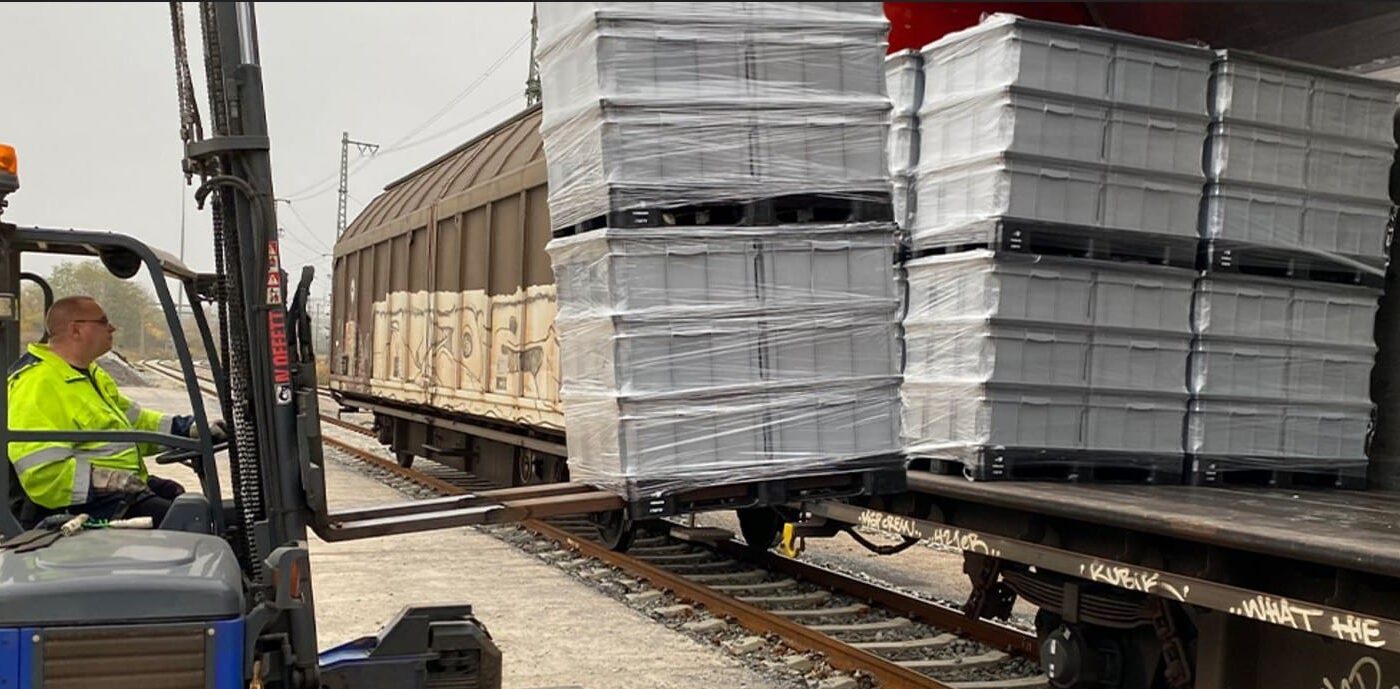
At the end of last year, Webasto tested the delivery of components for production via rail at its plant in Mecklenburg-Vorpommern. A key result of the pilot project with DB Cargo Logistics and the Gertner freight forwarding company (Altentreptow) is that by using freight trains instead of trucks, carbon dioxide emissions for transport to and from the Neubrandenburg site can be reduced by at least three-quarters without additional costs.
(Mainz/Neubrandenburg) Additionally, all wagons arrived on time at the respective loading and unloading stations both domestically and internationally during the test phase. “Sustainability is an important criterion for the future design of our performance and supply chains. At the same time, a high level of reliability and cost-effectiveness is required, especially in the automotive industry. Our test run has convinced on all points. Therefore, we have decided to extend the project to additional partners,” explains Andreas Dikow, plant manager of Webasto Neubrandenburg.
In the first project phase “from road to rail,” two suppliers from southern Germany and the Czech Republic were involved. Within six weeks, Webasto sent around 1,400 empty transport containers to these suppliers for filling and return. By the end of the year, about 15 percent of the purchasing volume of components used in electric heating systems at the Neubrandenburg plant reached production almost exclusively via rail. Previously, these components had been transported entirely by truck over distances of 1,200 or 1,400 kilometers. Since the suppliers are not located near train stations, unlike the Webasto site in Mecklenburg-Vorpommern, transporters still covered about five percent of the routes. After the successful completion of the first test phase, the exchange of goods via rail with the two suppliers is to be transitioned to regular operation this spring.
To further reduce its emissions and utilize efficiency potentials for larger transport volumes by rail, Webasto is now planning to involve additional suppliers from Germany, the Czech Republic, Hungary, and Romania in the logistics project. The next test phase is planned for the second quarter of 2022. In the medium term, more than 50 percent of all heating components for the Neubrandenburg plant are to be delivered by rail.
Rail Connection Between Neubrandenburg and Wuhan
At the same time, the automotive supplier is working with DB Cargo on a rail-based freight transport connection between the Webasto locations in Neubrandenburg and Wuhan (China). The conditions for this are in place: “If we could use the railway track adjacent to our company premises for loading the wagons to Wuhan, the exchange with our other production for heating systems for electric vehicles could be completely realized via rail. This would not only be a forward-looking perspective for the CO2 balance of our Neubrandenburg site but also for the entire Webasto Group,” explains Dikow.
Photo: © Webasto