
IfW Kiel with Critical Study on the Port of Hamburg
8. February 2022
Samedaylogistics New Strategic Partner of GTC Race
9. February 2022
The strategy of the TRATON GROUP to clearly focus on battery-electric drive systems for the future is supported by a recent Fraunhofer analysis. In the scientific contribution from the Fraunhofer Institute for Systems and Innovation Research ISI titled “Hydrogen unlikely to play major role in road transport, even for heavy trucks,” published in the magazine “Nature Electronics,” the authors conclude that battery-electric drive systems are superior to fuel cells in almost all regions and applications of commercial vehicles, explicitly including long-haul trucking.
(Munich) The strategy of the TRATON GROUP to clearly focus on battery-electric drive systems for the future is supported by a recent Fraunhofer analysis.
“We are pleased with the clarity of the analysis results, even though it does not surprise us. It once again confirms the strategy of the TRATON GROUP to rely on battery-electric drives for our commercial vehicles,” comments Catharina Modahl-Nilsson, Chief Technical Officer of the TRATON GROUP. “In truck transport, especially on long distances, pure electric trucks will, in most cases, be the cheaper and more environmentally friendly solution. This is because hydrogen trucks have a significant disadvantage: only about a quarter of the initial energy is used for propulsion, while three quarters are lost through conversion losses. In contrast, the ratio is reversed for electric trucks.”
Additionally, the expected amount of green hydrogen, even with large-scale imports, is limited and should therefore be available for energy-intensive industries, as summarized by the current Fraunhofer study. The demand from the European industry, for example, steelworks, alone massively exceeds the total planned production capacity for green hydrogen in the EU for 2030.
Energy Cost Advantage of Battery Electric Trucks
The energy cost advantage of battery electric trucks is key to a rapid transition to electric trucks, as fuel or energy costs account for the largest share of the Total Cost of Ownership (TCO) for intensively used commercial vehicles. They far exceed the acquisition costs. The better the vehicles are utilized, the more intensively, longer, and regularly they are used, the greater the energy cost advantage of electric trucks will be. Overall, a typical heavy electric truck in Europe is expected to have lower total costs than a conventional diesel truck by 2025. However, this requires a comprehensive fast-charging infrastructure, designed in Europe for the 45-minute break of a driver after four and a half hours of driving.
“Battery-electric long-haul trucks are coming; the technology is there, and the networks are supporting it,” Modahl-Nilsson emphasizes, adding: “What is needed now is political support to quickly and significantly reduce CO2 emissions with this technology. Therefore, the establishment of a high-performance charging network for electric trucks must be accelerated with state support.” Further support options for a rapid transition, Modahl-Nilsson continues, could include incentives for operators of battery-electric trucks. Possible measures could include exemptions from Sunday driving bans or enabling night logistics.
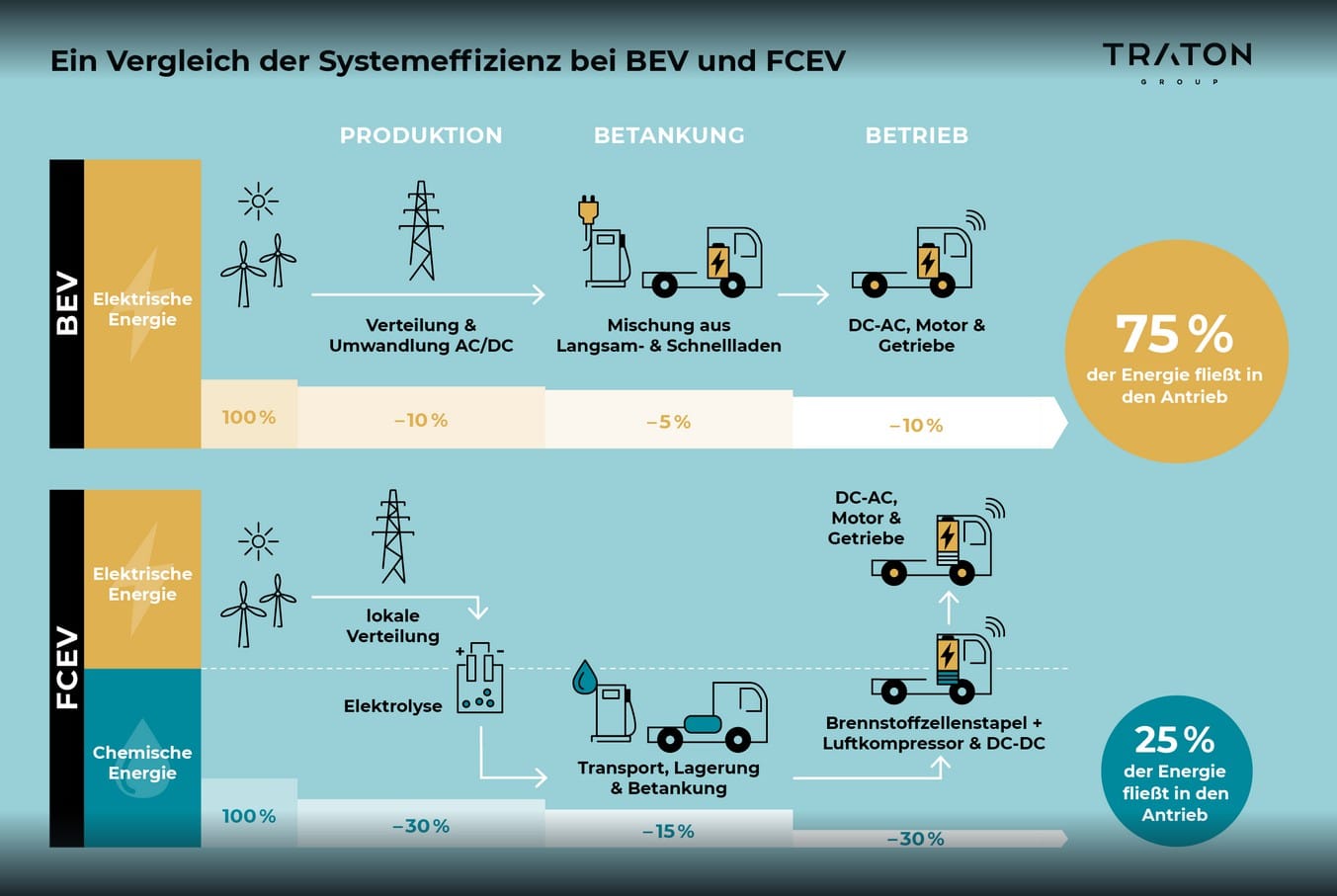
High Economic Efficiency of Electric Trucks
“For the TRATON GROUP, the high economic efficiency of electric trucks on long distances is the most important lever for an emission-free future. We expect that by 2030, 50% of our new sales in long-distance transport could be battery-electric, provided the charging infrastructure is in place. The resilience of the power grids should not be a barrier – our trucks primarily charge during the day and at night when demand and prices are particularly low,” says Dr. Andreas Kammel, responsible for the strategy for alternative drives and autonomous driving at the TRATON GROUP.
Photos/Graphics: © TRATON