






Trucking Platform driveMybox Continues to Grow in 2021
8. February 2022
Fraunhofer Analysis Sees Battery Trucks at an Advantage
8. February 2022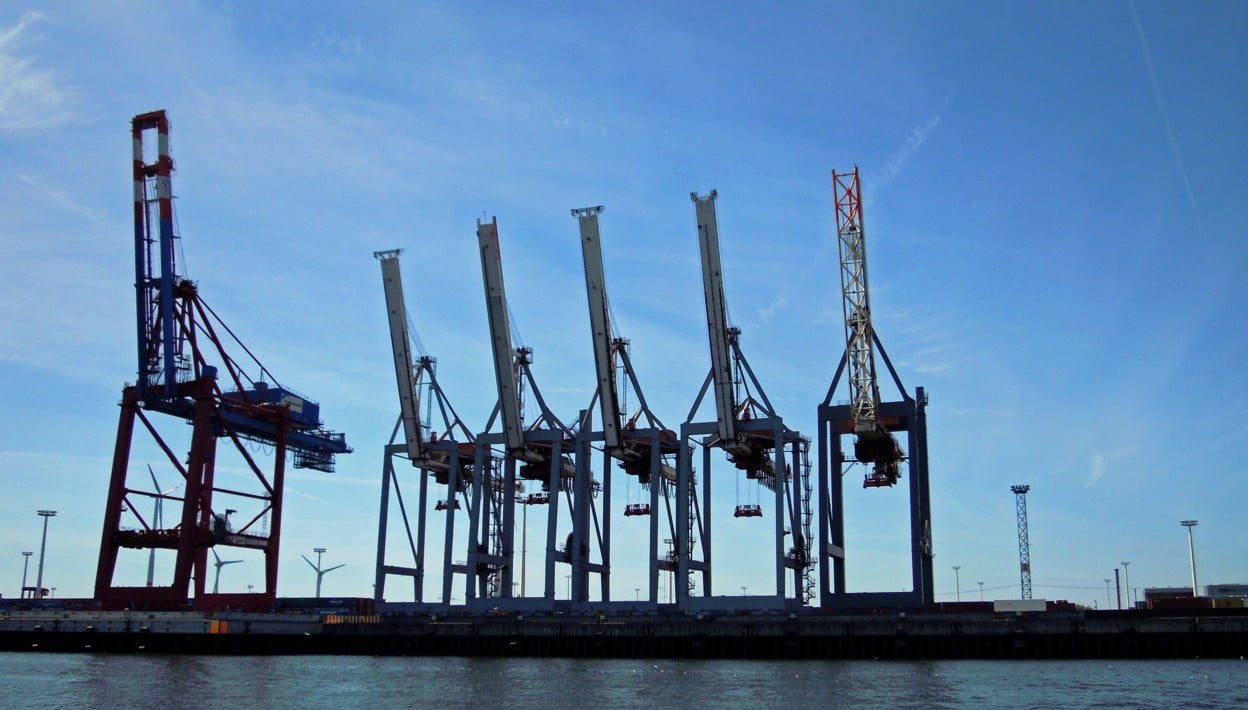
The Port of Hamburg experienced a significant decline in cargo handling during the Corona crisis, but a longer-term downward trend is more significant for its future. Hamburg has been losing market shares in European comparison for years, as shown by a study from IfW Kiel in cooperation with the Nordakademie. Global economic developments pose further risks for the port, which is heavily dependent on trade with China.
(Kiel/Hamburg) During the Corona crisis, cargo handling in the Port of Hamburg temporarily fell by almost 16 percent per quarter. This development followed the decline in overall goods trade in the EU during the lockdown phases in various regions of the world, according to the study published today by the Kiel Institute for the World Economy (IfW Kiel) for the Nordakademie Foundation (“At the Pulse of World Trade – Cargo Handling in the Port of Hamburg During the Corona Crisis“, Jessen-Thiesen, L.; Feb. 2022). The decline in Hamburg was as drastic as it had not been since the global financial and economic crisis of 2008/09. Hamburg was more severely affected by the Corona crisis compared to its competing ports. This is due to the importance of Asian traffic for Hamburg, which brings both special opportunities and risks for the development of the port.
“However, the temporary decline in cargo handling due to the Corona crisis seems to be a rather secondary problem for the Port of Hamburg,” says Levke Jessen-Thiesen, a researcher at IfW Kiel and author of the study. Cargo handling in the port has decoupled from the fundamental growth trend in goods trade: Imports and exports of the EU are steadily increasing and likely reached about 30 percent above the level of 2005 in 2021. In contrast, total cargo handling in the Port of Hamburg in the first quarter of 2021 was 27.6 million tons, not far above the figure of 25.8 million tons in the first quarter of 2005. Since 2014, total cargo handling has been on a downward trend. This is not because maritime traffic has lost significance for European imports and exports to this extent. The decoupling of port handling and EU goods trade rather indicates that the Port of Hamburg is falling behind in competition with other ports.
Antwerp and Rotterdam are Growing Stronger
The two largest European container ports in Antwerp and Rotterdam are on an expansion path that Hamburg is not following. The container handling, crucial for the role of the port in Hamburg, increased by about 17 percent from 2010 to 2019, while Antwerp experienced growth of over 40 percent.
Hamburg is the central European hub for container transport to and from China, accounting for more than 27 percent of total container handling in Hamburg. For Antwerp, Rotterdam, and Bremerhaven, however, China ranks only second as a partner country. The USA is the most important partner country for both Antwerp at 11.8 percent and Bremerhaven at 15.3 percent. “This focus on China carries both opportunities and risks. The geo-economic relationship with China is currently being reassessed – including by the federal government. Moreover, China is increasing the share of value creation in its own country. All of this can have consequences for trade volume with China, posing risks for a port that is heavily dependent on business with China,” says Jessen-Thiesen.

Goals from 2012 Were Not Met
Hamburg is working on a new port development plan, which is to be adopted this year. “The handling targets set in the currently valid port development plan from 2012 have clearly been missed by Hamburg,” says Jessen-Thiesen. “Given the development, one can question whether the growth of cargo handling in the Port of Hamburg can ever catch up with that of other European ports. Therefore, the plan must answer the question of whether to maintain the focus on handling growth. In doing so, it is important to weigh the development of the port against issues of quality of life in a densely populated city.”
The New Silk Road Plays a Role
In addition to regional aspects, geo-economic factors must also be considered, says Jessen-Thiesen. China is expanding its influence on international supply chains, among other things, within the framework of the Silk Road Initiative. “In this context, it may make sense to strengthen other European port locations instead of Hamburg. However, the Port of Hamburg could actively participate in this development through investments and partnerships.”
Download the study here
Photo: © Loginfo24


