Intermodal Platform driveMybox Expands to Italy
7. March 2022
Start of Study to Address Driver Shortage in Transport
7. March 2022
In November, Austrian Post, the University of Applied Sciences Upper Austria, and five local retail companies introduced the “Green Packaging”: a pilot project for reusable and sustainable shipping packaging for online trade. The packaging test has now officially started. Selected products from the project partners dm, INTERSPORT, Tchibo, and Thalia will now be shipped in reusable packaging, while INTERSPAR weinwelt will begin test shipping in the spring.
(Wien) “With scientific support from the University of Applied Sciences Upper Austria and five key customers, we are jointly addressing a significant problem of e-commerce, namely packaging waste. With the ‘Green Packaging’ project, we are therefore launching a pilot test with reusable packaging for the first time in Austria. We expect to have results by the second half of 2022,” says DI Peter Umundum, Board Member for Parcel & Logistics, Austrian Post AG.
As part of the pilot project, the participating retail companies will process their online orders as usual and ship selected products in reusable packaging via post. Recipients will take out the products, fold the packaging – instructions are printed or included – and return them, depending on size, through mailboxes, post offices, or self-service zones of the post to the retail companies. The packaging from dm, Thalia, and Tchibo can also be returned at the respective company locations. After return, the packaging will be cleaned and reused for shipping.
Recipients of the pilot shipments also have the opportunity to share their opinions on the new reusable packaging and their initial experiences with it through a short online questionnaire with the project team. The link to the survey and a QR code will be included with the shipments.
For up to 100 shipping cycles
“From a research perspective, we are very pleased with the companies’ commitment to sustainable packaging solutions. With the data obtained from the pilot test, we can conduct a comprehensive life cycle analysis of the packaging and analyze their lifespan and practicality. We hope to achieve meaningful results that provide high added value for online trade,” says FH-Prof. DI Franz Staberhofer, Head of the Logistics Institute at the University of Applied Sciences Upper Austria.
In a preliminary study by the University of Applied Sciences Upper Austria, over 40 sustainable packaging solutions were examined and analyzed in detail. The findings of the study showed that the greatest emission savings are possible through the establishment of a reusable cycle. In collaboration with the packaging providers and the five retail companies, four types of packaging have been selected for immediate use:
Re-Zip Boxes:
- Lifespan: up to 10 cycles
- Material: cardboard
- Replaces single-use boxes, already tested in Denmark
Re-Zip Bags:
- Lifespan: up to 30 cycles
- Material: coated wood fiber fabric
- Optimal for textiles, avoids plastic (polybags)
Packoorang Bags:
- Lifespan: up to 100 cycles
- Material: recycled PET
- Very high lifespan, suitable for fragile goods due to padding
Returnity Wine Boxes:
- Lifespan: up to 125 cycles
- Material: recycled PET
- Foldable bag with insert, shipping option for up to twelve bottles
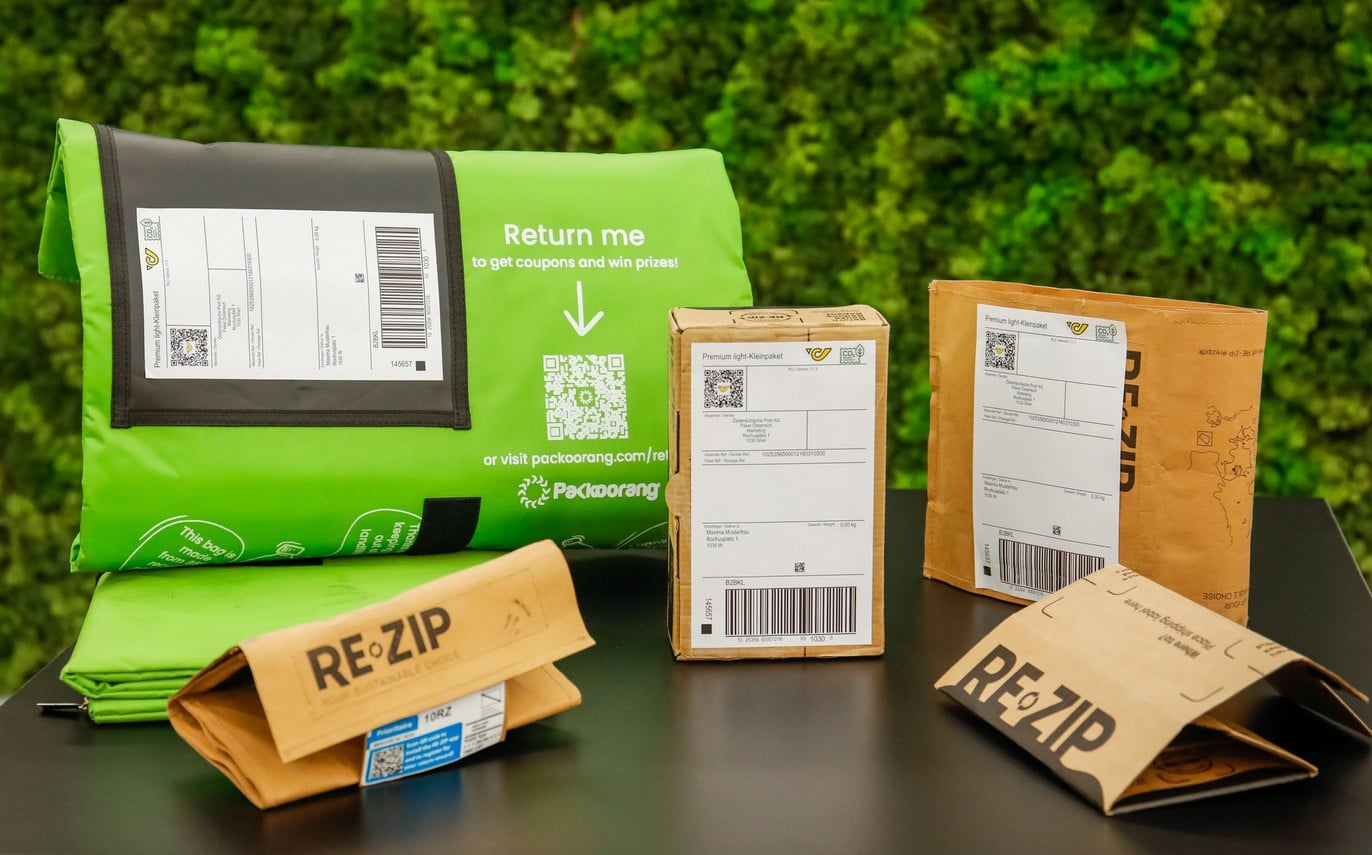
The entire project will undergo an ecological assessment by the University of Applied Sciences Upper Austria. Since the packaging is made from renewable raw materials or recycled PET, the ecological break-even point compared to conventional single-use cardboard will be reached after just a few cycles. The CO2-neutral delivery by the post also contributes to the sustainability balance. The pilot project will run until September 2022.
Opinions of the Cooperation Partners on Green Packaging
Mag. Elmar Riepl, Logistics Manager, Direct Customers & Retail Logistics, dm: “dm wants to not only raise awareness among its customers about how they can reduce their ecological footprint as consumers but also be sustainable as a business community. Therefore, we pay attention to sustainability in our product range, in the choice of operating materials, and in our processes. Online trade is part of this service for our customers, and the ‘Green Packaging’ project is a great initiative that we are happy to help shape.”
Mag. Lukas Wiesmüller, Head of Sustainability, SPAR Austria: “INTERSPAR offers the largest selection of reusable bottles among supermarkets. Now we are taking a step further and testing reusable packaging for shipping bottles. Part of the orders on weinwelt.at will be shipped in foldable reusable boxes with padded compartments. For the return shipment, bags will be provided where the folded boxes can be stored space-saving and returned via post. With this test, we are gathering important experiences for reusable logistics solutions for all our INTERSPAR online shops.”
Mag. Günther Junkowitsch, Head of Logistics and Personnel, INTERSPORT AUSTRIA: “As one of the largest sports retailers in Austria, Intersport offers everything a sports enthusiast desires with its physical stores and online shop. Customers shop online at Intersport.at, but still regionally with the INTERSPORT dealer of their choice. This was a significant step towards sustainability. Another essential piece of the puzzle is the entire ‘Green Packaging’ project, which allows us to easily and straightforwardly reuse the required packaging. We are very pleased to be among the first retailers to participate in this step; this is the future, and we as entrepreneurs are all called upon here.”
Existing Packaging Solutions in Focus
Mag. Erik Hofstädter, Managing Director, Tchibo Austria: “Our goal at Tchibo is to make 100 percent of our packaging environmentally friendly by 2025. For years, we have been working intensively to optimize our existing packaging solutions and prioritize reduction and reusable solutions. Best practices include the early transition to reusable shopping bags and the delivery of our products to Tchibo stores and the grocery trade in reusable transport packaging. In the increasingly growing online trade, it is also important for us to advance the development towards reusable packaging. We can do this as a partner of the ‘Green Packaging’ pilot and have already sent our first orders in reusable shipping bags to our customers in mid-February.”
Pickup Stations Reduce Shipping Actions
Andrea Heumann, Managing Director, Thalia Austria: “In times of online shops, pandemics, and ever-increasing shipping volumes, solutions to the packaging problem must be found. Thalia is trying to address this on several levels: Our offering of e-books, digital audiobooks, and our tolino B-goods (used, refurbished eReaders) conserves resources in production, as well as in packaging and transport. Our pickup service in bookstores or at the new, 24-hour open pickup stations reduces the number of shipping actions. With the ‘Green Packaging’, the remaining shipments are to be handled sustainably, recyclable, and environmentally friendly.”
Photo © Austrian Post / Image Caption: Peter Umundum, Board Member for Parcel & Logistics of Austrian Post AG and Prof. (FH) DI Franz Staberhofer, Head of the Logistics Institute at the University of Applied Sciences Upper Austria