






Dachser Achieves Revenue of Over 7 Billion Euros for the First Time
Apr 5, 2022 at 4:28 PM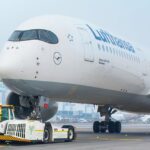
Goldhofer’s E-Tug Successfully Deployed at Lufthansa LEOS
Apr 6, 2022 at 3:11 PM
The world’s largest hybrid ferry from Scandlines will be powered by a liquid-cooled lithium-ion battery system from Leclanché, manufactured at Leclanché’s European facilities. Scandlines’ PR24 will connect Puttgarden on the German island of Fehmarn with the port of Rødby in Denmark.
(Hamburg/Yverdon) The zero-emission ferry project announced in November 2021 by Scandlines, which will create the world’s largest electrically operated hybrid ferry, will be powered by an advanced 10 MWh lithium-ion battery energy storage system (BESS) from Leclanché.
Leclanché SA is one of the world’s leading companies in energy storage solutions and a pioneering provider of lithium-ion battery systems for electric and hybrid marine vessels. Leclanché is part of a group of renowned companies selected to supply key components, systems, and expertise for the PR24 ferry (Puttgarden Rødby 2024), including Norwegian companies Kongsberg Maritime and Norwegian Electric Systems (NES). The ferry has been designed by LMG Marin AS, Norway, and is being built at the Cemre shipyard in Turkey.
The “RoPax” freight ferry (Roll-on-Roll-off) is expected to be operational in 2024. It will connect the ferry port of Puttgarden on the German island of Fehmarn with the ferry port of Rødby on the island of Lolland in Denmark – a distance of 18.5 km.
Battery Technology to Demanding Standards
The battery technology selected for the Scandlines PR24 project is among the most advanced and safest used in marine battery systems. Leclanché is one of the few battery system providers that manufactures its own lithium-ion battery cells to demanding standards at its German production facility. Additionally, Leclanché produces modules on its state-of-the-art automated assembly line in Yverdon, Switzerland. Leclanché’s Marine Rack System (MRS) helps ship owners and operators meet or even exceed international regulations for SOx and NOx emissions.
The MRS BESS is modular and scalable, meeting the highest safety standards with its integrated cooling system and active safety system. Leclanché’s liquid-cooled battery systems offer numerous advantages over air-cooled batteries, such as improved safety, faster charging, longer lifespan, reduced footprint, and lower energy consumption.
Liquid-Cooled Battery Architecture
“Our team was very impressed with Leclanché’s technology and practical experience in the maritime industry,” says Christian Thiemer, Technical Superintendent, Scandlines. “Some of the critical factors that influenced our selection were Leclanché’s liquid-cooled battery architecture and the energy density of the cells. Together with our PR24 team of experienced service providers, we are confident that our freight ferry will set the standard for high-performance, sustainable, and safe ship technology.”
Leclanché will supply a state-of-the-art GNMC battery system with a capacity of 10,028 kWh and a maximum voltage of 864 volts, guaranteed for 10 years. The BESS uses a highly redundant architecture with 48 battery strings distributed across 8 cabinets. Delivery will begin in January 2023.
Long-Term Partnership
Anil Srivastava, CEO of Leclanché: “We are very pleased with the selection of Scandlines and NES as the supplier of the critical battery system for the prestigious hybrid freight ferry project Puttgarden Rødby 2024. Our team has delivered large battery systems for diverse customers such as Grimaldi Lines, Damen, and Wasaline – and for pioneering projects like the E-ferry Ellen, funded by the Danish municipality of Ærø and the European Union, as well as the recently launched Yara Birkeland, the world’s first autonomous and fully electric container ship. We look forward to a long-term partnership with Scandlines to realize our shared vision of promoting electric and hybrid vessels powered by green energy to support a sustainable future.”
70 Minutes for Emission-Free Crossing
Scandlines’ emission-free freight ferry will be 147.4 meters long, 25.4 meters wide, and 5.3 meters deep. The freight capacity of the double-ended ferry will be 66 freight units and a maximum of 140 passengers at a speed of 10 knots. As a hybrid ferry, the crossing time between the two ports will be 45 minutes. In fully electric operation, the crossing time will be 70 minutes, and the ferry will be emission-free.
Photo: © Scandlines


