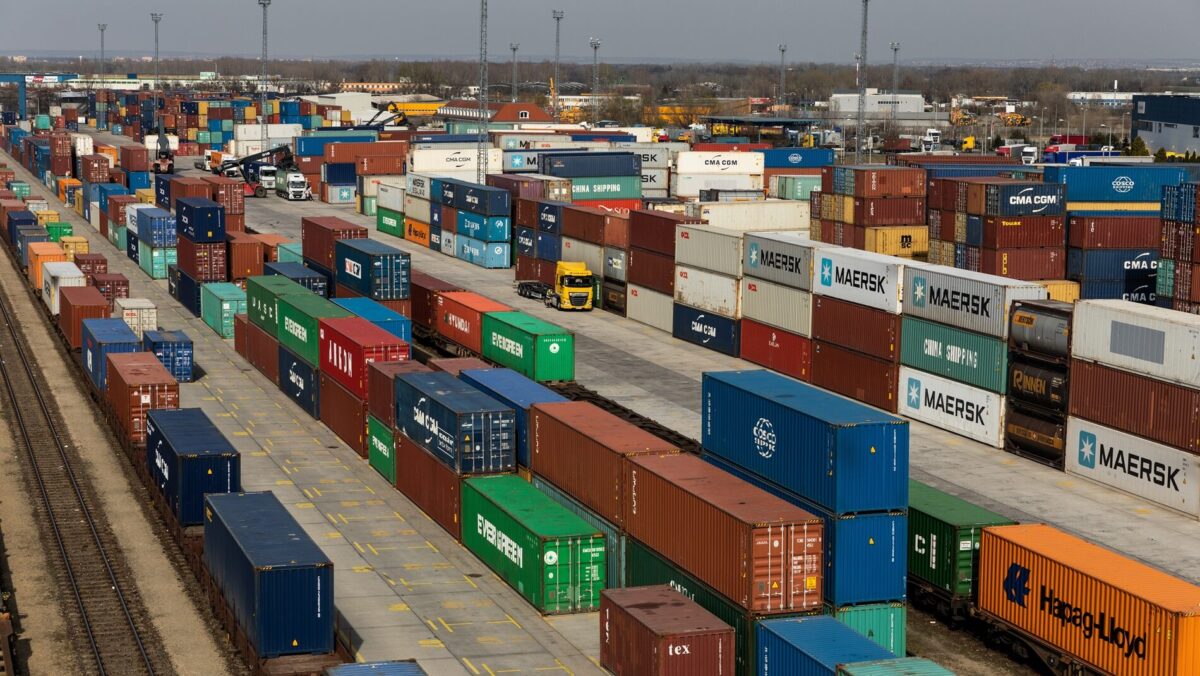
VTG AG: 150 Years of Private Wagon Leasing in Europe
15. May 2022
“Max Eighty” Brochure Complements the Initiative “Wide Awake at 80 km/h”
16. May 2022
Dr. Volker Wissing, Federal Minister for Digitalization and Transport, and Bernd Osterloh, Chief Human Resources Officer of the TRATON GROUP, exchanged views in Berlin on the sidelines of an event focused on the transport of the future and the urgent need for the development of charging infrastructure for commercial vehicles. Wissing and Osterloh agreed that establishing a Europe-wide charging network is a high priority for achieving the European Union’s climate protection goals.
(Berlin) “Battery-electric long-haul trucks offer great opportunities for achieving climate protection goals in the transport sector and for reducing dependence on fossil fuels. The first 100,000 electric trucks alone could save around ten million tons of CO2 annually,” said Osterloh in his discussion with the Federal Minister. Osterloh explained that the TRATON GROUP, with its brands Scania, MAN Truck & Bus, Navistar, and Volkswagen Caminhões e Ônibus, is already offering battery-electric trucks, buses, and vans in series worldwide. Advances in battery technology are expected to enable ranges of up to 1,000 kilometers on a single charge in the coming years, according to the TRATON GROUP. Charging times are significantly under one hour, making it possible to charge during legally mandated rest periods in Europe. “This will make electromobility finally suitable for long-distance transport and also for the mass market,” said Osterloh.
Joint Venture for Expanding Charging Infrastructure
So far, the necessary charging infrastructure for battery-electric commercial vehicles in long-distance operation is lacking in Europe. To kickstart this development, the TRATON GROUP, together with the Volvo Group and Daimler Truck, plans to establish a joint venture that aims to build and operate at least 1,700 high-performance charging points for green electricity at and near highways, as well as at logistics hubs and unloading points within five years of its establishment. Approval from the antitrust authorities is still required for the joint venture. “We hope for a timely conclusion of the regulatory reviews so that we can finally get the joint venture moving,” said Osterloh. With an investment of 500 million euros, the three commercial vehicle manufacturers want to take the lead in building the infrastructure through the joint venture.
Political Support Needed
Osterloh made it clear that, in addition to the planned network development by the joint venture, there must also be government support and a clear signal from politics, not least to build trust with other EU member states and freight forwarders. This should include the announcement by the federal government for the establishment of a German truck charging network, similar to the already approved Germany network for passenger cars. “The state has a special role to play, as many of the required areas along the highways cannot be repurposed for truck charging points without government intervention,” said TRATON board member Osterloh, adding: “Now it is up to politics to drive the expansion of the necessary charging infrastructure to help make electromobility successful for heavy trucks as well.”
The exchange between Wissing and Osterloh took place ahead of an event at the former Berlin-Tempelhof airfield. There, the TRATON brand MAN Truck & Bus will present the first near-series prototype of the battery-electric long-haul truck MAN eTGX, which is set to hit the market in early 2024.
MAN and ABB Leading the Way
In a discussion with Transport Minister Wissing and Kristin Kahl, whose logistics company Contargo has already gained experience with battery trucks, the CEOs of MAN Truck & Bus SE, Alexander Vlaskamp, and ABB E-mobility, Frank Mühlon, emphasized that the industry is ready for the transformation towards electric trucks. MAN, as a commercial vehicle manufacturer, and ABB E-mobility, as a provider of charging stations, have already made their investment decisions in battery-electric vehicles and charging networks; now, political frameworks are needed.
MAN CEO Alexander Vlaskamp: “We are ready. But the transformation towards zero-emission technologies will only succeed if politics invests massively in building a robust charging infrastructure network for heavy commercial vehicles. The accelerated expansion of charging infrastructure is the only way to bring about the transport transition and achieve climate goals.”
Decarbonization of Road Freight Transport
Federal Minister Wissing expressed his impression of the event: “To achieve our climate goals, we must decarbonize road freight transport. We are primarily relying on the market ramp-up of climate-friendly commercial vehicles and the establishment of corresponding high-performance charging infrastructure. It is now important to quickly get more electric trucks on the road. The cooperation between MAN and ABB shows that we are on the right track.”
Photo: © Traton / Caption: Alexander Vlaskamp, CEO of MAN, Dr. Volker Wissing, Federal Minister of Transport, Frank Mühlon, CEO of ABB E-mobility, TRATON Chief Human Resources Officer Bernd Osterloh, and Dr. Frederik Zohm, Board Member for Research & Development at MAN.