Lufthansa Cargo conducts over 100 charter flights for EgeTrans
23. May 2022
HEINLOTH relies on effective transport solutions with ECO-Trailers
24. May 2022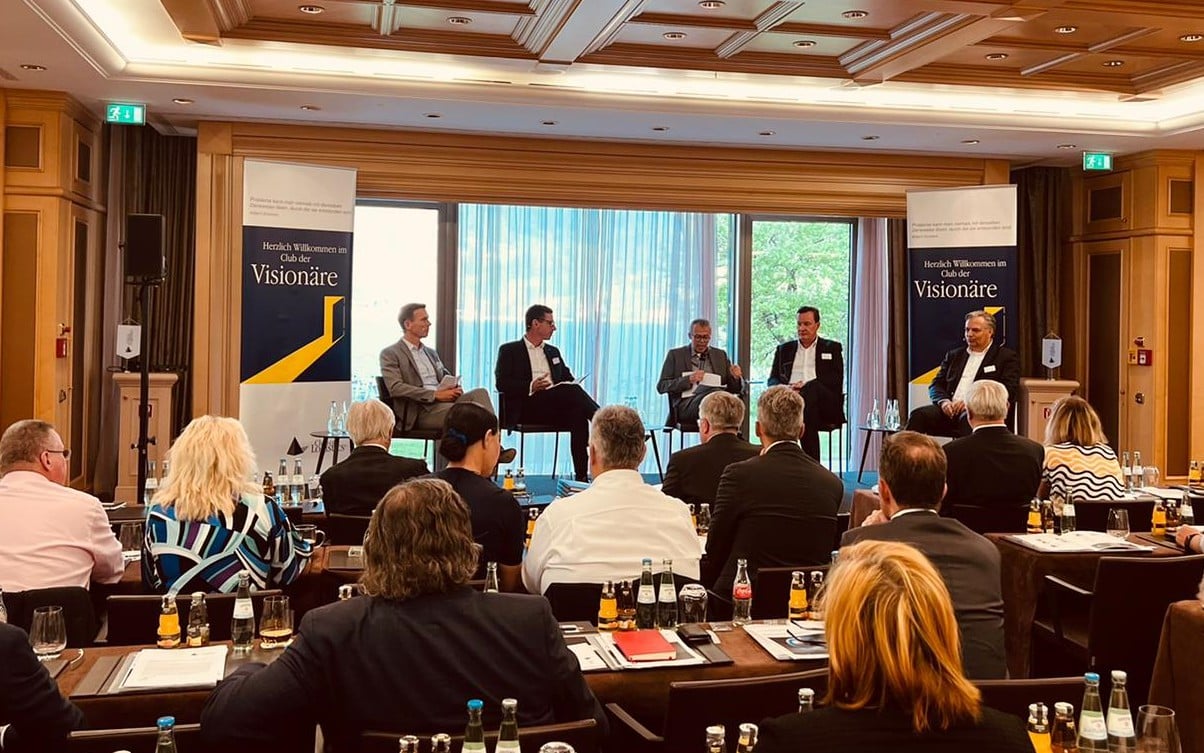
A congress of the think tank Club of Logistics focused on the themes surrounding the shifts in power within the leading economic regions and powers. China is not the insurmountable superpower it likes to portray itself as; the war over Ukraine will permanently affect the significance of East-West trade; and the increasing uncertainty of seemingly stable supply chains will pose major challenges for the logistics industry. These are some of the outcomes from discussions among high-ranking experts at the Club’s spring congress.
(Dormund/Rottach-Egern) The Club of Logistics is a think tank of the European logistics industry, which sees its mission as promoting the mastery of challenges for logistics with creative ideas and developing a comprehensive knowledge base for addressing the future tasks of Germany’s third-largest industrial sector. It is not a traditional lobbying instrument – there are already enough of those. Rather, the Club aims to create a solid foundation of expertise, know-how, and networking (both among members and with politics, society, and research) that will facilitate and enable the successful survival of the European logistics industry in turbulent times. It is no coincidence that the association also refers to itself as the “Club of Visionaries.”
The most important instrument for fulfilling this task is professional congresses, where members – all high-ranking managers from European logistics companies and logistics-related economic sectors – exchange ideas with renowned experts from business, research, and politics and collaboratively develop solution strategies and concepts. At the Club’s most recent congress, held on May 16-17, 2022, in Rottach-Egern, the agenda included nothing less than the dramatic shifts in the global economic order triggered by the pandemic, economic crises, and war, which will lead to a transformation of regional and international influence and power structures whose consequences are still unforeseeable.
End of Illusions
Under the heading “Disruption in the World Economy: Decliners, Dominators, and Winners,” historians, economists, political scientists, and corporate representatives debated the state of the logistics industry in uncertain times.
As expected, the Russian war of aggression against Ukraine, which several experts classified as an “attack on Europe,” dominated the four discussion panels. There was general agreement on one point: the previously unshakeable belief in Western countries in the end of military conquests and the victorious march of peaceful competition among nations in global markets has proven to be premature, even misguided. The notion that post-national thinking holds the future is, according to the consensus of the discussants, a gross misjudgment, as had already been evident before the war during the international fight against the COVID-19 pandemic. Unilateral actions by nations, China’s aggressive nationalist behavior both domestically and internationally, protectionist measures around the globe, and the reckless monetary policies of central banks were identified as significant burdens on the world economy.
When discussing how the war in Ukraine will affect the economic, political, and military balance of power in the world, there was largely consensus: Russia will not play a significant role as an economic power for the foreseeable future, regardless of the outcome of the war. Transatlantic relations are experiencing a long-term strengthening, while the rivalry between the world powers USA and China will increasingly come to the forefront. The pressure from the USA on European politics to clearly position itself on the side of the West and against China is expected to increase significantly in the coming years, given this growing opposition. The experts see a real danger that Europe will become a pawn in this power struggle among giants. Prof. Ulrich Schlie, holder of the Henry Kissinger Chair at the Center for Advanced Security, Strategic and Integration Studies (CASSIS) at the Rheinische Friedrich-Wilhelms-University in Bonn, succinctly summarized the situation: “Europe is clearly the underperformer worldwide.” Whether Europe can maintain a certain degree of independence and autonomous action will depend on how adaptable Europe is and how quickly it can develop.
The System Question is Reassessed
In this context, the guests analyzed the differing assessments of China’s rise to world power. While there are international voices convinced of the superiority of the autocratic path of Xi Jinping’s regime, this view found little support among the experts in Rottach-Egern. In particular, Prof. Stefan Kooths, Vice President of the Institute for World Economy (IfW) in Kiel and Director of the Research Center for Business Cycles and Growth, advocated for the long-term superiority of the West in the struggle of systems. “The authoritarian claim to truth and superiority of an autocracy prevents open error analysis and thus the correction of threatening misdevelopments.” The strength of democratic systems lies in their ability to correct mistakes and thereby create long-term stability.
However, there is no reason for complacency, as all present discussants agreed. Germany, for instance, is not a role model when it comes to honest error analysis. Prof. Markus Taube, holder of the Chair of East Asian Economics/China at the Mercator School of Management at the University of Duisburg-Essen, lamented the “blatant lack of strategic thinking” in Europe, while Dr. Michael Böhmer, Chief Economist and Head of Corporate Solutions at Prognos AG, urged haste in technology development, productivity, and political presence: “We need to hurry, because we are lagging behind.” Europe’s weight in the world economy is declining. Several discussants noted a lack of willingness to grow and compete.
Nevertheless, the consensus among the discussion participants is that it is still too early to write off Europe completely. The list of trains that have already left the station, which European states are now chasing after, is long (digitalization, internet economy, artificial intelligence, quantum computing, etc.), but alongside parts of smart production, it is primarily climate technology where Europe could position itself at the forefront internationally – but only if over-bureaucratization, paralyzing regulatory processes, and deficiencies in education and infrastructure are swiftly addressed.
Logistics in Transition
The logistics industry is currently undergoing significant changes in the framework conditions under which it must operate in the future. According to the expert panel, the most important factors include a permanent decline in East-West trade following the war over Ukraine, an increasing shift of production sites from China to other Asian countries or back to Europe, and a setback in the reliability of supply chains, which, according to Matthias Magnor, Board Member of Contract at BLG Logistics Group, currently stands at only 30 percent. Since logistics follows production and the reorganization of supply chains takes time, it is becoming increasingly difficult for companies to maintain their delivery reliability. Therefore, due to rising inflation, there are tendencies in production facilities to hoard parts, i.e., to increase inventory levels. Thus, just-in-time logistics is becoming just-in-case logistics. This, in turn, increases the demand for storage space and not only becomes a cost driver but also faces resistance in a society that is opposed to logistics properties.
The assembled experts see no easy way to replace China on a large scale with other production sites. The quality know-how built up there cannot simply and quickly be transplanted to new locations like Vietnam or the Philippines. In the longer term, Africa could become an option for supplying Europe. However, quality orientation and political stability would need to be improved there.
The experts do not expect a noticeable easing of the currently highly volatile situation in the logistics industry in the short term. For example, Andreas Kujawski, Managing Director of the freight forwarding service Savino del Bene, estimates that improvements will not be evident before mid-2023.
In general, the logistics sector has proven to be systemically relevant in politics and society in recent years. This has strengthened the reputation of the industry, which is now able to attract new talent from the labor potential. The success or failure of survival in the changed markets will depend on the smart management of companies through this challenging time.
From Discussion Guests to Club Members
The intensive and fruitful exchange of ideas between the experts participating in the discussion panels in Rottach-Egern and the members of the Club of Logistics had an unexpected and pleasing side effect for the board and management of the Club: Three discussion guests – Mario Cavallucci (Managing Director CEVA Logistics), Andreas Kujawski (Managing Director Savino del Bene), and Jane Enny van Lambalgen (CEO Planet Industrial Excellence) – as well as the invited guest co-founder and COO of MotionMiners, Sascha Kaczmarek, signed the membership documents for the Club of Logistics immediately after the event, bringing the number of members to around 120. The congress concept, with numerous networking opportunities with top executives from various industries, research fields, and social groups, clearly impressed both guests and discussion participants.