


Digital Customer Platform myDHLi Becomes Smarter and Greener
23. May 2022
Lufthansa Cargo conducts over 100 charter flights for EgeTrans
23. May 2022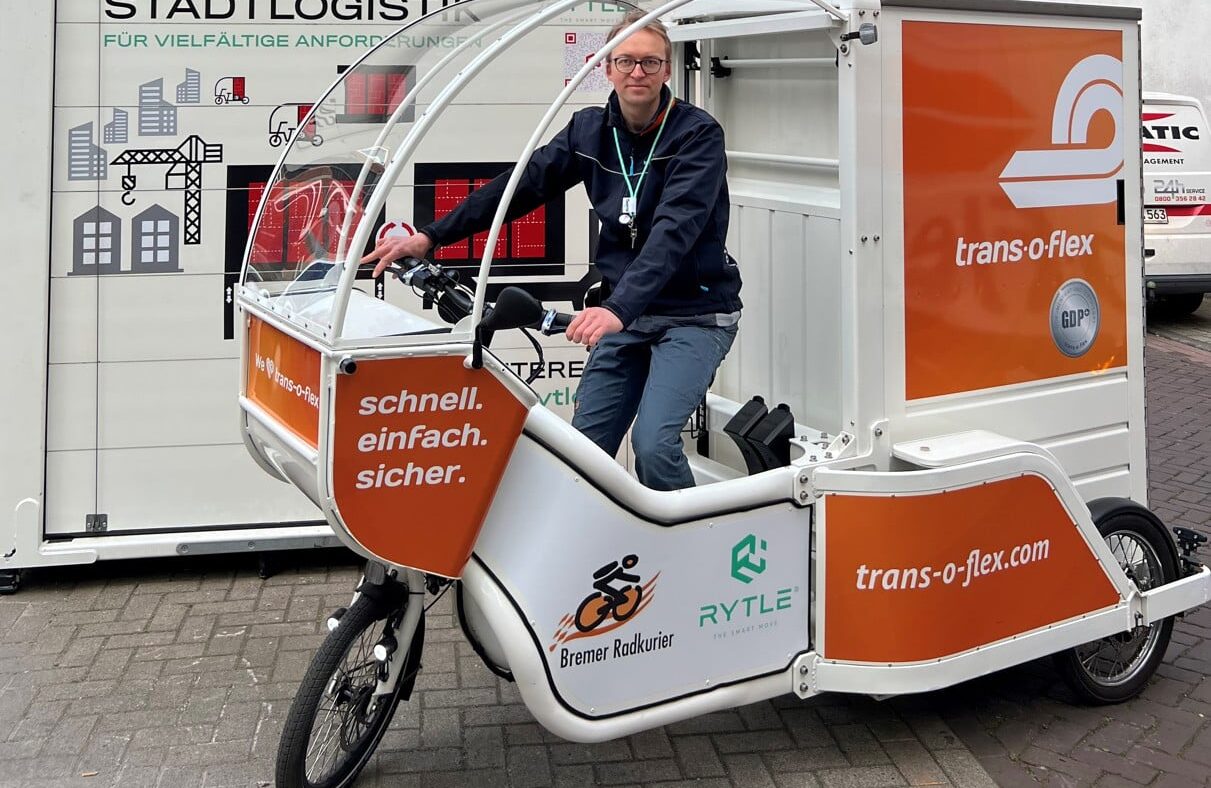
After a year of preparation, the express service trans-o-flex has launched a multi-month test this month in the city center of Bremen, where two cargo bikes will replace the previous delivery method using traditional vans in a specifically defined postal code area. Delivery personnel can pick up fully loaded boxes and set off – to recharge, they simply swap an empty container for a full one at a mini-hub.
(Weinheim) “It is clear that delivery by cargo bike is quieter and cleaner than the traditional use of vans and can contribute significantly to the much-needed relief of traffic, especially in the city center,” says Wolfgang P. Albeck, CEO of trans-o-flex. “However, for them to be truly sustainable and economically efficient, cargo bikes need a completely new delivery system, where deliveries can be made from a mini-hub as close as possible to the delivery area. Otherwise, the distances for the cargo bikes become too long, and the cyclists can only deliver an unreasonably small number of packages per day.”
That is why trans-o-flex has chosen a system bike from the Bremen company RYTLE for its test, which can accommodate a box with around 1.4 cubic meters of cargo space and a payload of 180 kilograms. Nine of these boxes in Euro-pallet format fit into a swap body in 10-foot format, which serves as a mini-hub. It has a fixed parking space in Jakobikirchhof in Bremen. The system allows a truck to either take the entire hydraulically autonomous swap body or individual boxes to transport them back and forth between the parking space in the city center and the trans-o-flex sorting center. This way, pre-commissioned boxes can also be delivered, and the delivering cyclists only need to slide the box between the two rear wheels of the three-wheeled cargo bike, secure it, and can immediately start their delivery tour.
Mini-hub as a hub
In the test, the delivery drivers initially use the mini-hub as a transshipment point, where they load the delivered packages into the box themselves and then deliver them. Once a driver has delivered all shipments, they return to the mini-hub and can either exchange the empty container for a full one in less than five minutes or load manually again and set off. “It is also possible for drivers to pick up shipments along the way,” explains Albeck. “The driver then brings them to the mini-hub.” In the evening, the packages are taken to the next trans-o-flex logistics center. From there, the collected shipments are sent on their way to the recipient on the same day. The next morning, the mini-hub is restocked with new shipments from the logistics center.
Sufficient energy thanks to exchangeable batteries
The cargo bikes used are equipped with two electric motors. They are built into the rear wheels and assist the riders up to a speed of 25 km/h. “Since the distances for the cargo bikes are very short, they will likely cover less than 20 kilometers per day in Bremen.” Thanks to exchangeable batteries, the riders have sufficient energy available for significantly longer delivery tours without needing to recharge during the day.
Active temperature control as a future option
The system that trans-o-flex is testing is not yet designed for the delivery of actively temperature-controlled shipments. “However, we chose RYTLE as a partner partly because the company is working on concepts to enable the delivery of temperature-sensitive shipments with its system,” says Albeck. “If the current test is successful, a possible expansion could therefore be the delivery of shipments within a specific temperature range.” As a logistics partner for the pharmaceutical and healthcare industry with its numerous temperature-sensitive shipments, trans-o-flex offers nationwide active temperature-controlled transport at 2 to 8 degrees and 15 to 25 degrees Celsius within 24 hours. “The reliable maintenance of the respective temperature range along with the necessary documentation of a continuous temperature history is an indispensable part of our service. Delivery by cargo bike must also be able to achieve this in the long term.”
New B2C-Pharma offering
This is especially true in light of the ever-increasing demands for actively temperature-controlled deliveries of pharmaceutical shipments, particularly in the private customer sector. Trans-o-flex is further expanding this segment and has developed the new B2C-Pharma offering, where private recipients receive their medications as shipments with active temperature control.
Photo: © trans-o-flex