GROUP7 Logistics Center in Hamburg Celebrates Topping-Out Ceremony
28. June 2022
Gebrüder Weiss and Hellmann: Partners for 45 Years
28. June 2022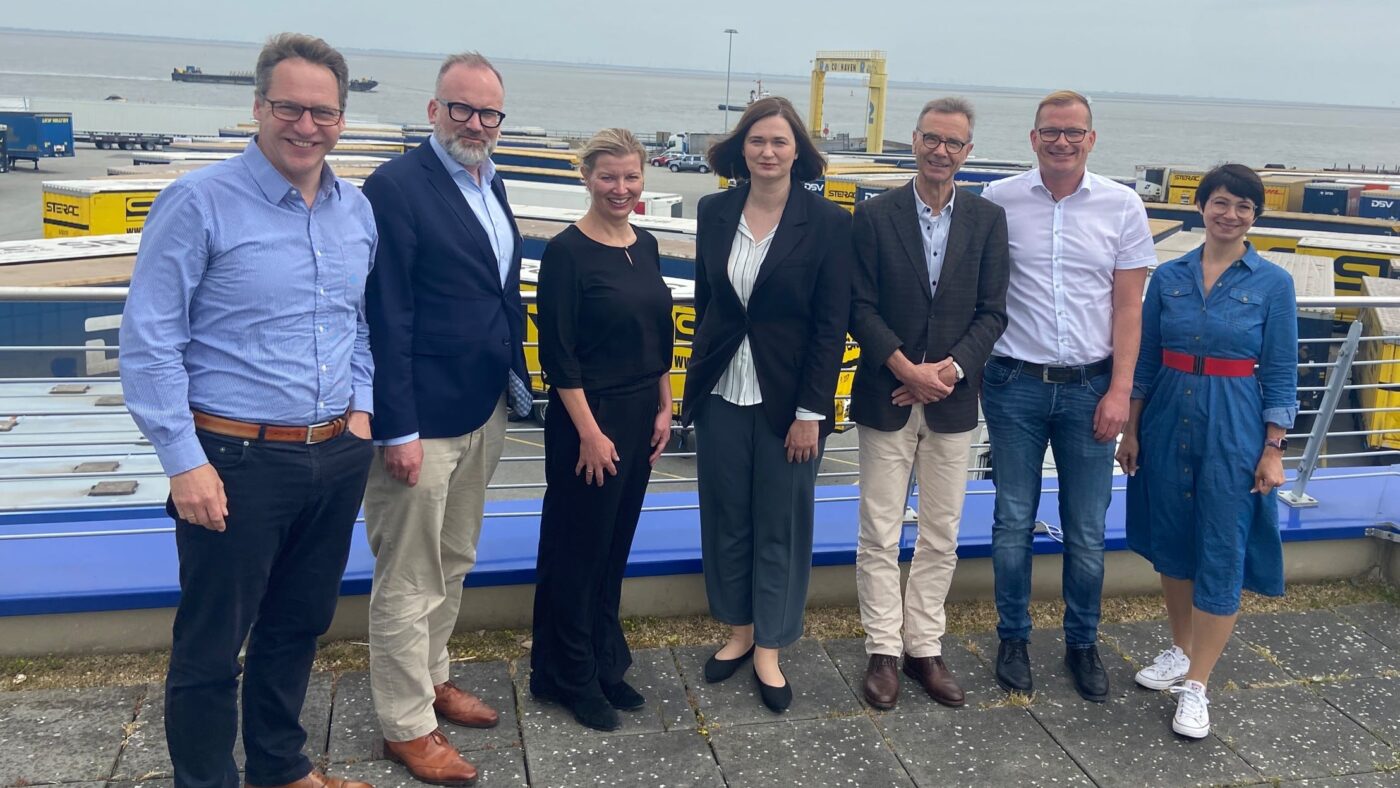
The ramp-up of the energy transition requires port capacities. Cuxhaven is the only German North Sea port that can alleviate the emerging bottleneck on time in three years with three planned berths. A possible solution proposal for the financing of the port expansion was presented by the Cuxhaven Port Economic Community (HWG) to the Federal Government’s Coordinator for Maritime Economy and Tourism, Claudia Müller, MP, during a site visit.
(Cuxhaven) During her visit, Ms. Müller was convinced of the established expertise and infrastructure in the field of onshore and offshore wind energy. “For the success of the energy transition and for the rapid shift to renewable energies, we need our German ports on the North and Baltic Seas. The Cuxhaven location has great potential to further position itself as a maritime logistics hub and as an industrial cluster for onshore and offshore. I am confident that it will continue to expand its role,” Claudia Müller expressed her optimism.
It is time to set the course in Cuxhaven so that the German Offshore Industry Center Cuxhaven (DOIZ) can continue to fulfill its function as the most important maritime transshipment point for offshore and onshore wind energy in Germany. “The additional port infrastructure needed to achieve the ambitious energy transition goals of the federal government is planned and can be realized in the short term,” Hans-Peter Zint, Chairman of the Cuxhaven Port Economic Community (HWG), pointed out in a conversation with Müller.
Possible Financing
The financing model favored by the HWG for the port expansion was discussed in the form of a cooperation between the federal government, the state, and the private sector. From the HWG’s perspective, the national and European task of implementing the energy transition includes creating the logistical prerequisites. Consequently, the state of Lower Saxony has already requested financial support from the Federal Ministry for Economic Affairs and Climate Action for the construction of the three berths.
According to the HWG, no extra path needs to be taken. The federal government has already signed a declaration of intent with the state of Lower Saxony for cooperation on the national task of establishing an import infrastructure for LNG and green gas and is examining its participation in construction measures for Lower Saxony’s port infrastructure in this context. “We propose to expand this examination in the short term to include the federal government’s (and the EU’s) participation in the investments for the construction of berths 5-7 in Cuxhaven,” Zint specified to Müller. The concrete implementation could take place through a project company consisting of the federal government, the state, and the private sector. This would manage the financing of the new port infrastructure for wind energy.
Also on the agenda was the urgently needed electrification of the Cuxhaven-Stade railway line. “To meet the demands of our port customers for green logistics chains and to remain attractive as a tourism location for our guests in the future, we need to end diesel traction and establish climate-neutral rail connections,” Zint emphasized.
Photo: © HWG / Image caption (l. to r.): Arne Ehlers (HWG), Philipp Rademann (HWG), Alexandra Brandt (Niedersachsen Ports), Claudia Müller (MP), Peter Zint (HWG), Knut Kokkelink (Niedersachsen Ports), Verena Hedtke (personal assistant to Ms. Müller).