


Rail Logistics Company InterRail Opens New Location in Vienna
21. July 2022
VSL Baden-Württemberg Honors Four Trainees from Schuon
21. July 2022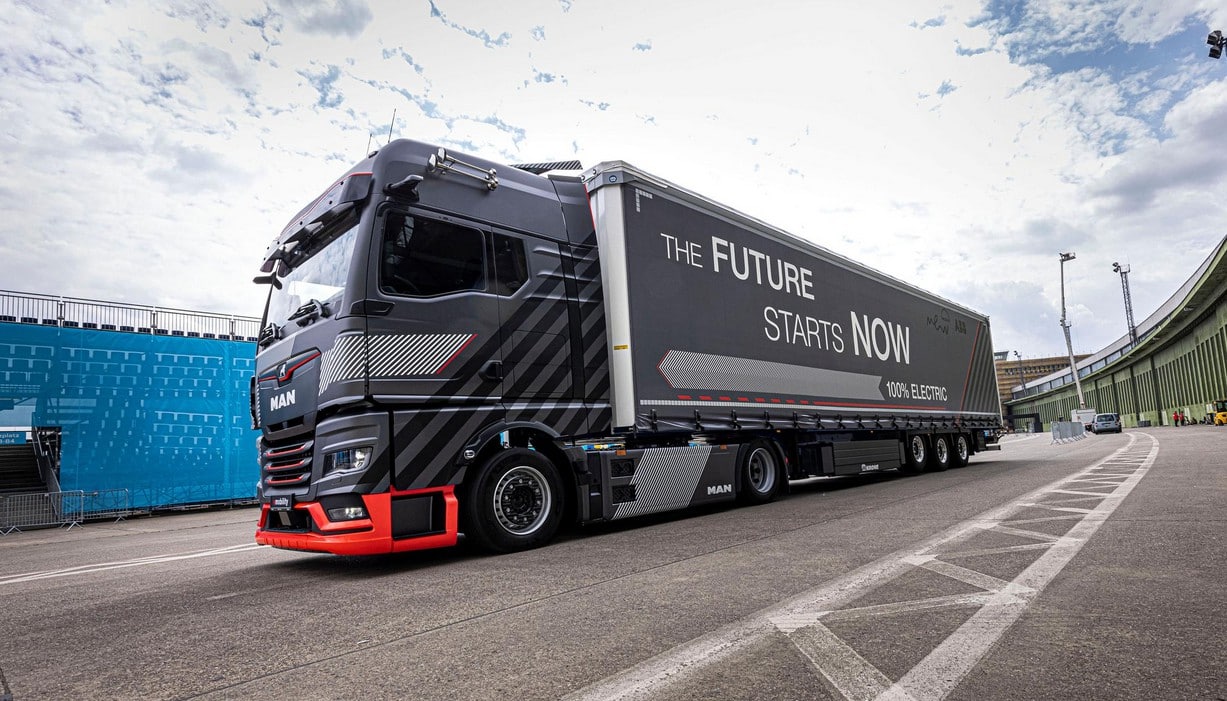
MAN has for the first time anchored the topic of sustainability in its corporate strategy. In its 2021 sustainability report, the truck and bus manufacturer commits to achieving carbon neutrality by 2050. The most important component of the greenhouse gas reduction strategy is decarbonization through the electrification of the fleet.
(Munich) Without sustainability, there is no future. Following this fundamental insight, MAN Truck & Bus has firmly integrated the topic into its corporate strategy for the first time in its more than hundred-year history. A corresponding commitment is at the core of the 2021 sustainability report, which the Munich-based truck and bus manufacturer submitted to the UN Global Compact – the world’s largest initiative for responsible corporate governance – on June 9, 2022. The guiding principles of the strategy are the guidelines of the Global Compact, of which MAN has been a long-standing member, and the Sustainable Development Goals (SDGs) of the United Nations.
Addressing Global Challenges
“We also commit ourselves to our corporate responsibility in these challenging times and view sustainable action as a prerequisite for competing and addressing global challenges,” says MAN CEO Alexander Vlaskamp. “We want to become a sustainable company. This goal must become part of our DNA in the medium term, meaning the awareness of all employees,” adds Stefan Klatt, Head of Corporate Responsibility at MAN, a company of the TRATON GROUP and one of the leading European commercial vehicle manufacturers.
Decarbonization of the Fleet as the Main Goal
Decarbonization of the fleet plays a central role in the sustainability strategy. This is because 97.4 percent of all greenhouse gas emissions caused by MAN occur during the use of its products. By 2030, the greenhouse gas emissions per kilometer driven by the trucks, buses, and vans sold by MAN are to be reduced by 28 percent compared to 2019. By no later than 2050, MAN aims for carbon neutrality – that is, net-zero emissions along the entire value chain. The traditional company committed to this goal in 2021 as part of the climate protection initiative Science Based Target Initiative (SBTi).
Seven Action Areas in Environment, Social, and Governance
Overall, the MAN sustainability strategy focuses on the three criteria of Environment, Social, and Governance (ESG). They are understood as a unit. Within ESG, measures are taken in the seven action areas: • Decarbonization • Circular Economy • Responsible Transport and Mobility Solutions (Environment) • People and Culture • Product, Service, and Traffic Safety (Social) • Compliance, Ethics, and Integrity • Responsibility along the Value Chain (Governance).
Production Start for Heavy Electric Trucks in 2024
The most important strategic measure for CO2 savings is the electrification of the MAN fleet as part of the already initiated transformation. “By the end of the decade, at least half of our vehicles sold in the EU should be electrically powered,” emphasizes MAN CEO Vlaskamp. Since the launch of the fully electric city bus MAN Lion’s City E in 2020, contracts for more than 1,000 units have already been signed. Vlaskamp: “At the beginning of 2024, we will also start producing heavy electric trucks.” The e-trucks will meet the technical requirements for a daily range of 600 to 800 kilometers. In addition, MAN is also researching with partners on the development of a hydrogen truck.
CO2-Low Production Planned for 2030
In production, CO2 emissions are to be halved by 2025 compared to 2015. By 2030, a CO2-low manufacturing process is planned, meaning 95 percent less CO2 produced and the compensation of the 5 percent that cannot be saved due to operational reasons. In the reporting period of 2021, CO2 emissions per produced vehicle decreased by 27 percent compared to the previous year, while absolute emissions at the sites fell by 21 percent. Furthermore, procurement processes, logistics, and supply chains are to be optimized from an environmental perspective.
Attractive Work Environment, Fair Behavior
In terms of materials, the circular economy will be the guiding principle to conserve resources and avoid waste. The already known NewMAN strategy (electrification, digitalization, automation) is to provide responsible transport and mobility solutions in the future. Social aspects and good corporate governance are also reflected. CEO Vlaskamp: “We want to offer an attractive work environment, ensure fair and integral behavior in dealing with our business partners, and fulfill our human rights due diligence along the entire value chain.”
Sustainability Board Reports on Progress
The MAN sustainability strategy was developed and validated primarily with the involvement of stakeholders such as customers and suppliers, as well as representatives from large companies, academia, the community, consulting firms, and prominent NGOs. Results of the strategy process, the sustainability roadmap, updates on progress, and KPIs will be reported in the future within the framework of the MAN Sustainability Board, which meets several times a year under the chairmanship of the CEO.
Photo: © MAN