Maersk Acquires Danish Company Martin Bencher Group
7. August 2022
Survey Sees Skilled Labor Shortage in Logistics as Self-Made
7. August 2022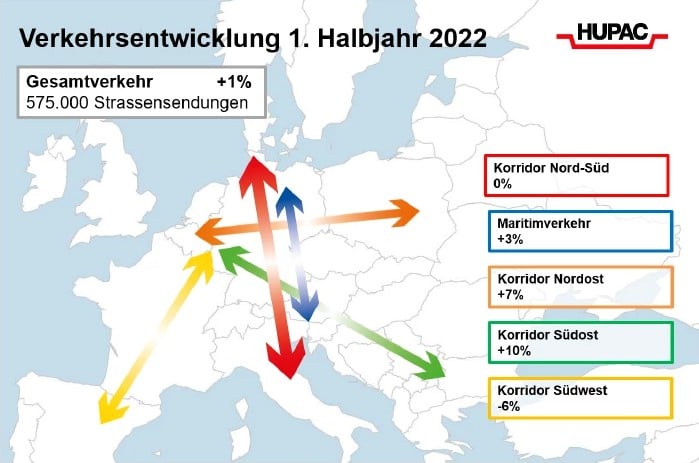
Despite strong demand, Hupac’s traffic stagnated in the first half of 2022 with a 1% increase compared to the previous year. The construction activity in Germany during the months of April and June had a particularly negative impact.
(Chiasso) In the first half of 2022, traffic in the Hupac network reached a volume of 575,000 road consignments, representing a slight increase of 1% compared to the previous year. After a lively development in the first quarter with monthly growth rates in the high single digits, traffic collapsed in April and June. The reason for this was track closures and capacity restrictions due to intensive construction activity on the Rhine-Alpine corridor. The segment of transalpine traffic through Switzerland was particularly affected. “In the North-South corridor, we were unable to achieve our set growth targets,” explains Michail Stahlhut, CEO of the Hupac Group. “On the other hand, traffic in the Northeast and Southeast corridors developed positively. The traffic to Spain fell short of expectations due to capacity bottlenecks.”
The situation in maritime transport remains tense. The pandemic-related backlog in overseas traffic is causing negative cascading effects in European seaports, inland terminals, and in combined transport operations. Additionally, the performance of the German rail network is in need of significant improvement. Despite a 3% increase compared to the previous year, the subsidiary ERS Railways has not yet reached the pre-pandemic volume.
Hupac Invests in Resilience
Hupac is addressing the ongoing difficult situation in the rail network in Germany with a 10-point program “Contingency & Resilience,” which was presented at the general meeting in May 2022. “Our response to the capacity restrictions caused by construction activity in the network is investments in reserves and emergency measures,” says Michail Stahlhut. Initial measures have already been implemented. By the end of the year, the wagon fleet will be significantly strengthened through the purchase and leasing of nearly 900 additional modules. A large part of these wagons will be available as reserves at network hubs for use in case of irregularities, thus contributing to the stability of the transport offer.
Hupac is also strengthening its position in the traction sector. By focusing on powerful rail partners, deepening collaboration with SBB Cargo International, securing additional train drivers who can step in on behalf of Hupac in case of failures, and not least through proactive information and management, performance is being improved. In the terminal area, bottlenecks at the Busto Arsizio-Gallarate hub have been overcome through active management of the loading units.
Securing Capacity in the Network, Avoiding Supply Bottlenecks
A central concern of the Hupac Group is to ensure sufficient capacity in the rail network. For the construction work planned in the coming years, the focus must be increasingly placed on capacity-saving planning and efficient diversion routes. The negative experiences of recent months show that time-sensitive combined transport also requires full track capacity on a weekly basis during construction work to avoid supply bottlenecks.
“All parties involved in the transport chain must significantly increase their ambition for more capacity under the given circumstances,” demands Stahlhut. A short-term shift to pure road transport is only partially possible for customers of combined transport. In particular, the extensive corridor renovations planned in the German network from 2024 still pose a risk to Europe-wide supply if the construction measures are not planned in a market-oriented manner and no functional diversion concepts are created. To prevent this, improved international coordination of construction sites across all corridors is needed, as well as, in some cases, the upgrading of diversion routes. Smaller measures such as additional switches, changes to operating rules, etc., can make a significant difference and must be prioritized.
Capacity Preview for Customers
For the coming months, Hupac expects a satisfactory capacity offer despite the numerous construction sites on the Rhine-Alpine corridor, given the current Covid-19 situation. This is made possible by diversions, strengthening the offer on alternative routes, and providing reserve compositions. Stahlhut: “We have understood our customers’ request for more transparency and will provide a detailed capacity forecast with monthly updates starting in August. This way, transport companies and shippers can better manage traffic volumes even with capacity restrictions.”
Photo: © Hupac