







Oliver Lehmann is Head of Logistics at neska
17. August 2022
ELVIS AG Warns of Liability Risks Due to Gas Crisis
17. August 2022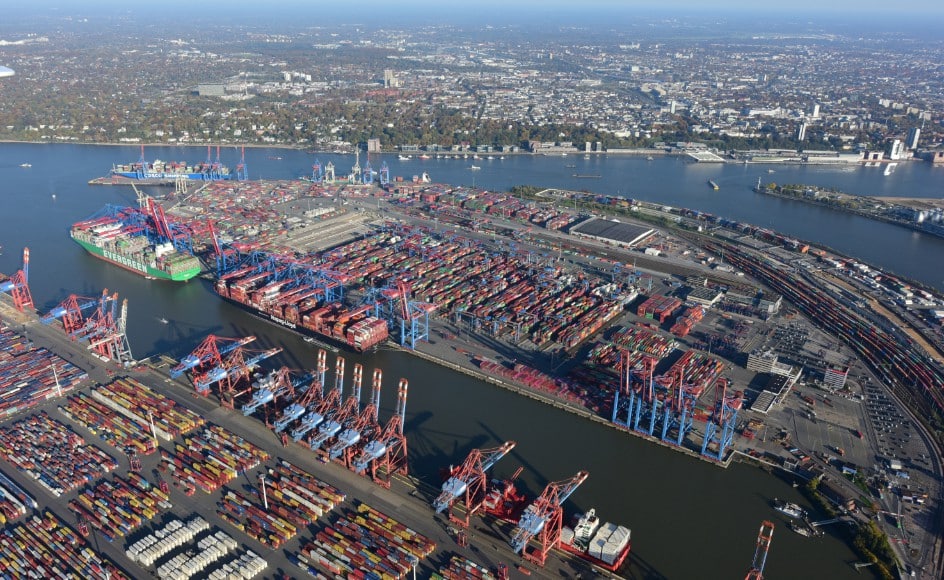
The container handling in the Port of Hamburg developed more positively than expected in the first half of 2022. With a handling result of 4.4 million TEU (20-foot standard containers), a slight increase of 0.9 percent was achieved in the first six months of the year. Compared to the major northern European competitor ports of Antwerp-Bruges, Rotterdam, and Bremen/Bremerhaven, all of which reported declines in container handling, Hamburg was the only main port in the range to record an increase.
(Hamburg) On average, the total decline in the container handling segment among the big four northern range ports in the first six months was 4.6 percent. Against this trend, Hamburg gained market share of 1.1 percentage points and was the only one of the main ports to achieve growth in container handling.
The total handling in Germany’s largest universal port fell slightly to 61.8 million tons (-2.7 percent) compared to the same period last year. The decline in total handling can be explained by weaker results in bulk cargo handling. In total, 17.6 million tons (-8.9 percent) of bulk goods were handled in Hamburg in the first six months. In all three segments of suction goods (3.0 million tons / -7.2 percent), grab goods (10.2 million tons / -3.2 percent), and liquid cargo (4.5 million tons / -20.5 percent), partly intensified EU sanctions against Russia and market-related changes in the trade and transport of raw materials contributed to this handling result.
Particular Challenges for the Port
“The first half of 2022 posed particularly significant challenges for the Hamburg port companies, their employees, and all logistics partners and port customers. The war in Ukraine led to extensive sanctions in foreign trade, which also had a considerable impact on sea cargo handling in the Port of Hamburg and continues to do so. In connection with the nearly completely halted container traffic with Russian ports, there were significant declines in bulk cargo handling as a result of the Russian attack on Ukraine, alongside declines in general cargo handling,” says Axel Mattern, Managing Director of Port Hamburg Marketing, and adds: “The general cargo handling, which is dominant in Hamburg, developed stably under difficult conditions. In this handling segment, a double-digit increase of 34.3 percent was even achieved in conventional general cargo with a total of 798,000 tons.”
Mattern points out that not only the war in Ukraine but also the effects of the global COVID-19 pandemic continue to cause transport and supply bottlenecks for trade and industry. On numerous transport routes, this leads to longer transport times and sharply increased freight rates. According to Mattern, the main causes of the disrupted supply chains, delays, and disruptions in global transport processes cannot be solely attributed to the ports. Rather, it is the case that at the interface of land-sea transport, disruptions such as ship congestion and delays in truck and rail traffic become most visible and noticeable for port customers and the public. “The weeks-long lockdown in the Port of Shanghai and the disruptions in ship arrivals have led to extraordinary peak loads at the handling terminals in the port. Containers that are not picked up in time and thus block urgently needed handling areas cause additional effort and problems in the efficient organization of handling and pre- and post-haulage between the seaport and the destinations inland,” adds Mattern.
Better Conditions for All Modes of Transport
To prevent further disruptions in the Port of Hamburg, the Hamburg Port Authority is responsible for the maintenance and further development of the infrastructure. “As the Port Authority, it is our central task to provide a functional and efficient infrastructure for the logistics chains, thereby ensuring the supply of Germany and other parts of Europe through the Port of Hamburg. When supply chains get out of sync, as we have been experiencing for months, this task not only comes more into the public consciousness but also increases in importance. With the completed fairway adjustment in January, our customers can now realize more containers per call. This strengthens both the competitiveness of the Hamburg location and the supply of the economy and consumers for all of Germany. Specifically: in the first half of 2022, 117 large container ships immediately took advantage of the opportunities provided by the fairway adjustment. The average draft of these large container ships has increased by about 0.5 meters compared to 2021. In doing so, eight percent more containers were handled per call. This underscores the immediate acceptance of the fairway adjustment by our customers. With the shore power supply for container and cruise ships, we have taken on the next major project. In the first half of 2022, construction began at the three container terminals Burchardkai, Tollerort, and Eurogate, as well as at the cruise terminal Steinwerder. The start of test operations is planned for 2023. The Port of Hamburg is thus a pioneer in Europe in the field of shore power supply and sustainability,” says Friedrich Stuhrmann, a member of the management board at HPA.
The Top 10 Partner Countries in Hamburg’s Sea Container Handling
The sanctions imposed on Russia by the EU led to a decline in container handling between Hamburg and Russian ports to 79,000 TEU (-50.9 percent) in the first half of the year. As a result, Russia fell from fourth place to fifteenth place in the top 10 ranking list. The order of the three most important trading partners for the Port of Hamburg in terms of handling volume remained unchanged, with China including Hong Kong (1.3 million TEU / +5.8 percent), the USA (291,000 TEU / -3.9 percent), and Singapore (218,000 TEU / +6.7 percent). They are followed by Poland (166,000 TEU / +53.2 percent), Sweden (157,000 TEU / +8.3 percent), Finland (108,000 TEU / +31.5 percent), Denmark (103,000 TEU / +2.8 percent), Brazil (102,000 TEU / -2.8 percent), the United Kingdom (100,000 TEU / -19.8 percent), and South Korea (95,000 TEU / -18.6 percent). The pleasing increases in handling for the Port of Hamburg in the sea container handling with Poland, Finland, Sweden, and Denmark in the first six months are partly due to restructuring and the concentration of feeder services. Hamburg is increasingly being used as a hub in transshipment traffic to serve the Baltic Sea region. Overall, container handling in transshipment traffic in Hamburg reached 1.6 million TEU (+2.7 percent) in the first half of the year.
Port Hinterland Traffic by Rail at Previous Year’s Level
In the first six months, 1.4 million TEU were transported on the tracks of the Hamburg port railway. This is only slightly below the previous year’s result at -0.2 percent. In total, 23.6 million tons (-0.3 percent) were transported by rail to and from the Port of Hamburg in the first half of the year. “Extensive construction measures in the port area and on the rail network are significant causes for the slightly weaker result compared to the previous year. In the inbound and outbound traffic of the Port of Hamburg, rail freight transport remains the leading mode of transport with a share of 52.8 percent of the modal split,” says Mattern. On the efficient rail network of about 300 kilometers in length, the Hamburg port railway operates around 210 freight trains with more than 5,500 wagons daily. “In recent weeks, very different influences, including the numerous ship delays, have had a disruptive effect on the railway handling in the Port of Hamburg. The terminal operators and railway operators are making great efforts to minimize and avoid bottlenecks in handling,” adds Mattern. Ulfert Cornelius, Managing Director at EVOS Hamburg, shares this view: “The excellent connection of the Port of Hamburg to the rail network is of central economic importance for Germany and Central Europe. This applies not only to container handling but also to liquid bulk goods. This is particularly evident at the moment, as the Port of Hamburg can close significant gaps in the supply chain of such liquid bulk goods. These gaps have arisen due to the current low water levels of the Rhine and can now be largely compensated from Hamburg by rail, thus significantly contributing to reducing the negative impacts on the economy.”
Outlook 2022
In the coming weeks, the marketing organization of the Port of Hamburg hopes for an agreement in the still unresolved tariff conflict between the negotiating partners ver.di and the German seaport companies. Against the backdrop of a deterioration in the overall economic situation, which is likely to be characterized by an expected rise in energy prices and a weakening in consumption, a further weakening in sea cargo handling is expected until the end of the year. A temporary growth could be caused by the shift of especially bulk transports, which could lead to a diversion to other transport routes due to the ongoing low water phase on the Rhine. The Port of Hamburg could benefit as a versatile universal port and leading rail port.
A handling result of around 130 million tons and 8.7 million TEU is optimistic but not excluded with a stabilization of the transport chains and the global economic situation.
Photo: © Hafen Hamburg


