
Hapag-Lloyd acquires 49 percent of the Spinelli Group from Italy
15. September 2022
Panattoni fully leases City Dock Berlin Falkensee to Moodja
18. September 2022
DHL and the NYU Stern School of Business have released the new DHL Trade Growth Atlas, which provides an overview of the key trends and outlooks in global goods trade. The report covers 173 countries and offers valuable insights for decision-makers in politics and business. Despite recent shocks and the currently pessimistic market sentiment, the report casts a positive light on the resilience of global trade.
(Bonn, Brussels, New York) “The DHL Trade Growth Atlas is intended to be the central resource for understanding and navigating the changing global trade landscape. Trade remains a key driver of prosperity – as it has been for centuries. As the world’s leading logistics company, we provide our customers with solutions for all logistical challenges. We have repeatedly demonstrated that we can reliably support them even in a volatile market environment,” says John Pearson, CEO of DHL Express.
International trade is considered particularly important in the current environment, as it can accelerate economic growth, reduce inflation, and provide countries and companies with the opportunity to source essential resources from diverse origins.
Growth, Shifts, and Opportunities
The DHL Trade Growth Atlas also measures the change in the shares of countries and regions in global trade. It has been shown that:
- Contrary to many expectations, the Covid-19 pandemic was not a major setback for global trade: Despite significant supply chain disruptions that slowed growth, international goods trade has grown by 10 percent beyond pre-pandemic levels.
- The outlook for future trade growth remains surprisingly positive: Due to the war in Ukraine, forecasts for global trade growth have been revised downward. Nevertheless, trade is still expected to grow slightly faster in 2022 and 2023 than in the past ten years.
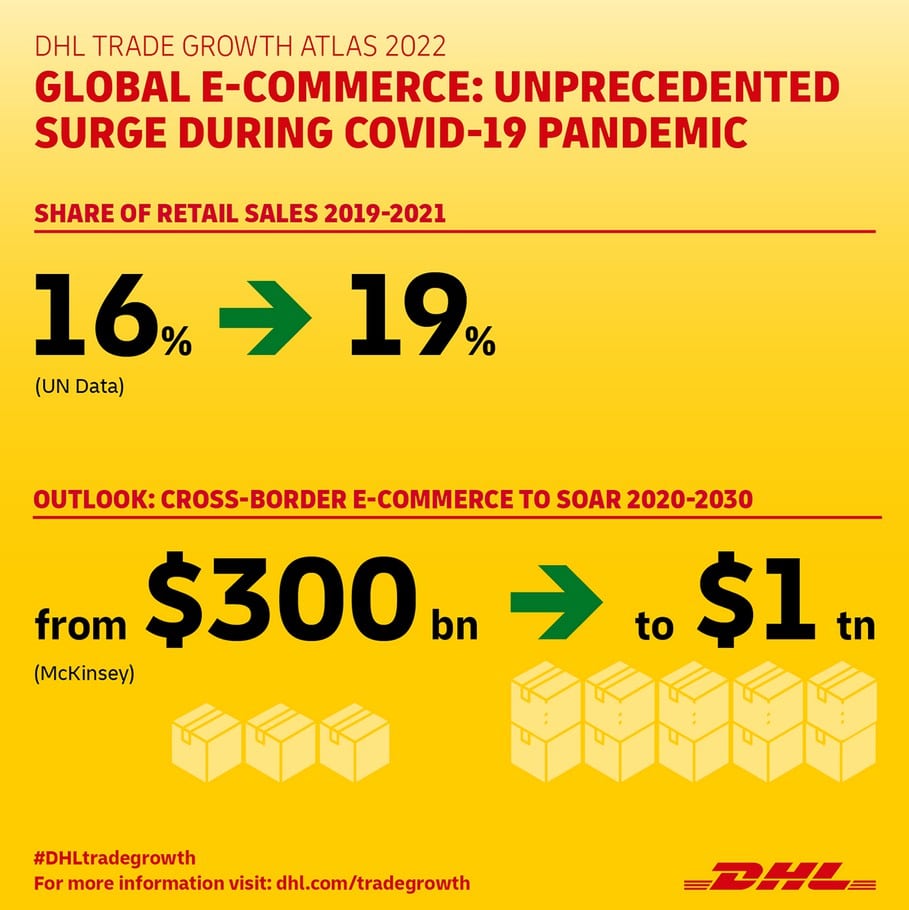
- After the boom in online trade during the pandemic, forecasts indicate a sustained strong growth in cross-border e-commerce.
- New poles of trade growth are emerging in Southeast and South Asia, and a drastic acceleration of trade growth is expected for African countries south of the Sahara.
- Trade growth is spreading across a larger number of countries: In recent years, China accounted for a quarter of trade growth. Current forecasts suggest that China will continue to show the strongest growth, but its share of global trade growth will halve to 13 percent.
- Vietnam, India, and the Philippines stand out both in terms of the pace and the scale of projected trade growth by 2026. All three countries could benefit from many companies striving to diversify their production and sourcing strategies away from China.
- The share of emerging markets in global trade rose from 24 percent to 40 percent between 2000 and 2012, with half of this increase attributed solely to China. However, these shares have hardly changed in the past decade.
- Emerging markets continue to make rapid progress in terms of connectivity and innovation strength, as well as the emergence of leading companies. They are becoming more important exporters of sophisticated industrial products and are increasingly competing not only on low costs but also on innovation and quality.
 Understanding global trade and its opportunities
The DHL Trade Growth Atlas examines trends regarding global trade growth, geographical shifts, the mix of traded goods, and changes in the business environment. It analyzes goods trade worldwide, by regions, as well as for industrialized and emerging economies. A total of 173 countries are considered. The report includes concise summaries for each of these countries on a single page. The countries examined account for more than 99 percent of global trade, global GDP, and the world population.
“We capture key data on the development of global trade and illustrate it with maps, charts, and other visual content. The results show that there are still significant growth potentials for trade in both industrialized and emerging countries, as well as in various regions of the world. The trade landscape is changing, and this change brings new challenges. However, forecasts of a massive setback for global trade are clearly refuted by this report,” says Steven Altman, Senior Research Scholar and head of the DHL Initiative on Globalization at the Center for the Future of Management at NYU Stern.
Detailed insights into global goods trade
The DHL Trade Growth Atlas complements the established DHL Global Connectedness Index. While the DHL Trade Growth Atlas provides detailed insights into global goods trade, the DHL Global Connectedness Index analyzes the broader phenomenon of globalization. Since 2011, the index has examined not only trade in goods and services but also global capital, people, and information flows. Both reports help to highlight business opportunities and contribute to a fact-based debate on trade and globalization.
Photos/Graphics: © DHL