Austrian Post Inaugurates Logistics Center in Upper Austria
14. October 2022
trans-o-flex awarded as price winner for the third time
17. October 2022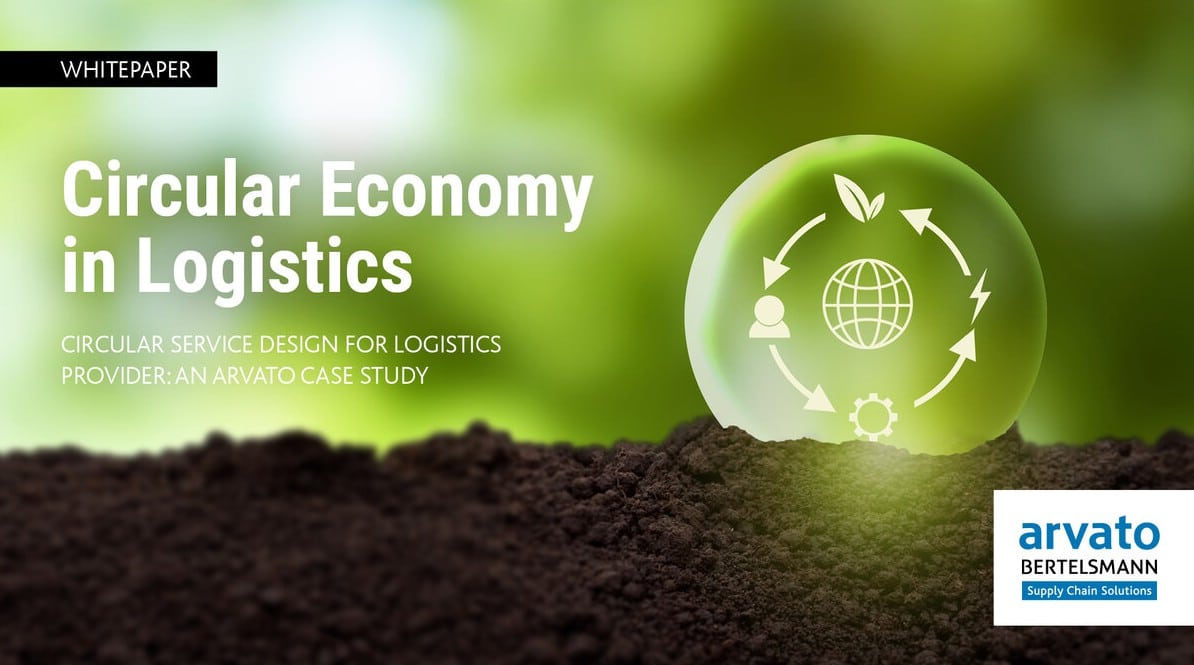
The global Earth Overshoot Day 2022 was July 28. Every year, this date shifts a few days earlier. Earth Overshoot Day means that humanity consumes more resources than the Earth’s biosphere can produce in a year. When the Earth’s resources are consumed faster than they can be regenerated, it has serious consequences for people.
(Gütersoh) Serious consequences also for the planet and the industry for current and future generations – for example, the increasing competition for a stable resource base, rising prices for resources, and a lower quality of life. To counteract these effects, it is necessary to move away from the linear economy, defined as the “take, make and waste” approach, and turn to the concept of the “circular economy.” The fundamental idea of this model is to close the loop: not to use new raw materials, but instead to utilize waste or extend the lifecycle of a product. Logistics plays a crucial role in this. Arvato Supply Chain Solutions has highlighted the current situation in the white paper “Circular Economy in Logistics” and outlined the challenges that logistics service providers will face in the future.
Consider product design early in the supply chain
While product design must consider repair options, reuse, and recyclability early in the supply chain, logistics service providers can strategically utilize and design the supply chain network to support lifecycle extension and product recycling through reverse logistics. This means not only collecting and transporting materials. It also includes value-adding activities such as repair, refurbishment, recycling, and redistribution. Furthermore, logistics providers can increase transparency, simplify and consolidate returns, and pre-sort secondary raw materials, thereby becoming a pioneer for return and reverse logistics.
Circular economy transforms logistics
To accurately define the role of logistics service providers in the circular economy, Arvato surveyed customers on this topic as part of the white paper. The results show that companies must collaborate with their customers and suppliers along the value chain. Moreover, the circular economy requires long-term collaboration, and logistics service providers must act as advisors and supporters on this path. Logistics providers must also invest in technologies such as on-demand packaging that can help avoid or reduce waste. All materials used should be recyclable and reusable. In the medium term, logistics providers are expected to support their customers in refurbishment and reuse, as they already have the necessary networks for the return and shipping of products. In the long term, they should also be able to repair and refurbish products. However, since this is not yet common practice, logistics providers still need to build the required expertise and fundamentally rethink the organization of value chains, proactively involving suppliers and customers in these discussions.
Transforming waste into opportunities
This assessment was confirmed by industry leaders and experts who intensively discussed the topic at the Arvato Supply Chain Masterclass event in early October. “The circular economy is the future,” emphasized Andreas Barth, President Tech Vertical at Arvato Supply Chain Solutions. “It transforms waste into opportunities, especially as recycling and proper disposal of production by-products become increasingly stringent. If companies want to remain profitable in the coming decades, they must recognize the importance of the circular supply chain model and begin to implement the necessary steps.” Very concrete advice for entering the circular economy was provided by Robert O’Mahony, Head of Sustainability, Global Operations at Logitech: “First: Start with the data. Second: Get motivated and motivate your entire company based on this data to understand how much you as an individual can achieve. Third: Think beyond carbon. Think beyond climate. We cannot have a healthy economy if we do not also have a healthy society and a healthy planet.”
Show concrete solutions
Concrete solutions are also presented in the white paper: Arvato provides circular services for several customers in the high-tech industry, such as testing, refurbishing, and dismantling old and defective devices. The components obtained from this process are reintroduced into the value chain – either as B-goods, spare parts, or raw materials for new devices. “We prefer to drive change rather than follow it,” explains Paul Brolly, Vice President Global Business Development & Solution Design, Arvato Supply Chain Solutions. Additionally, Arvato is already using innovative packaging machines in its warehouse processes. These machines reduce the amount of cardboard used and the empty space, leading to lower CO2 emissions. The company also offers circular solutions in fashion logistics: returns are cleaned, inspected, minimally repaired, and returned to stock or donated, leading to greater sustainability. Finally, second-hand and vintage stores are becoming increasingly popular among end consumers.
Free white paper
What other opportunities arise for logistics service providers on the path from linear to circular logistics and what they need to do to unlock these potentials can be found in the white paper “Circular Economy in Logistics.”
Free download:
arva.to/circular-economy-in-logistics