Deutsche Post Simplifies Customs Declaration for Goods Outside the EU
27. October 2022
Logistics Infrastructures Are Important for the Basel Region
27. October 2022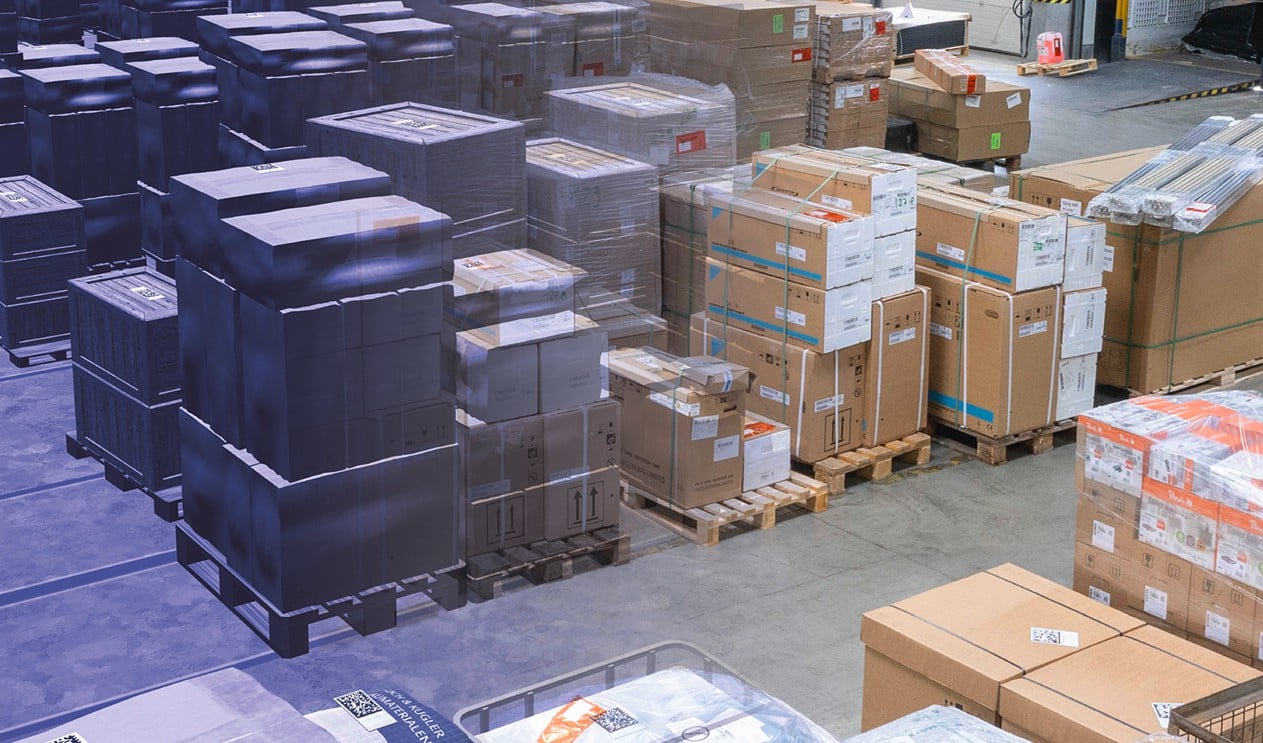
Dachser, in collaboration with Fraunhofer IML, has developed and implemented an innovation in general cargo logistics. At the so-called “@ILO Terminal,” a complete digital representation of all packages, assets, and processes of a transshipment warehouse is created fully automatically and in real-time. This accelerates the inbound and outbound processes, and current information is always available regarding the location of each package. This benefits commercial employees, drivers, as well as staff in dispatch and customer service.
(Kempten/Dortmund) The technological innovation is already proving itself in the transshipment warehouses of Dachser branches in Unterschleißheim near Munich and Öhringen near Heilbronn. @ILO stands for “Advanced Indoor Localization and Operations” and is a research project from the DACHSER Enterprise Lab, which the logistics service provider operates in collaboration with the Fraunhofer Institute for Material Flow and Logistics (IML). The heart of the project is the jointly developed @ILO software. Special AI-based algorithms interpret the data captured every second by optical scanning units to automatically and immediately identify, locate, and in the future also measure all packages. This creates a complete, always up-to-date representation of the warehouse and its processes – a so-called digital twin. This is expected to provide real-time data on every palletized shipment in the European Dachser transport network.
Consistent Digitalization
“With the consistent digitalization of our core processes, we can further improve our services,” explains Burkhard Eling, CEO of Dachser. “We are not only relying on the latest technologies but also want to take our employees into the digital world, as seen in the @ILO Terminal. This innovation brings clear advantages for daily work in the transshipment warehouse and has the potential to be a milestone on the way to more efficient and sustainable logistics operations.”
“With the @ILO Terminal, we are reaching a new level of supply chain visibility,” says Stefan Hohm, CDO of Dachser and board member. “Together with Fraunhofer IML, we have worked for over four years on the digital twin. With a lot of knowledge, ideas, and above all passion, the teams from science and practice have made the Internet of Things and the vision of Logistics 4.0 a reality in general cargo logistics.”
Fully Automatic Identification and Meter-Precise Localization
At the @ILO Terminal, packages are fully automatically identified upon entry, during their stay, and upon exit, and recorded in the transport management system. Manual scanning of barcodes and additional labeling of packages are eliminated. The technological basis of the system consists of two-dimensional data matrix codes on the top of each package, which serve as identifiers, as well as several hundred optical scanning units in the ceiling area of the halls that cover the entire floor.
This also enables meter-precise localization of all pallets in real-time in the often football field-sized transshipment warehouses. The storage locations of shipments as well as the position of forklifts can be visualized in real-time and displayed on websites, apps, or mobile displays along with guiding information for internal transport, significantly improving transparency in the warehouse and speeding up search and loading processes.
A novelty is the so-called automatic “marriage” of forklifts (FFZ) and packages. The @ILO system automatically recognizes the pickup of a pallet with a forklift and transmits real-time information about the respective package to the employees via displays. This functionality also saves processing time and can redesign processes in the transshipment warehouse.
Permanent Measurement of Packages
Another technological highlight of the @ILO Terminal is expected to be the fully automatic and permanent measurement of all packages in the future. Already in pilot operation, the system can determine the dimensions of packages with high accuracy. Once the system is fully practical, the determined volume data can be used by intelligent algorithms to assist drivers and employees in the transshipment warehouse with loading and route planning, further increasing the utilization of swap bodies, trailers, and local transport vehicles. This would then lead to a reduction in transport kilometers and thus also to a reduction in emissions.
Even More Efficient Processes in the Terminal
“The practical advantages of the @ILO Terminal have already become evident in the first tests,” reports Alexander Tonn, COO Road Logistics at Dachser. “Colleagues save valuable time with the system and can make processes in the terminal even more efficient. Loading and departure are also significantly more relaxed for drivers. All of this has the potential for a leap in innovation in general cargo logistics.”
Photo: © Dachser