






Michael de Reese becomes new Chairman of the Board in Cuxhaven
21. November 2022
DEKRA and Hydrogen Europe Aim for Regulations on Hydrogen
21. November 2022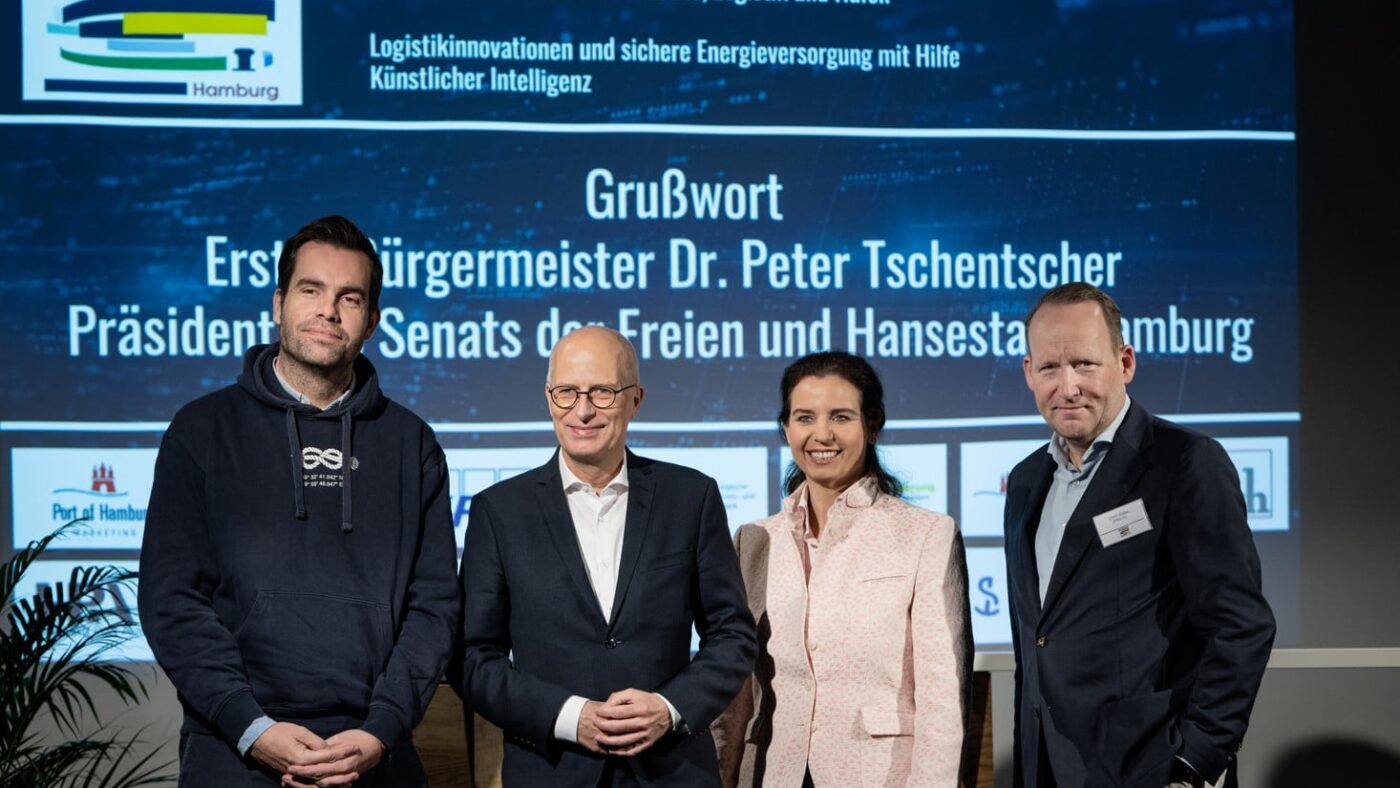
The 3rd Future Conference for Industry, Logistics, and Ports highlighted the progress of digital processes in logistics and energy supply. At first glance, they may not seem to fit together, but logistics has a lot in common with energy supply. It mainly concerns a constant, permanent supply chain, whether it be goods and products or energy from various sources. Both areas have been heavily strained in recent months, almost years.
(Hamburg) Digitalization, along with Artificial Intelligence (AI), cannot solely ensure stability and security in supply chains. However, they can make predictions in certain areas that help respond to events in a timely manner. About 250 participants, both in-person and online, were convinced of this at the 3rd Future Conference for Industry, Logistics, and Ports under the title “AI Location Northern Germany – Logistics Innovations and Secure Energy Supply with the Help of Digitalization and Artificial Intelligence.”
At the Digital Hub Logistics Hamburg, Hamburg’s First Mayor Dr. Peter Tschentscher outlined the important role that digital innovations play for secure energy supply and logistics: “Hamburg is an ideal location for the development of new digital applications in logistics. The use of artificial intelligence and high-performance computers offers great potential for even more efficient and sustainable processes. The Future Conference for Industry, Logistics, and Ports is an important platform for dialogue about new developments in these future industries.”
Companies Become More Efficient
Dr. Susan Wegner, responsible for the area of Artificial Intelligence & Data Analysis at Lufthansa Industry Solutions, described the advantages that modern techniques can offer. “Whether it’s various predictions in the logistics value chain such as dynamic pricing or replacement value formation and automated text recognition and classification in the energy industry: By using artificial intelligence, companies in all sectors can achieve higher efficiencies, make more informed decisions, and develop entirely new business models.”
Intelligent Solutions for Logistics
In the area of maritime port economy, there are already some solutions that build their analyses on real-time data and automate business processes. The project “SANTANA” by HPA and DAKOSY aims to connect the existing networks of logistics and infrastructure of the Port of Hamburg. Evelyn Eggers, Head of Business Development at DAKOSY, presented how this looks in practice and emphasized: “You don’t have to reinvent everything; connecting existing platforms is also an intelligent form of innovation. In Hamburg, we are working on this with ‘SANTANA’, the network of networks.”
An impressive solution is being developed by HHLA Sky: a future-proof platform for scalable drone operations. HHLA Sky Managing Director Matthias Gronstedt and his team have developed a complete system that enables the active and intelligent control and monitoring of more than 100 automated drones, autonomous mobile robots (AMRs), and their tasks. “Our platform is capable of safely controlling hundreds of autonomous devices such as drones, as well as mobile and soon swimming robots. For example, drones can handle various tasks such as transporting goods or inspecting structures or container bridges,” explained Gronstedt.
With a somewhat different application of artificial intelligence, the intralogistics specialist KION is engaged. For many years, the share of digitalization in this area has been increasing. “In Germany, we must particularly deal with the consequences of demographics in intralogistics, which naturally triggers a reflex towards automation. Implementing automation solutions without sufficiently considering the human factor is often not sustainable,” explained Tino Krüger-Basjmeleh, Project “IIL – Industrial Indoor Localization” and Senior Robotics Expert at KION Group, and immediately presented a possible solution: “The development of human-centered robotics for intralogistics can better address central questions of automation, as the integration of technologies with the working methods of people and organizations can create the highest synergies.”
AI Accelerates Approval Processes
Digitalization and artificial intelligence are already part of everyday life in logistics. However, they are also being used more frequently in energy supply and especially energy security, although much is still in its infancy. “Solar systems on roof or open spaces larger than 135 kilowatts require certification in Germany before they can connect to the grid. However, this process is extremely lengthy, sometimes taking months. We want to digitize this process and accelerate it with the help of artificial intelligence,” said Marko Ibsch, Founder & CEO at CarbonFreed, adding: “For this, we want to create standardized interfaces, as only then can all process participants exchange their data automatically.” If the solution works, approval processes should be completed almost in real-time.
Prof. Dr. Martin Leucker, Director of the Institute for Software Engineering and Programming Languages at the University of Lübeck and project partner in the “AI Transfer Hub Schleswig-Holstein,” pointed out a somewhat different problem with the transition to renewable energies: “The transition to renewable energies creates many small power plants that feed in different amounts of energy at different times. This can lead to instability in the grid. We need intelligent control to ensure the stability of the power grid.” At the same time, Leucker expressed the desire to create locally autonomous grids, so-called decentralized micro-grids. This could also be a household. Here, it would also make sense to manage the power loads sensibly. This requires artificial intelligence.
Thirteen Organizers Ensured a Successful Event
“These examples showed how far digitalization has already progressed in logistics and energy supply. They also made it clear that much is only possible if the data is correct,” summarized Ingo Egloff, former board member at Hafen Hamburg Marketing and initiator of the Future Conference. This year, 13 organizers ensured a successful event. They were ARIC, Digital Hub Logistics Hamburg, egw:wirtschaftsförderung, Hafen Hamburg Marketing, Hamburg Invest, Hamburg Port Authority, Hamburg Chamber of Commerce, Hanseatic City of Stade, IFB Hamburg, IVH Industrial Association, KPMG, City of Brunsbüttel, and UMCO. The event was moderated by Marina Tcharnetsky, Chief Business Development Officer at ARIC, and Ulrich Balke, Director Consulting at KPMG.
Photo: © Johannes Koop Photography / Caption: Hamburg’s First Mayor Peter Tschentscher (2nd from left) delivered the opening speech at the 3rd Future Conference. Johannes Berg, Managing Director at the Digital Hub Logistics (1st from left) provided the location. The conference was moderated by Marina Tcharnetsky, Chief Business Development Officer at the Artificial Intelligence Center Hamburg (ARIC), and Ulrich Balke, Director Consulting at KPMG AG.


