Ford Pro and Deutsche Post DHL Group Announce New Collaboration
5. December 2022
Post Electric Vehicles Successfully Filter Graz Air
6. December 2022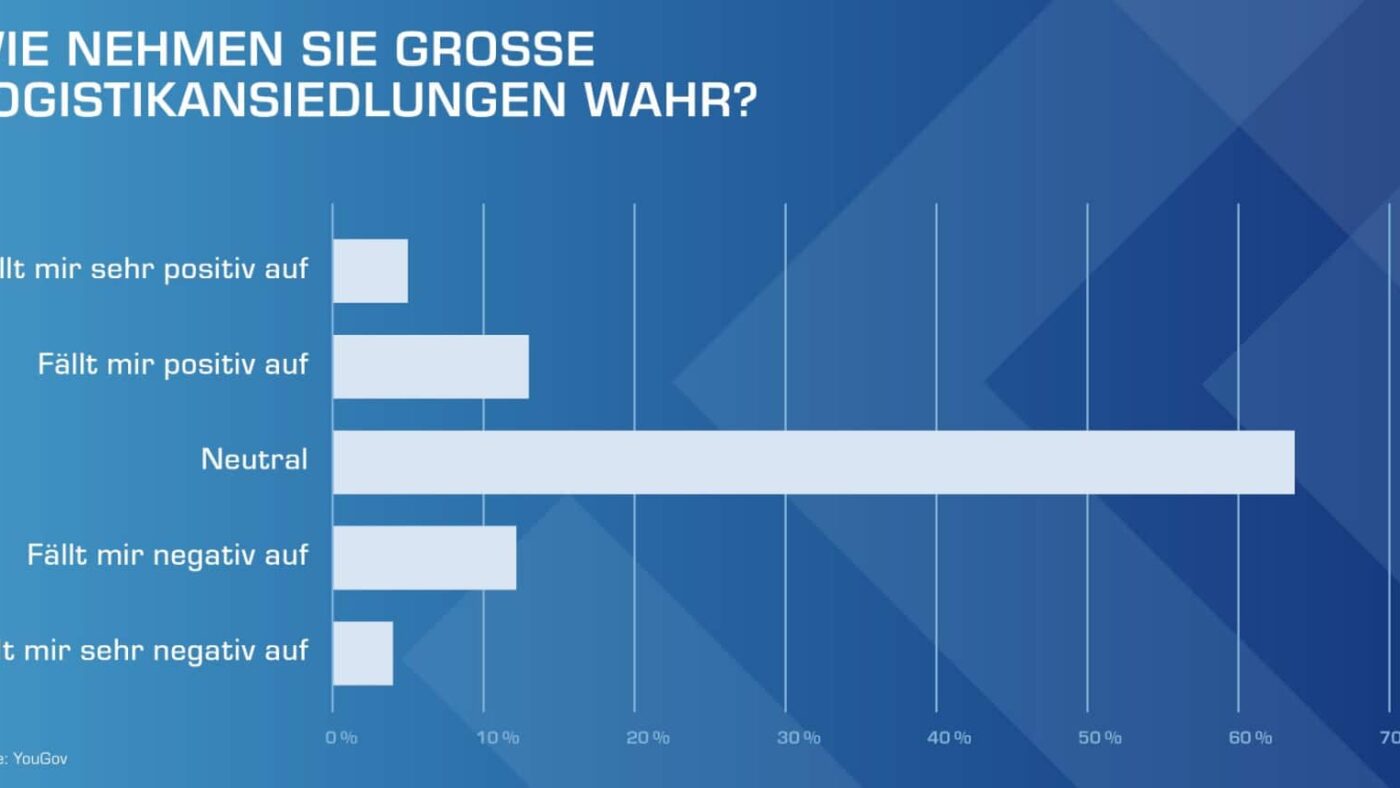
84 percent of Germans recognize the importance of supply security for the population with goods – and are not negatively inclined towards logistics developments. For the supply security of the economy, the figure is 82 percent. This is shown by a recent survey conducted by the opinion research institute YouGov on behalf of the logistics real estate advisor Logivest. For the representative survey, 2,149 people were interviewed across Germany in October 2022*.
(Munich) When asked about the relevance of supply security for the population with food and consumer goods as well as for the economy with raw materials and intermediate products, 46 percent attributed a “very high importance” to food and consumer goods, and another 28 percent a “high importance,” while ten percent at least assigned a “medium importance.” Only 14 percent took a neutral position regarding the importance of supply security – and only one percent assigned it a “low” or “very low” importance. For the supply security of the economy with raw materials and intermediate products, the figures were 34 percent (for “very high” and “high”), 14 percent (for “medium” and “neutral”), two percent (“low”), and one percent (“very low”). “Presumably, the supply bottlenecks due to the pandemic and the war in Ukraine have sensitized many people to how important supply security actually is. Many have realized that it is not a given,” says Kuno Neumeier, CEO of the Logivest Group.
In the survey, respondents were also asked about their perception of large logistics developments, warehouses, and the necessary traffic areas in their residential area and the surrounding area within their respective federal state. A clear majority of 67 percent took a neutral position. Only 18 and 15 percent had a positive or negative perception, respectively.
Surprised by the Result
“This result surprised us a bit,” admits Neumeier. “Because since we find a shortage of logistics space in many places in Germany, we regularly talk to various municipalities about the possibilities of new logistics developments. Often, a negative attitude from citizens is expected there, especially considering the size or the additional traffic volume – which apparently is not the case at all.” Thus, the survey indicates that municipalities do not have to fear an outright rejection from the population. However, Neumeier adds: “Although we wanted to exclude this with the formulation of the question, we cannot rule out a ‘NIMBY effect.'” ‘NIMBY’ stands for ‘not in my backyard’ and means that a person may not accept an infrastructure project such as the construction of new wind turbines or a railway line due to feared negative impacts directly at their own residence, even though they actually recognize the societal importance of the project.
Transparent Communication is Crucial
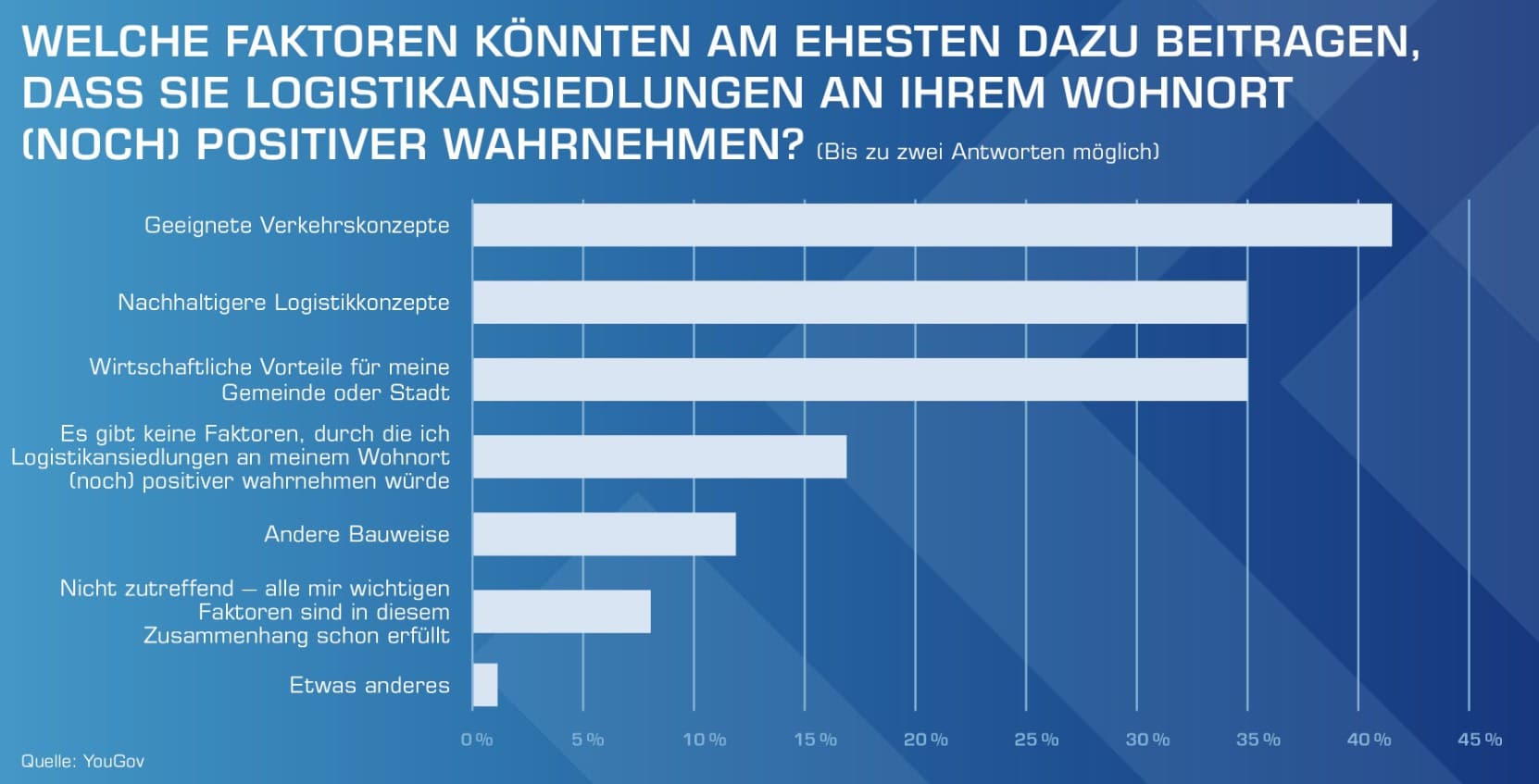
The neutral stance of the majority of the population towards logistics developments shows that for specific development projects, the individual concept and transparent communication are crucial for local acceptance. To determine which aspects play a prominent role in acceptance, respondents were asked to select factors from a list that most contribute to them perceiving logistics developments in their residential area (even more) positively. Up to two factors could be selected. At position one, with 42 percent, were suitable traffic concepts such as bypassing local and city centers as well as residential areas or creating designated overnight areas for truck drivers. 35 percent advocated for sustainable logistics concepts – for example, green logistics halls, solar and photovoltaic systems, and electric trucks. Also, 35 percent demanded economic benefits for their municipality or city. This could manifest, for example, in the provision of green electricity through photovoltaic systems on the roofs of the halls. This potential that logistics real estate can represent for municipalities and communities is also highlighted by the newly founded initiative “Power of Logistics” from the logistics real estate working group of the Federal Association of Logistics. The initiative aims to establish logistics as a provider of sustainable energy in the long term and focuses on the topics of “expansion of renewable energies” and “utilization of surplus capacities from logistics” in its activities. According to the initiative, the roof area created by logistics real estate in the past ten years alone has the potential to supply around 800,000 households with electricity from photovoltaic systems.
Only twelve percent of respondents demanded a different construction method
“The survey shows that there is indeed acceptance for logistics with good and sustainable concepts. A population that is neutral on average towards logistics real estate can be convinced with good arguments,” summarizes Neumeier and appeals to municipalities: “Do not fundamentally close yourselves off to new logistics developments – but demand concrete commitments and compromises from companies regarding traffic concepts, sustainability, economic viability, or construction methods.” In the end, everyone benefits – municipalities, logistics companies, the population, and the economy as a whole. Because supply security with goods is essential – and the population is well aware of this, as the survey confirms.
* The data used is based on an online survey conducted by YouGov Deutschland GmbH, in which 2,149 people participated between October 4 and 11, 2022. The results were weighted and are representative of the German population aged 18 and over.
Photo: © YouGov