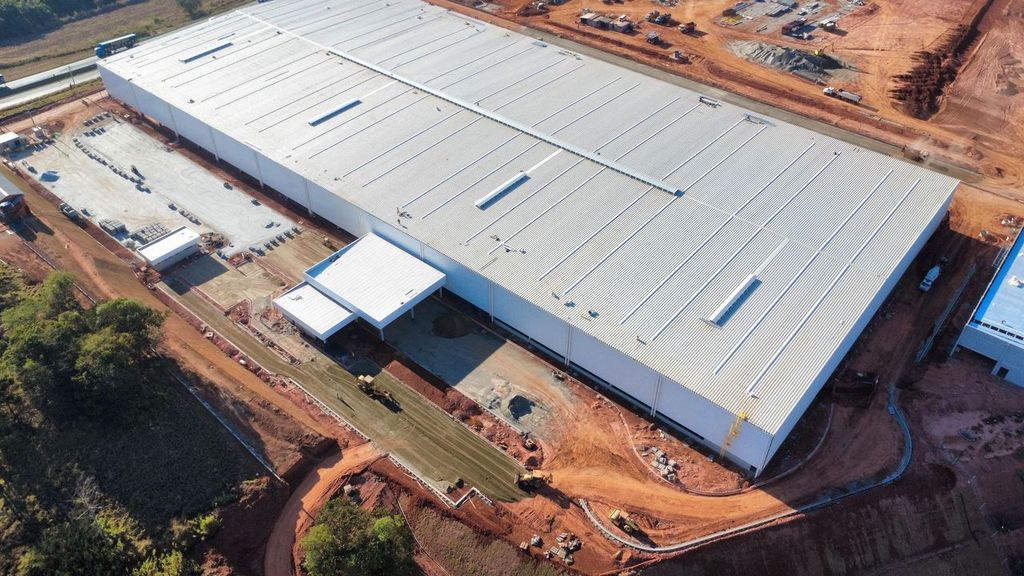
Rhenus Opens New Multi-User Warehouse in the Mumbai Metropolitan Area
6. December 2022
SSI Schäfer Automates Ostendorf’s Warehouse in Emstek
7. December 2022
Three out of four CFOs indicate that they plan to increase budgets for digital transformation projects in their departments over the coming year. The demand for qualified employees is high, and CFOs are struggling to attract new talent to their companies.
(San Francisco – USA) A new study by Tradeshift – in collaboration with CFO Dive – highlights the challenges faced by finance leaders as they grapple with an expanding role and a range of strategic tasks that were previously outside the scope of the finance department. A key finding of the study is that nearly half of CFOs (45 percent) cite talent acquisition and retention as their primary concern in 2022 and beyond. Other major concerns include rising costs of goods and services (42 percent) and the adoption of new technologies (39 percent).
Respondents largely expressed positive views about their recent technology investments. However, well over half (59 percent) admitted that they would have taken a different approach had they been able to foresee the events of recent years. This tension illustrates how CFOs are coping with the sudden evolution of their roles and responsibilities triggered by the seismic events of recent years.
“The upheavals of recent years have brought the evolution of the CFO role to the forefront. CFOs now have to deal with an ever-increasing range of strategic tasks,” says Mikkel Hippe Brun, co-founder and General Manager, Payment Automation, at Tradeshift. “Finance leaders recognize the critical role that technology must play in addressing a growing number of strategic challenges, from risk mitigation in the supply chain to ESG. They also understand that every investment in technology requires an equivalent investment in human talent capable of leveraging new technologies and extracting value from new datasets.”
Other key findings from the report include:
CFOs are struggling to juggle shifting priorities. Most CFOs (28 percent) reported spending too much time on traditional finance functions (areas such as financial management, accounting, treasury, and controlling), while 35 percent also stated that they spend too little time on talent development.
CFOs believe they have generally done an excellent job, but the transition from efficiency to value creation is crucial. Almost all CFOs (93 percent) are at least satisfied with their company’s finance function. More than a third (38 percent) rated it as excellent. Nevertheless, 49 percent of CFOs identified providing a more detailed overview of the company’s cash and liquidity, and 41 percent identified automating processes through intelligent automation as high-priority areas for new technology investments.
To future-proof the finance function, three key competencies are required. To reach the next level of value creation, CFOs expect to need financial technology expertise (59 percent), followed by data and technology knowledge (50 percent) and knowledge of corporate strategy (38 percent).
Companies are lagging in adopting the latest technologies that help their departments perform their work better and more efficiently. Only a third (35 percent) of CFOs reported that their latest technology projects have reached the implementation stage or beyond, with most still in the planning or proof-of-concept phase.
CFOs lack the necessary resources to support their teams in their work. For their teams to work better, they need better data integration (56 percent), better training (48 percent), and more modern technologies (42 percent).
The vast majority of CFOs plan to increase budgets for digital transformation projects within their departments. More than one in three respondents (36 percent) indicated that they plan to increase technology spending by more than 26 percent, with one in five CFOs reporting an increase of more than 50 percent. Only 6 percent of respondents planned to reduce their investments in new technologies.
Investments in technology are important, but … CFOs assign high priority to several technology investments but also acknowledge that their companies’ main concerns regarding the adoption of new technologies are diverse, including implementation costs (46 percent), ease of integration into an existing technical system (41 percent), and training or hiring employees who can optimally utilize the technology (38 percent).
CFOs believe their teams can tackle tomorrow’s challenges, but they lack expertise. While the vast majority (88 percent) of CFOs report being very or somewhat confident that their current team can meet evolving business demands, more than a third (37 percent) indicate that they lack internal expertise to properly analyze their financial data.
As their role evolves, CFOs will oscillate between old and new priorities to find the right balance. More information on how they are leveraging technologies to meet new challenges and elevate the finance department can be found in the full report “Building for Change: How CFOs’ Priorities Are Shifting From Efficiency to Creating Long-Term Value,” which is available for free download in English on the Tradeshift website: https://hub.tradeshift.com/research-and-reports/talent-and-tech-investment-top-the-list-of-cfo-priorities-for-the-year-ahead/
Survey Methodology
Tradeshift and CFO Dive conducted an online survey in July and August 2022 among 150 CFOs, Vice Presidents of Finance, Chief Accounting Officers, and other finance executives. Qualified survey participants were senior finance professionals in companies with a global revenue of over $100 million. The survey was conducted on the Verint Survey Platform. Demographic data is available upon request.
Photo: © Tradeshift / Image Caption: Mikkel Hippe Brun – Co-founder and General Manager, Payment Automation, at Tradeshift.