Logivest Brokers Logistics Space in Sachsenheim
Dec 20, 2022 at 4:55 PM
Bertschi Reduces Electricity Consumption at Birrfeld Terminal by 40%
Dec 20, 2022 at 5:05 PM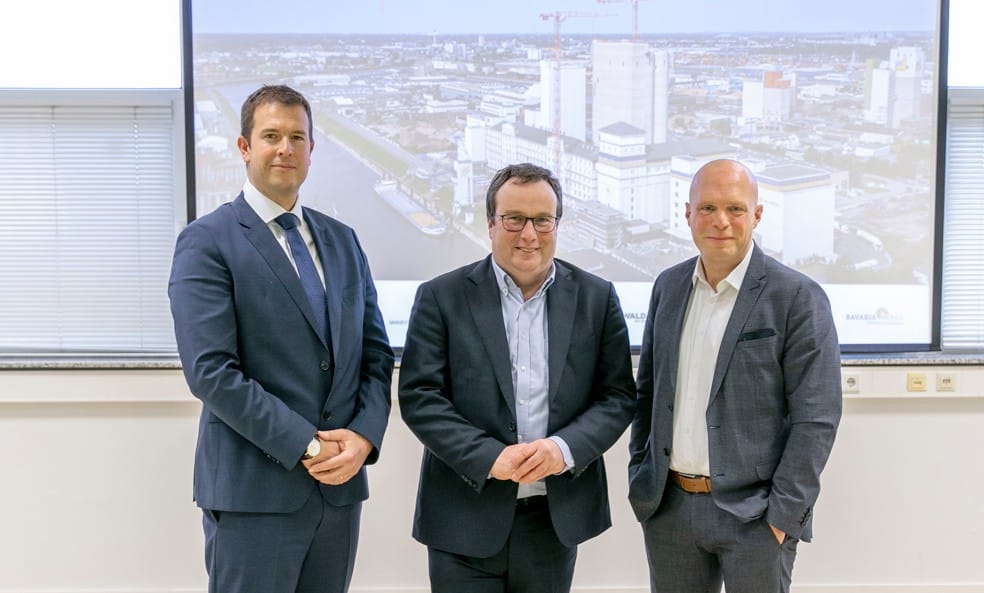
The Rhine port of Neuss, operated by RheinCargo, serves as a perfect interface for local companies. As a trimodal location, it ideally connects the modes of transport waterway, rail, and road. This is a significant reason for the Bindewald Gutting mill group to expand and modernize the local Neuss planning mill. NRW Minister for Environment, Conservation, and Transport, Oliver Krischer, personally informed himself about the forward-looking project during a site visit.
(Neuss) “By 2025, we will have invested a total of about 80 million euros in Plange GmbH. The decisive factor is that we find ideal conditions for our mill in the Neuss port,” explained Managing Director Martin Bindewald regarding his company’s commitment. He emphasized that “for Bindewald Gutting, sustainability as a concept is at the center of all thinking and actions.” To be able to perform sustainable milling, they are increasingly focusing on climate protection, regionality, and ecological production.
“I am extremely pleased about this site development. The values that Bindewald Gutting stands for are fully shared by RheinCargo. The concept of Plange GmbH proves that ports must play a significant role in the desired and necessary transformation of transport,” explained RheinCargo Managing Director Jan Sönke Eckel. He added: “The ports operated by RheinCargo in Düsseldorf, Cologne, and Neuss provide perfect conditions for shifting goods flows from road to waterway and rail.”
Since 2018, Bindewald Gutting has been consistently developing the company location in Neuss. In addition to modernizing production, a new wagon unloading facility was put into operation in 2022, allowing complete trains to be processed in short time frames. A new ship suction system and a waterside loading facility will be installed in the foreseeable future.
“North Rhine-Westphalia is the number one inland shipping region in Germany. And that is also because we have strong ports. I am convinced that we can leverage the great potential of shifting traffic to the waterways with shipping, the ports, and the involved companies,” said NRW Minister Oliver Krischer. He added: “However, a strong and efficient infrastructure is necessary for this. This also includes our ports in the state, as they are the distribution centers for a smooth logistics chain. The Neuss port is a significant logistics hub on the Rhine. I am very pleased that the port location is further strengthened through private investments for large-volume transport goods.”
Inland ports are no longer just for storage and transshipment of goods. They are rather modern freight transport centers that specialize in comprehensive logistics concepts and services to best meet the demands of the shipping economy. The example of Plangemühle and RheinCargo shows how effectively the three modes of transport – road, rail, and waterway – can be combined here for sustainable freight transport for the benefit of the environment.
Photo: © RheinCargo – Dietrich / Image caption: Minister’s visit in Neuss: Oliver Krischer (M.) exchanged ideas with Martin Bindewald (l.) and Jan Sönke Eckel about the great potential of inland ports.