Port of Kiel Achieves Positive Annual Balance Despite Volume Decline
17. January 2023
VTG Expands Its Offerings for Rail Transport in the Baltics
17. January 2023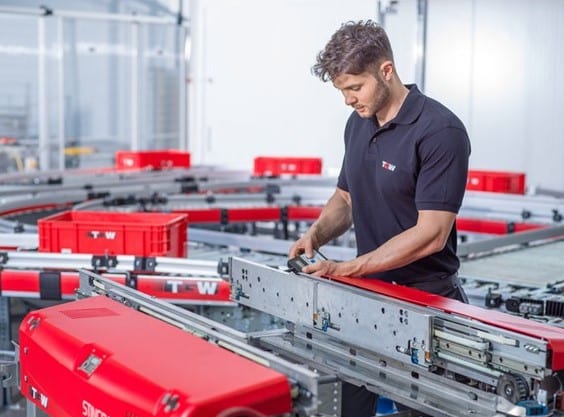
More and more companies are playing it safe by entrusting the technical management of their highly automated warehouses entirely or partially to intralogistics specialists. They have recognized that performance availability is crucial for overall success. The example of TGW Logistics Group illustrates how On-Site Services can be tailored to meet customer needs.
(Marchtrenk) This is what nightmares for supply chain managers look like: Black Friday or another promotional day is approaching, the new central warehouse is well-stocked, and just at the moment when consumers are adding offers to their virtual shopping carts, the system comes to a standstill. Nothing works anymore, troubleshooting begins. Minutes turn into hours, and the in-house technicians are at a loss. Only after meticulous analysis is the error discovered. The system is back up and running, but the damage is done: extra shifts, delayed deliveries, and disappointed consumers are the result.
On-Site Services
To ensure that supply chain managers can sleep peacefully—especially during peak seasons—manufacturers of highly automated systems offer on-site services for technical operations. Under the term On-Site Services, TGW offers a range of services: from ramp-up services to maintenance and support services to technical cleaning. 400 experienced experts ensure that distribution centers run smoothly—whether in China, Europe, or the USA.
TGW has already implemented more than 1,000 systems worldwide and has gained valuable experience not only in planning and production but also in technical operations. System operators can, of course, hire specialists themselves to ensure that the technology runs smoothly. “But even experienced professionals often lack the TGW-specific knowledge that our experts possess, as well as the ability to tap into the company’s global network,” says Georg Katzlinger-Söllradl, Director Global Lifetime Services at TGW.
Responsibility Matrix Defines Responsibilities
The crucial question is: Which service makes sense for my company? Katzlinger-Söllradl emphasizes: “There is no simple answer to this. The scope of services depends on many factors—among them size, business focus, and the knowledge of the customer.”
The basis for all decisions is a responsibility matrix. The operator decides for each listed item whether they or the external specialists are responsible. The matrix makes it transparent who bears which risk. The less risk-averse the operator is, the more services and manpower they can utilize externally. “The trend is clearly moving towards total responsibility with TGW,” says Katzlinger-Söllradl. Typically, at least two TGW experts are on-site, and for large systems, it can be 50 or more.
However the customer decides: The agreements made at the start of the project are not set in stone; the responsibility matrix can be adjusted as needed. In principle, adjustments are made to the number of tasks (quantitative) and availability (qualitative) until all wishes are fulfilled.
Consider Technical Operations Early On
Katzlinger-Söllradl advises companies to think about technical operations and on-site services already during the purchasing decision—long before the go-live of a fulfillment center: “When our experts are already on-site during the setup, they can contribute their experience to important decisions, such as the positioning of platforms and spare parts storage.” This can save hundreds of hours during operations. “Because during maintenance activities or in the event of a malfunction, long distances or poor accessibility are significant drawbacks.”
Other advantages include the knowledge that TGW employees have acquired over the years and the global network they can involve. Typically, significantly fewer external than internal employees are needed to technically manage a system. Therefore, cost efficiency in outsourcing projects is also higher. Furthermore, TGW offers a price guarantee of up to ten years—making it one of the pioneers in the industry.
Ramp-Up Service
One of the most requested services is the ramp-up service. TGW technicians act as a link between the project team and the TGW Lifetime Services organization and also take care of training the customer’s employees.
Many companies continue to rely on comprehensive service even after the ramp-up phase and leave as many risks as possible to the manufacturer. In all-inclusive packages, TGW takes responsibility for both operational maintenance and all maintenance, repair, and inspection activities. Additionally, the technicians improve operations and keep an eye on the total cost of ownership (TCO).
Computerized Maintenance Management System
An experienced team on-site is one thing; modern IT tools are another. TGW uses state-of-the-art software for both remote services and on-site services. In the area of on-site maintenance services, for example, the Computerized Maintenance Management System (CMMS) is employed—a software that ensures consistent efficiency. The tool includes forecasting, planning, and evaluation of all maintenance activities.
In addition to permanent services up to 365 days a year, temporary services can also be utilized. To prevent bottlenecks or failures during peak seasons or promotional days, TGW offers what is known as peak support. In advance of sales-promoting actions, specialists adjust several parameters. On one hand, more technicians can be dispatched; on the other hand, routine maintenance can be brought forward. With a few weeks’ notice, it is also possible to make small changes to the material flow to increase throughput, such as adding an additional pickup point for packages from the conveyor technology.
Do Not Underestimate Complexity
Over more than half a century, TGW has gained a lot of experience. One important insight is that the complexity of automated systems is often underestimated. Taking on technical management oneself often only seems to lead to cost savings at first glance. An excess of disruptions and low availability frequently contradict this approach. Consistently defining the responsibility matrix is often already a significant help that can prevent poor decisions.
Photo: © TGW Logistics Group GmbH