Has the ver.di Union Overplayed Its Hand with Deutsche Post DHL?
10. February 2023
RWE and VTG with Concept for Rail Transport of Ammonia
14. February 2023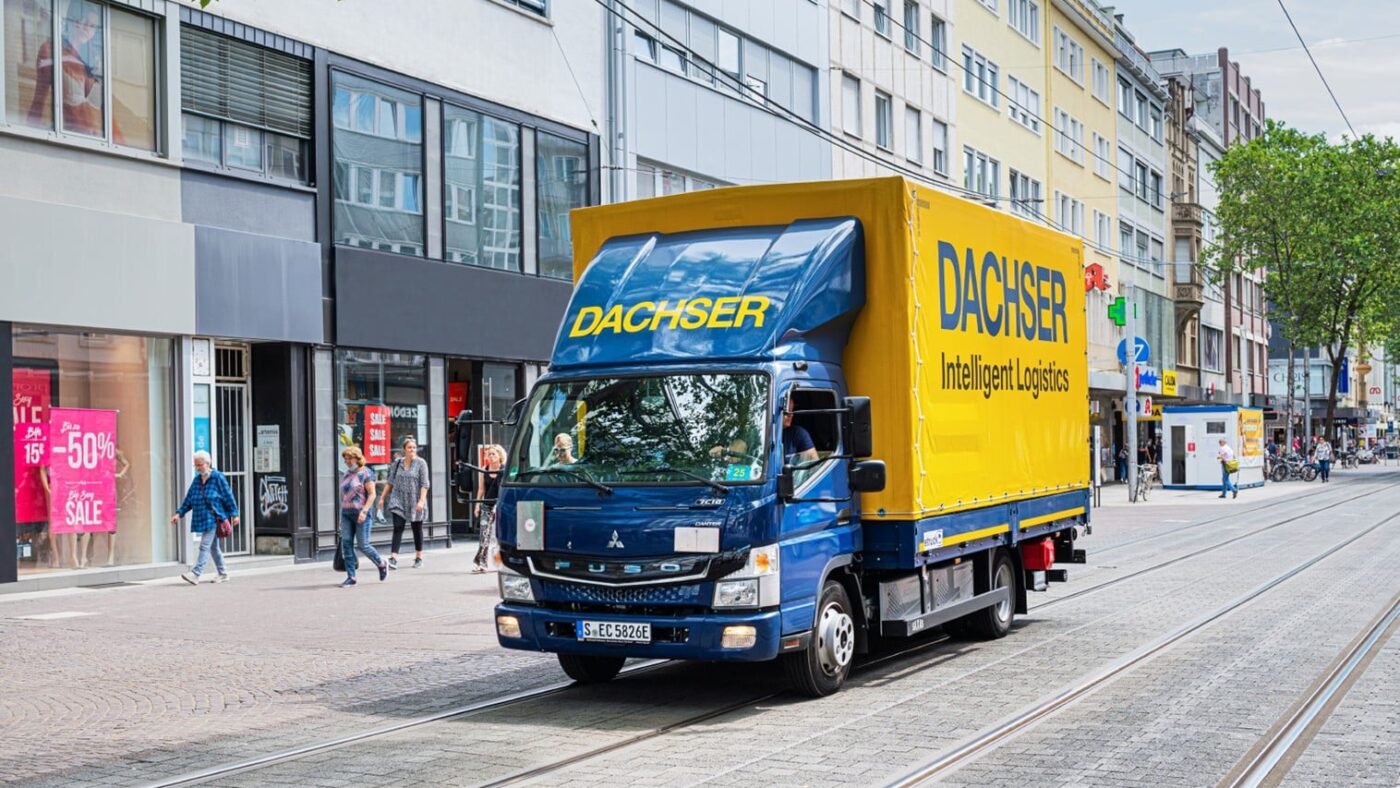
The concept “DACHSER Emission-Free Delivery,” which started as a research and innovation project, has proven to be a complete success in urban deliveries. Currently, there are already twelve locally emission-free urban delivery areas for non-perishable goods in the Dachser network. Further growth is planned: By 2025, at least ten more European major cities are to follow.
(Kempten) “With DACHSER Emission-Free Delivery, we have demonstrated that we can deliver the last mile emission-free with general cargo. The research project has made the leap into practice and points the way towards more sustainable urban logistics,” says Stefan Hohm, Chief Development Officer (CDO) at Dachser.
The emission-free delivery of non-perishable parcel and general cargo shipments currently takes place in defined delivery areas in Berlin, Freiburg, Stuttgart, Munich, Dortmund, Copenhagen, Oslo, Prague, Strasbourg, Paris, Madrid, and Porto. Zero-emission vehicles are used: Based on a modular system and tailored to local requirements, battery-electric vans and trucks as well as electrically assisted cargo bikes are deployed. The latter are specifically designed for general cargo and palletized goods weighing up to 250 kilograms. The cargo bikes start their tours from a city-center-adjacent transshipment warehouse – referred to as a “Microhub” – and travel into busy pedestrian zones. The electric trucks supply the Microhubs with goods or deliver directly to recipients when packages and pallets are unsuitable for bicycle transport due to their weight or dimensions.
Roll-out in Additional Metropolises Planned
The availability of zero-emission vehicles and corresponding charging infrastructure is a crucial factor in the introduction of the city logistics concept.
“The production capacities at vehicle manufacturers have been significantly ramped up, so we can expect better availability of electric trucks in the future,” says Alexander Tonn, Chief Operations Officer Road Logistics at Dachser. “We are therefore planning with at least ten more cities by 2025, responding to the wishes of many customers.”
The focus is primarily on European metropolitan regions with at least one million inhabitants, where Dachser is represented with its own branches of the European Logistics business unit.
Positive Effects for the Environment and Drivers
With locally emission-free urban deliveries, Dachser contributes to the efforts of city administrations for better air quality and less traffic-related noise. The battery-electric trucks and cargo bikes produce no air pollutant emissions on-site, making a significant contribution to air purification. In conjunction with Dachser’s exclusive use of renewable energy, operational greenhouse gas emissions for the last mile from the branch to the recipient are reduced to zero. Additionally, noise emissions from diesel engines are significantly reduced, and the use of cargo bikes lowers the traffic burden from trucks. Truck drivers also benefit from the battery-electric vehicles, as the vibrations from the engine that are usually felt in the cab are absent.
Part of the Long-Term Climate Protection Strategy
DACHSER Emission-Free Delivery was developed together with the Kornwestheim branch and was first introduced in the city of Stuttgart. In December 2018, Dachser won the award for Sustainable Urban Logistics from the German Federal Ministry for the Environment and the Federal Environment Agency for the concept and pilot implementation.
The concept is fundamentally suitable for all European cities thanks to the modular system. This prepares Dachser optimally for the existing or planned entry bans for combustion engines in larger metropolises. Overall, DACHSER Emission-Free Delivery contributes to the long-term climate protection strategy of the company based in Kempten/Allgäu. In the interest of sustainable business development and with a focus on efficiency, innovation, and inclusive responsibility, the family-owned company is driving the transition towards more sustainable logistics together with customers and partners.
Photo: © Dachser