






HARDER Logistics Expands Location in Neu-Ulm
14. February 2023
New Managing Director at TX Logistik Transalpine GmbH
16. February 2023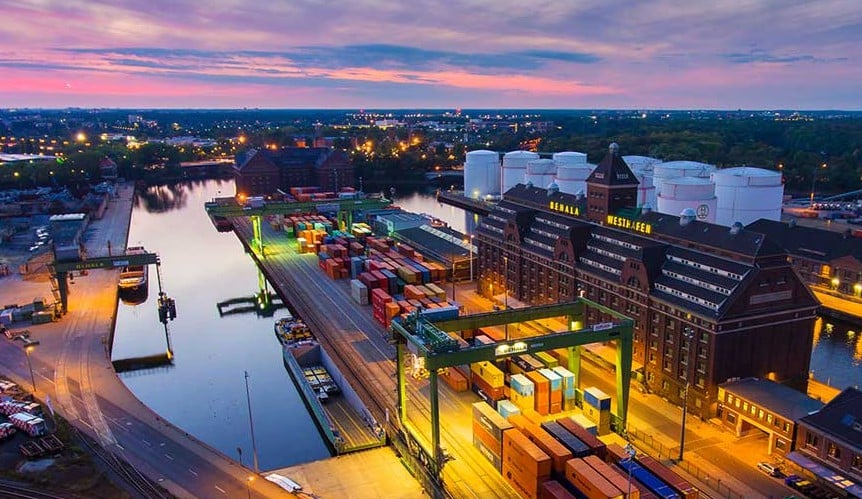
After a Logivest study already identified the shortage of space in ports as a challenge for the expansion of trimodal and sustainable logistics in spring 2022, the logistics real estate consultant has now published a comprehensive research paper on the topic “Development of Logistics Properties in German Ports.”
(Munich) Of the approximately 650 ports in Germany, according to the Federal Waterways and Shipping Administration, about 180 logistics-oriented ports have bi- or multimodal transshipment options and an increased new construction volume of logistics properties. Based on the new construction monitoring presented in the annual Logivest Logistics Real Estate Seismograph, the logistics-oriented ports were identified using a specially developed methodology, and those properties that were newly constructed between 2017 and 2021 within the ports and within a radius of one kilometer around the ports were mapped. “This gives us a very good data basis on the areas in the logistics-oriented ports. Data like this is the foundation for informed location analyses and consulting,” says Markus Seidle, Head of Research at Logivest. From 2017 to 2021, approximately 1.2 million square meters of new construction space were developed within the port areas – just a fraction of the nearly 26 million square meters of logistics new construction space developed nationwide during the same period. On average, nearly 240,000 square meters were developed annually within the ports – and about 415,000 square meters when the examined area is expanded to a radius of one kilometer around the ports.
Demands on Port Logistics Properties Have Changed
“Ports have become a sought-after location for logistics property users who want to take advantage of not only the logistical shipping traffic but primarily the other location advantages. Therefore, larger and more modern logistics properties are usually built today than before, which also exhibit a very high third-party usability,” says Kuno Neumeier, CEO of the Logivest Group. The average size of today’s logistics properties within the port areas in Germany is approximately 15,000 square meters (built between 2017 and 2021). Among other things, due to the increased space requirements for logistics properties over time, a logistics property built in 1980 usually no longer meets today’s standards. It must therefore be modernized accordingly and adapted to the new tenant clientele, or make way for a new, contemporary property. “But often the available space in the ports is very limited,” says Neumeier.
Ways Out of the Space Shortage: Land Reclamation, Revitalization, and Multi-Level
One possible approach to address the space shortage is to reclaim unused water areas within the ports. For example, completely new port areas were created at the JadeWeserPort in Wilhelmshaven over nearly 20 years. Approximately 290 hectares of port and logistics land were reclaimed in the former harbor basin, thus creating new space for logistics. Another way to create new development areas is through the revitalization of brownfields. This involves demolishing outdated buildings to subsequently develop a new property on the freed-up space. Thus, brownfield development offers the opportunity to create ecologically sustainable projects without having to seal green spaces. Industrial wastelands can thus become modern and efficient logistics hubs.
An example of this is the “LogPort Duisburg VI” in the Duisburg district of Walsum, where properties in the port were demolished and new logistics halls were established. Multi-level concepts are another variant of efficient land use. Their advantage lies in the fact that the usable area exceeds the mere footprint of a property and that servicing can occur on all levels. However, the implementation of such multi-level concepts is usually associated with higher construction costs. An example of a successful establishment is the Mach 2 project by Four Parx in the Port of Hamburg: There, the project developer chose a two-story construction method to create more usable space and thus address the space shortage. Multi-story projects will primarily be implemented first in urban areas where the demand for space is already very high and the availability of space is very low.
The entire paper is available for free download on the Logivest website:
https://www.logivest.de/researchpaper-hafenlogistik
Photo: © Logivest


