Post Kicks Off Emission-Free Delivery in Innsbruck
Feb 16, 2023 at 4:55 PM
inTime Relies on Newtron for Process Optimization
Feb 18, 2023 at 5:12 PM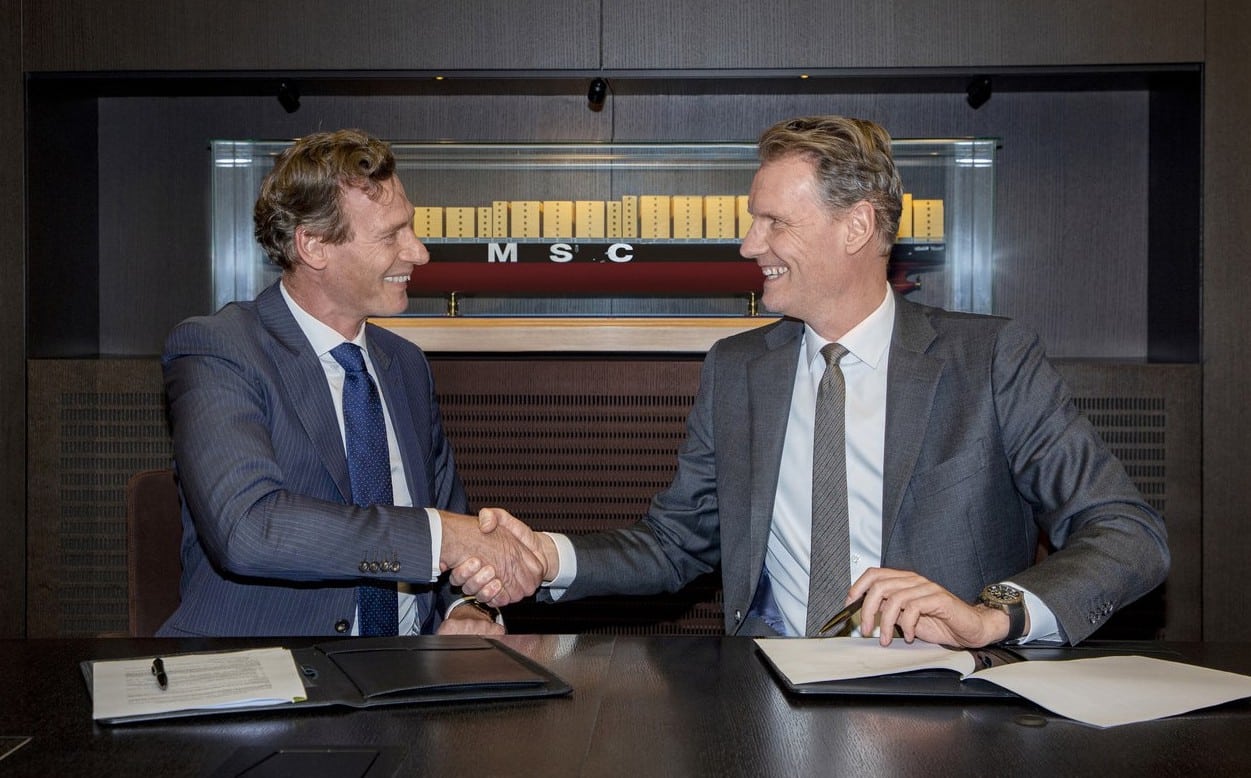
DB Schenker significantly expands its offerings in green sea freight. Together with the shipping company MSC, an agreement has now been reached for the use of 12,000 tons of biofuel. Whether LCL shipments (Less-than-Container Load), FCL containers (Full Container Load), or refrigerated containers (Reefer): All sea freight offers from DB Schenker on MSC ships can now also be booked CO2-neutral.
(Essen/Geneva) The amount of biofuel purchased is sufficient to save pollutants equivalent to approximately 35,000 tons of CO2 equivalents (CO2e) along the entire production chain (well-to-wake) additionally in the market. Depending on the type of fuel used, around 30,000 standard containers (TEU) can be shipped net CO2-free.
The agreement between DB Schenker and MSC is one of the most comprehensive agreements to date between a freight forwarder and a shipping company to use biofuel from used cooking fats instead of conventional fossil-based ship fuel.
The 12,000 tons of green fuel will be blended into the ships’ fuel at 20-30%, providing a total of around 50,000 tons of biofuel mixture available for MSC’s container ships. This allows DB Schenker to offer its customers a standardized product that enables net emission-free transport even by sea.
Customers Receive Certificate for Their Climate Balance
The new partnership underscores DB Schenker’s commitment to lead the transformation towards green logistics. Once again, a contribution is being made to increase the demand for alternative fuels in the industry. Similar to the CO2-neutral freight flights with sustainable aviation fuel (SAF), customers can now also book CO2-free sea transports. Through the purchased emission reduction, they will receive an annual certificate for their climate balance.
Thorsten Meincke, Board Member for Air and Sea Freight at DB Schenker: “Together with MSC, we offer our customers a simple and clean solution that allows them to measurably reduce their emissions thanks to second-generation biofuel. We do this out of conviction and therefore take the lead in purchasing maritime fuel. Because one thing is certain: the more customers demand climate neutrality throughout the supply chain, the faster we will achieve clean container sea freight.”
Caroline Becquart, Senior Vice President of MSC: “The decarbonization of sea freight cannot be achieved by a single player but requires collaboration between shipping and logistics companies and their customers. MSC Biofuel Solution is our first certified CO2 insetting program that reduces emissions in our customers’ supply chains. This accelerates the energy transition by increasing the demand for CO2-neutral shipping and enabling direct CO2 savings. We are very pleased about the partnership with DB Schenker, as we share the common climate goal of achieving net-zero.”
Biofuel can be used in regular sea freight and fed into the tanks without the need for technical adjustments to the ship or along the supply chain. Its ease of use makes it a particularly practical and immediately applicable solution. The MSC Biofuel Solution is designed as a mutually beneficial approach to make the ambition a reality: MSC bunkers sustainable biofuel, and customers benefit from the CO2 savings by passing them along the entire value chain of shipping. This distinguishes the program from climate protection initiatives that focus on future emission reductions outside of sea freight.
Biofuels in Sea Freight:
Biofuel is considered a particularly suitable transitional fuel for decarbonization due to its high quality (according to EU RED II Annex IX, Parts A+B) and the additionality principle. The additionality principle states that every ton of biofuel is produced “additionally” to the baseline values. This represents an additional reduction of emissions in the overall climate balance and a real avoidance of fossil fuels.
The entire control chain for the CO2 insetting process is independently verified. The CO2 savings confirmed by external certification organizations demonstrate the avoided emissions from the CO2 footprint of freight transport. A sustainability certificate for the biofuel is also issued by the bunker supplier.
Second-generation biofuel ensures a reduction of CO2e emissions by at least 80% (well-to-wake). For DB Schenker’s sea transports, it is also guaranteed to be free from palm oil and palm oil waste and does not contribute to land-use change (ILUC).
To reduce the emissions of container transport by 100%, the fuel demand is ensured through an over-allocation. The additional quantities also compensate for the emissions generated during the production and transport of the fuel. This allows DB Schenker to achieve a net-zero emission overall and completely avoid fossil fuels in sea freight.
Photo: © MSC – Oliver O’Hanlon / Image caption: Thorsten Meincke (Global Board Member DB Schenker) and Soren Toft (CEO MSC) at the signing in Geneva.