Ostendorf Plastics Digitizes Logistics Processes with e.bootis
20. July 2023
Book ‘The Reinvention of Logistics’ by Peter H. Voss
20. July 2023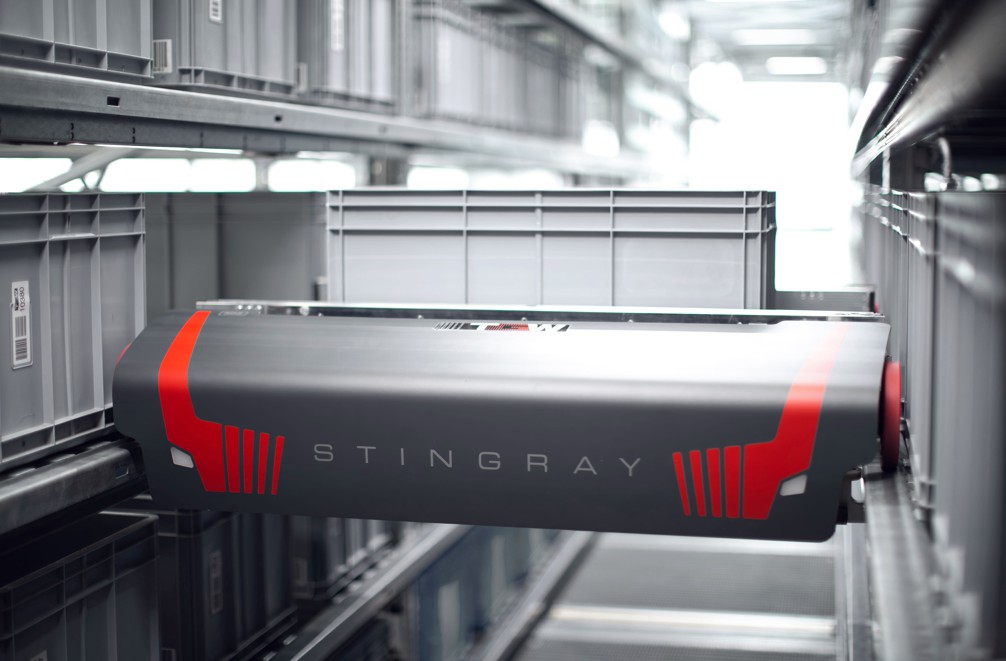
The Stingray Shuttle is the efficient all-rounder for transporting containers, boxes, trays, and hanging goods. More than 20,000 shuttles are in operation worldwide, proving their reliability day after day. With the next generation, the focus is increasingly on robustness and sustainability – including covers made of wood. Thanks to the renewable raw material from local production, 25 tons of plastic can be saved per year.
(Marchtrenk) As part of the Goods-to-Person system FlashPick®, shuttles play a central role, as do many other TGW solutions. They transport both containers and boxes as well as trays weighing up to 50 kilograms. The Stingray HG (Hanging Garment) is a special variant designed for transporting hanging goods (e.g., clothes, coats, or suits) on hangers.
Its particular strength lies in the high or highest performance range: whether in order picking or order consolidation, whether in normal, refrigerated, or deep-freeze environments. Capacity-driven applications with lower performance requirements can also be efficiently covered through partial loading.
Ten Percent Higher Performance for the Overall System
With a throughput of more than 1,500 load carriers per hour, the latest generation shuttle is the most powerful shuttle in the world: Its performance is ten percent higher than that of its predecessor. The individual Stingray vehicles travel at a top speed of 5 m/s, which is 20 percent faster.
“The latest generation Stingray combines high performance and robustness with energy-saving operation and sustainable materials,” describes Thomas Gruber-Blanka, Director of Product Management at TGW. “Users benefit from an extremely short commissioning time thanks to the plug-and-play concept. Full data transparency also enables condition monitoring and predictive maintenance: both help to optimally plan maintenance and increase availability.”
The shuttles also autonomously perform automatic ‘health checks’, detect misaligned containers, and resolve the situation without human intervention. In total, manual interventions can be reduced by 90 percent, and maintenance effort decreases by 75 percent.
Energy-Saving Function as a Standard Feature
Since shuttles accelerate and decelerate hundreds of times daily during loading and unloading, the energy-saving potential in this area is particularly large. The Stingrays store braking energy in supercapacitors and subsequently make it available to all vehicles on a level for acceleration. Shuttle and container lifters are also equipped with a recuperation function as standard, feeding back unused energy into the power grid. Additionally, the dynamic parameters can be flexibly adjusted depending on the order situation.
Photo: © TGW