AM Logistic Automates Warehouse of Meyer & Meyer in Peine
17. August 2023
Gebrüder Weiss becomes a sponsor of SpVgg Bayreuth
17. August 2023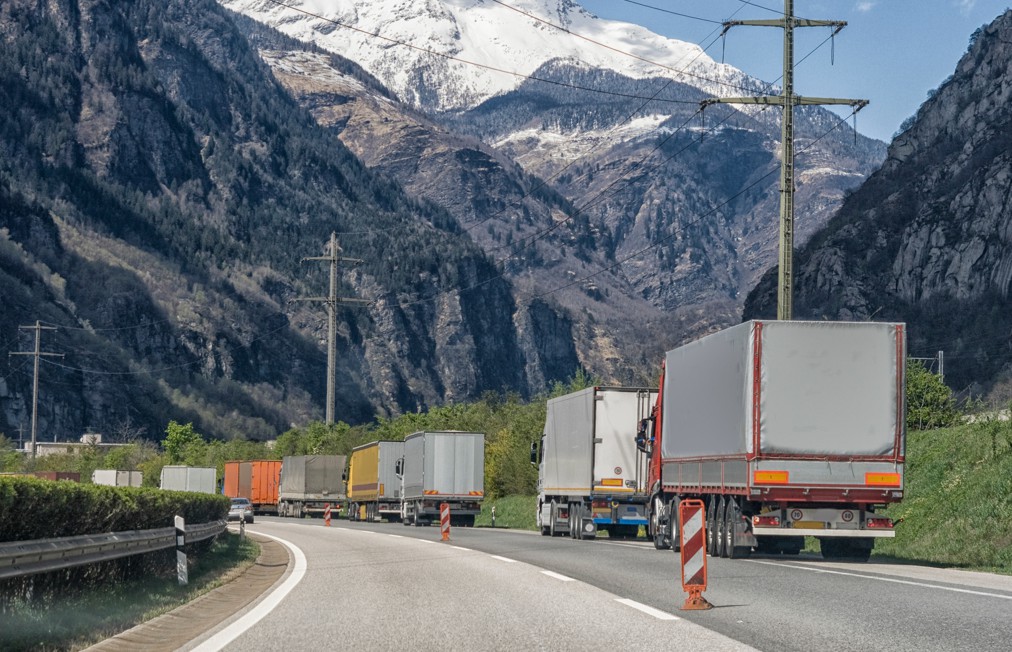
Despite a difficult economic situation with declining economic activity, the federal government plans to increase the LSVA by 2024. A price adjustment of 5 percent is planned across all tariff categories. Additional cost drivers, primarily the enormous shortage of skilled workers, will also contribute to this. As a result, the Swiss Commercial Vehicle Association ASTAG expects an increase in cost burden of 2 to 3 percent.
(Bern) The cost burden in the Swiss road transport industry has continued to rise this year. The outlook for 2024 is also less than favorable. Economic activity is developing less dynamically, and expenses for energy, personnel, and vehicles will – driven by inflation – rise again.
The Swiss Commercial Vehicle Association ASTAG therefore explicitly opposes an increase in the performance-dependent heavy vehicle charge LSVA as of January 1, 2024, as planned by the federal government. A 5 percent adjustment for inflation is apparently under discussion – which would lead to thousands of francs in additional costs per vehicle per year. The logical consequence would be that freight prices would rise at the expense of industry and commerce. It cannot and must not be the responsibility of the industry to bear state-induced cost increases themselves. Rather, there needs to be a consistent passing on of all additional expenses to customers. For ASTAG Central President Thierry Burkart, it is clear: “Quality, reliability, and flexibility come at a price – and it will only get more expensive if the federal government wants more money!”
Higher Overall Burden Due to Numerous Cost Factors
Overall, ASTAG expects a cost increase of 2 to 3 percent for next year. It is becoming increasingly evident that there is a lack of suitable skilled workers. Recruitment is becoming more difficult, the wage level and thus personnel costs are generally rising, both for drivers and for office staff (dispatch, administration, IT, etc.). Additionally, there is enormous dynamism in the transport sector: customer requirements are increasing, as is political pressure in the environmental and climate sectors. The result is high and recurring investments in new IT systems, modern vehicles, and solutions for “Green Logistics” – which also drives up costs.
The main factors that significantly increase costs are thus:
- Increase in personnel costs due to rising living costs;
- Rising expenses for personnel retention and recruitment;
- Increasing energy prices in the building sector (electricity, water, heating);
- Rising costs for vehicles, superstructures, spare parts, maintenance, and upkeep;
- Increasing requirements in the IT sector (security, data solutions, etc.);
- Rising interest rates;
- Increasing costs for politically desired solutions for “Green Logistics”.
Costs Due to Traffic Jams and Congestion Not Considered
As the experience of recent years shows, transport prices are likely to change in the same order of magnitude. For nationwide freight and long-distance transport, ASTAG estimates an increase of 2 to 3 percent. Not taken into account are the additional costs arising from traffic jams and congestion across the entire road network, as well as diesel costs, which are typically billed separately in most cases. The specific increases, depending on the transport sector, company, and self-costs, must in any case be negotiated individually with customers.
Photo: © Loginfo24