







Jens Schmale Appointed CEO of Swisslog
3. October 2023
Webfleet with Guide to Transitioning to E-Mobility
5. October 2023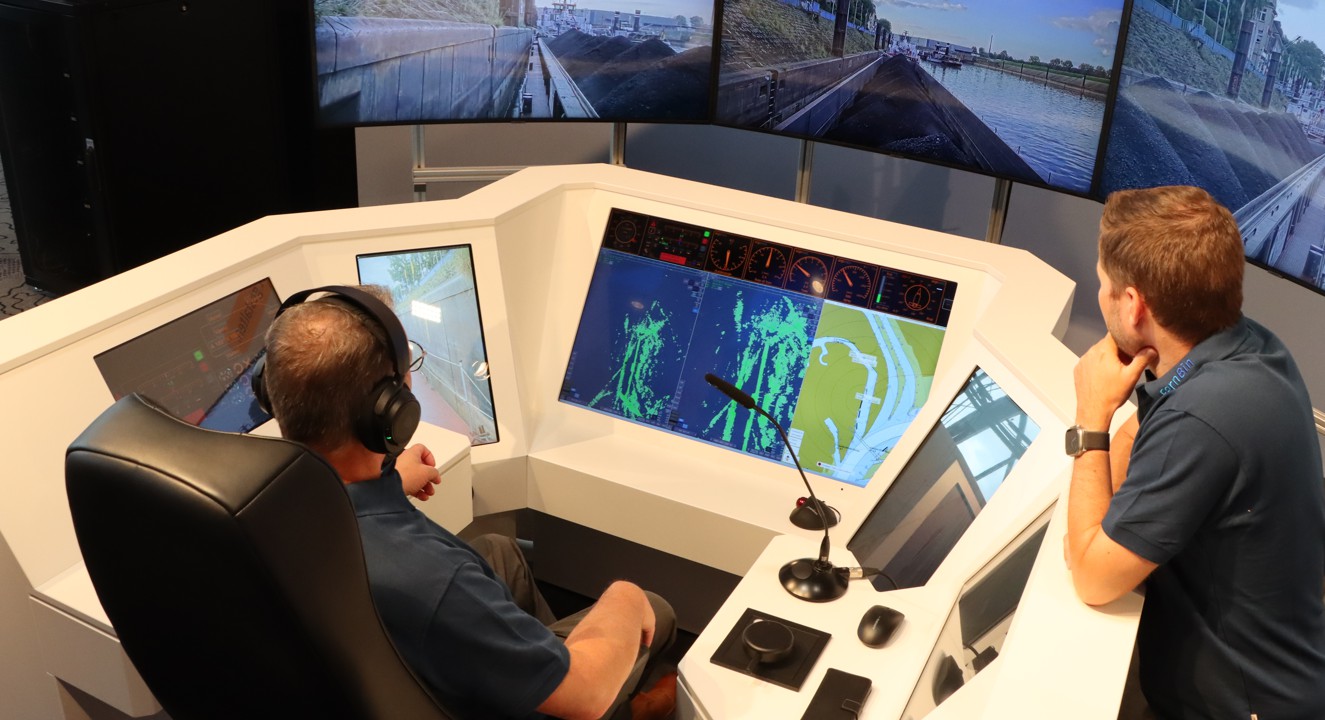
Together with several project partners, including Argonics, DST, the University of Duisburg-Essen, and RWTH Aachen, Rhenus PartnerShip launched the research project “FernBin” in 2020. The goal: comprehensive inland shipping via remote control. The project group chose the nearly 50-year-old inland vessel Ernst Kramer as the test object. At the National Maritime Conference (NMK), Rhenus presented the remote-controlled ship to a wide audience for the first time.
With a length of 104.97 meters, a width of 9.50 meters, and a maximum draft of 3.15 meters, the inland vessel Ernst Kramer is designed for a payload of 2,273.645 tons. To access the main engine, rudder, bow thruster, radio, and radar equipment remotely via mobile communication, the project team restructured some analog processes during the project. After initial test runs in July of this year, Rhenus now presented the extraordinary project at the 13th National Maritime Conference, the central event of the federal government to strengthen the maritime economy.
At the FernBin booth in the conference center, the audience could witness the possibilities of remote-controlled inland shipping: From the control station at the Bremen fair, ship captains Bernhard Büche and Herbert Berger navigated the inland vessel Ernst Kramer via remote control. Through a live connection, visitors could follow on both days of the fair how the ship navigated the Duisburg port and the mouth of the Ruhr – all remotely controlled. To ensure that the ship captain has a clear view of the situation on-site, he can access all navigation data from the sensor systems and cameras via mobile communication from the control station. “From a distance, all functions necessary for navigation must be controllable. So far, these include the speed of the main engine, the transmission including clutch, the rudder position, as well as the transmission and adjustment of the radar image and the radar pilot,” explains Lars Reckers, Technical Inspector at Rhenus Ship Management. During the test runs, project participants identify which transmitted functions need refinement or expansion depending on the scenario. “We also need to look at which areas allow remote control during navigation and where mobile reception poses problems,” says Lars Reckers. Therefore, an important step in the project is obtaining official approval for comprehensive test runs.
Pioneering for the Profession
The prototype of the remote-controlled inland vessel is not only a technical achievement but also offers significant advantages for the entire profession in the long term. “Inland shipping is also affected by the shortage of skilled workers. With remote control, it would be conceivable to offer some ship captains the option of working from home, thus making the profession more family-friendly,” says Lars Reckers. Furthermore, the use of remote control could lead to longer operating hours for the ships: While the crew takes their rest periods, the ship could continue to operate from the remote control station. The research project “FernBin” will continue until the end of this year, with participants aiming for a three-month extension.
Technical Data of the Inland Vessel Ernst Kramer:
- Year of Construction: 1974
- Dimensions: Length: 104.97 meters, Width: 9.50 meters, Depth: maximum 3.15 meters, Depth empty: 0.731 meters
- Payload: 2,273.645 tons
- Cargo Space Interior Dimensions: 78 meters x 7.36 meters
- Main Engine: Mitsubishi Heavy S16R-MPTA, 1170 kW 1600 rpm
Photo: © Rhenus / Caption: Herbert Berger (Managing Director of Rhenus Ship Management GmbH) controls the inland vessel Ernst Kramer


