Cargo Trans Logistik (CTL) Strengthens Activities in Spain with SEITRANS
11. December 2023
Galenica and Planzer Establish Joint Venture Health Supply AG
14. December 2023
Since the years 2020-2022 were turbulent but also very profitable for the global economy, and especially for the logistics industry, one could almost speak of a “normal” year in 2023. However, the issues from the aforementioned period persisted, and with the toll increase effective December 1, 2023, a new challenge arose, particularly for Germany, the effects of which will extend to the entire industry in Europe, and whose consequences can only be anticipated from spring 2024 onwards.
By: Andreas Müller
(Basel) In the logistics industry, many aspects have “normalized” or, to put it more mildly, calmed down compared to the Corona years 2020-2022. The pressure on supply chains has eased and has largely returned to pre-Corona levels. While people have not yet gotten used to the energy prices resulting from Russia’s invasion of Ukraine, they have learned to cope with them.
For road transport in Europe, the toll increase in Germany brings a price spiral whose consequences are still unpredictable. Since Germany is also an important transit country, this affects all of Europe.
In summary, here are some important events and facts from the year 2023:
General
Sustainability remains a permanent topic and will not quickly disappear from the requirements for logistics. However, it is becoming increasingly difficult to stand out from the competition, as it is simply expected, whether it is sometimes a “sham fight” or not. The acquisition of an electric truck is still exciting, but it no longer throws anyone off track. Solar panels on the roofs of logistics facilities (both new and existing) are also the norm. The industry has addressed its tasks regarding the replacement of fossil fuels, but it relies on third parties.
The German Railway remained in the headlines in 2023. The numbers do not add up, and now towards the end of the year, it has also been revealed that a profit drop at the subsidiary DB Schenker makes the already negative results even worse. The intention to sell DB Schenker, announced at the end of September, is not to be shaken. Just recently, it was reported that the board of Deutsche Bahn approved bonuses of 5 million euros for 2022. An outrageous decision at an inopportune time. One may rightly ask who approves such things?
The shortage of skilled workers, especially in the area of driving personnel, is still considered a major problem, although by the end of the year, there are again people who cannot immediately find a job in the logistics industry.
Automation, artificial intelligence, and robotics are gaining momentum in the industry. The frontrunner is intralogistics, where progress is rapid. Many innovative companies have emerged, and even established market leaders are not standing still, resulting in enormous dynamism. In other areas, it is primarily booking platforms that are driving digitalization. The core business of transporting goods from A to B cannot yet be easily automated. Autonomous driving is still lagging behind. However, dispatch tools are becoming increasingly intelligent.
Many believe that the logistics industry cannot make anyone rich with its margins. Klaus-Michael Kühne of Kühne+Nagel would disagree, as he was named the richest resident in the not-so-poor Switzerland in April. Of course, he does not earn his money solely from pure logistics.
The transport logistic, the “mother of all logistics fairs,” was able to take place this year after a four-year break and has lost none of its popularity. The four days of the fair in Munich were full of inspiration and networking, as if Corona had never happened.
Intralogistics
Automation in intralogistics is not merely a phenomenon resulting from the introduction of online commerce, which was further accelerated by Corona. No, the first automated internal transports (automated guided vehicles AGVs) celebrated their 70th anniversary this year, dating back to 1953, developed by Barrett Vehicle Systems. They were first applied in the USA, of course.
Nevertheless, developments are progressing at a rapid pace. Storage, warehousing, and order picking are becoming increasingly digital and intelligent. More throughput in smaller areas is no longer just a wishful thinking. Even containers are becoming smarter, and more and more reusable containers are leaving warehouses and being used for transport.
The leading trade fair for intralogistics in Stuttgart, LogiMAT, recorded a new participation record among exhibitors and visitors.
 Intralogistics is becoming increasingly digital
CEP
City logistics and the last mile remained a permanent topic in the past year. More and more innovations and attempts to optimize this last part of the supply chain were presented. Algorithms are expected to help improve this area even further. However, it also becomes evident, due to the failure or insolvency of individual companies, that focusing solely on last-mile delivery is a tough business and financially difficult to make successful.
In Germany, another sword of Damocles hangs over the CEP industry, namely the ban on subcontractors. This was initiated by the union ver.di and brought into politics. Although signs are increasing that such a ban has little chance in politics, the issue is not yet resolved. The next year will bring a decision.
 A possible subcontractor ban remains an uncertainty factor for the CEP industry
Air Freight
After a brief surge at the beginning of the pandemic, when disinfectants, masks, protective suits, etc. had to be urgently transported by air, this market segment quickly calmed down again. The challenges remain the same as in 2022, such as higher energy costs and the search for sustainable solutions in aviation as well.
Rail Freight Transport
The development of freight transport by rail is not progressing. Not a single kilometer of track was built in Germany in 2023 (Source: DIE GÜTERBAHNEN). The doubling of the toll does not help, especially not in the short term. Rail projects, if the approval and construction phase has not yet begun, take 30 years or longer.
Moreover, freight transport is also influenced by external factors. During storms, freight transport is the first to come to a halt. However, other countries are much better prepared for weather disruptions than Deutsche Bahn.
Strikes are also a recurring issue, especially currently with the GDL union. They plan to really get started in January.
But freight railways in other countries are also fighting for market shares and generally report massive red figures, as is the case in Switzerland.
A new report indicates that Italy has terminated its contract with China regarding the new Silk Road. There are concerns about dependencies. However, it was emphasized that this does not mean the end of relations with China, just not through entrenched contracts, the implications of which many other countries in the Caucasus and Eastern Europe do not consider (or have no choice) and continue to adhere to the project with China.
Sea Freight
 In sea freight, “business as usual” has returned.
In sea freight, “business as usual” has returned this year. Gone are the days when prices per 40′ container for a crossing from Asia to Europe were in the five-digit range.
As early as August, the daily passage through the Panama Canal was reduced from 36 to 32 ships. On November 1, 2023, another limitation to 25 ships per day was implemented, representing a capacity reduction of more than 30 percent. The renewed restrictions lead to increased congestion and extended transit times. However, this has less impact on Europe than an event in the Suez Canal.
One danger zone remains the Suez Canal. Not necessarily due to a repeat of an accident like with the EVER GIVEN, but due to impending attacks while passing through the Gulf of Aden. While pirates from Somalia have been a danger to passing ships, on the other side of the gulf, the Houthi rebels in Yemen have discovered this type of terror for themselves. Eritrea is also a constant source of unrest.
Road Transport
The scandal of the year comes from road transport. With the nearly doubling of the toll in Germany, the cost spiral is heating up again and dragging other countries in Europe along, as Germany is not least the most important transit country in Europe. The aim is to promote the transition to electric trucks and/or shift goods to rail. In both cases, however, we are still far from being able to provide even a partial compensation for transport with combustion trucks. From this perspective, many are talking about a hidden tax increase.
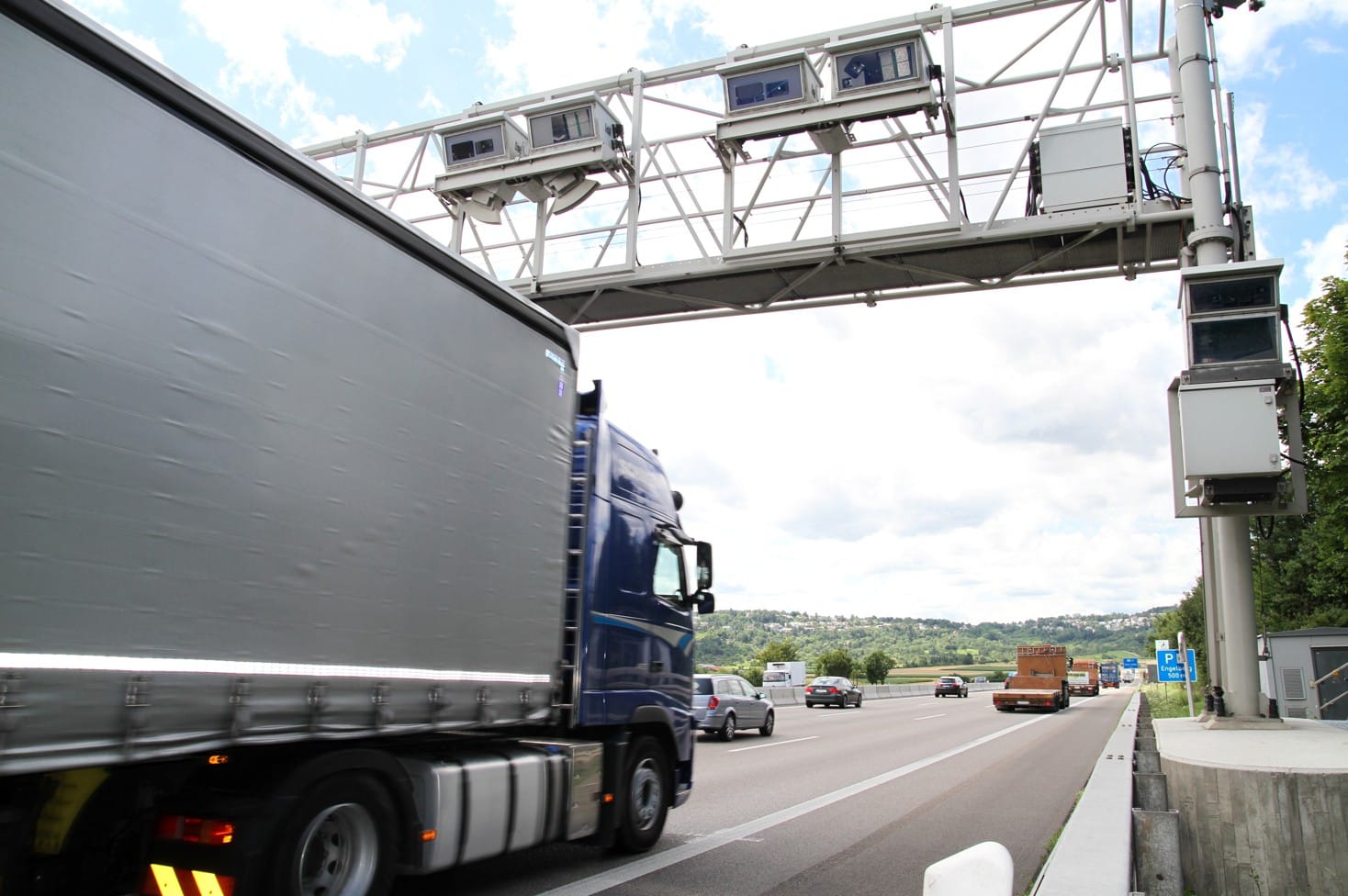 The toll increase that came into effect on December 1 will continue to occupy transporters in the new year
Even though e-mobility cannot yet replace combustion engines, as the required quantities of vehicles cannot be produced in the short term, developments are progressing rapidly. There is also significant progress in charging infrastructure (pun intended…). E-mobility is most active in local transport, particularly in urban deliveries. The big question remains the power supply. Will it keep pace with the constantly increasing demand?
Outlook for 2024
As harsh as it sounds; with the war in Ukraine, a certain arrangement has been made. Energy prices have recovered somewhat. The war in Israel in the Gaza Strip shakes the world, but has only a minor impact on the economy, which does not exclude the possibility that energy companies will use this as an excuse for a price increase. However, an end to this conflict is in sight.
The stock markets are proving surprisingly stable, which is always a sign that there is belief in a good economic development.
It remains to be seen how the toll increase in Germany will affect the economy in Germany and thus at least in Europe.
From this perspective, 2024 could be a year of consolidation, barring unforeseen events. The controversies of the last four years are over or have subsided. However, it still seems too early for a rapid upswing. It will remain a year of further development in sustainability and digitalization.
Title image: © Deutsche Bahn
Other photos: © Loginfo24