Arvato Deploys More Robots from Nomagic in Dortmund
25. January 2024
Christa Hostettler appointed Director of the Swiss Federal Office of Transport
25. January 2024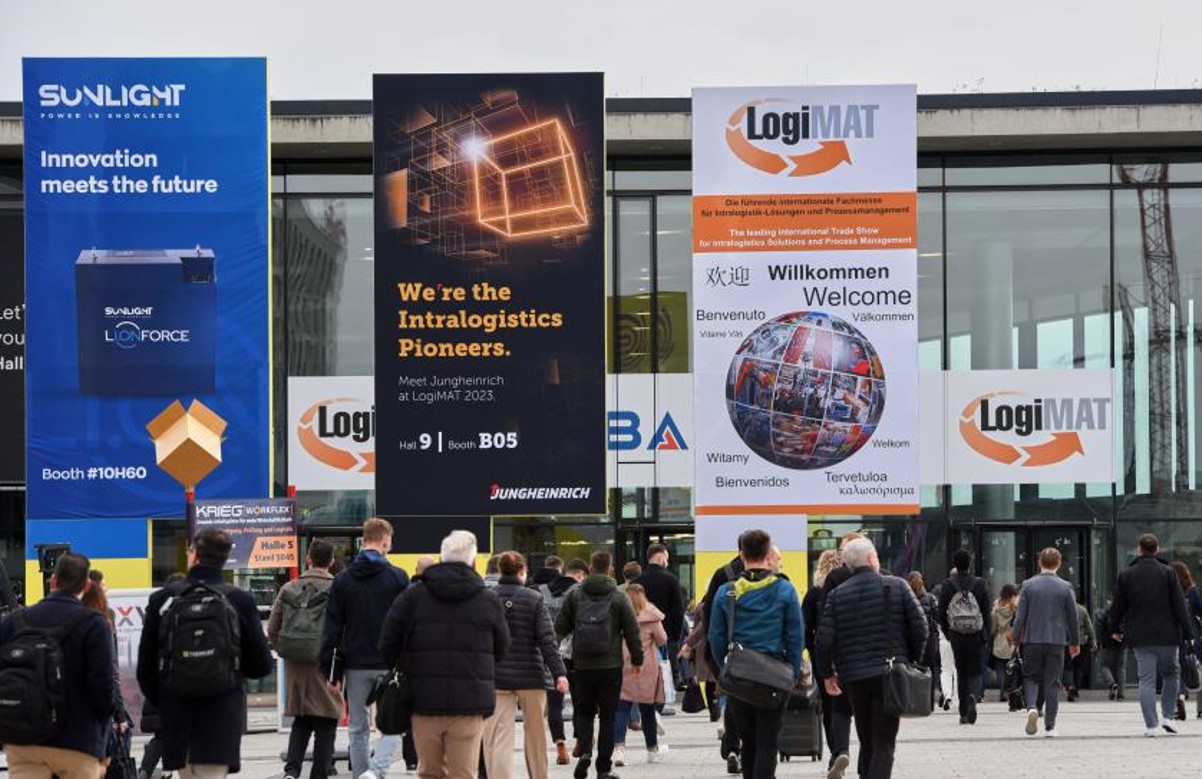
At LogiMAT 2024, exhibitors from nearly all industry segments will showcase their current product developments and solutions for ergonomically optimized intralogistics processes, healthy work practices, and prevention. The spectrum ranges from new modular workplace concepts and systems to world premieres in lifting devices, as well as software-controlled, voice-based picking processes with data glasses, to new equipment and assistance systems for forklift workplaces. An expert forum as part of the trade fair will present solutions and tools for the ergonomic alignment of workplaces and processes.
(Munich/Stuttgart) The shortage of skilled workers and the demographic change are also clearly felt in intralogistics. Around 100,000 positions in the logistics sector in Germany remain unfilled. This makes the topic of ergonomics increasingly important for companies. Qualitative enhancement of workplaces and manual tasks, digitization, and the design of intelligent workstations, collaboration between humans and robots, as well as devices for physically relieving employees are just some of the tools that can make processes and work environments in intralogistics more attractive and increase efficiency. A study published at the end of last year on the introduction of wearable exoskeletons found that muscle strain for employees can be reduced by up to 30 percent in the most demanding tasks. The accuracy of work and execution speed increase by 27 and ten percent, respectively. Additionally, workplace safety improves while the rate of illness-related absenteeism decreases. “Ergonomics is a crucial aspect of intralogistics. Ergonomically equipped workstations make intralogistics future-proof and create advantages in the competition for skilled workers,” says trade fair director Michael Ruchty from the Munich-based event organizer EUROEXPO Messe- und Kongress-GmbH. “As a trend barometer for intralogistics, LogiMAT serves as the central platform for presenting relevant new developments. Therefore, this topic is one of the three focal points of this year’s event, summarized under the trade fair motto ‘SHAPING CHANGE TOGETHER – Sustainability – AI – Ergonomics.'”
Paths to Ergonomic Alignment
The paths to ergonomic alignment of workplaces and processes will be presented by Dr. Dipl.-Psych. Veronika Kretschmer, Senior Scientist for Assistance Systems and Human-Technology Interaction at the Fraunhofer Institute for Material Flow and Logistics IML, during the supporting program of LogiMAT 2024 on the second day of the fair in an expert forum at the East Entrance Atrium. The forum’s content is geared towards the Social Networked Industry in the future world of work, where people and new technologies collaborate safely, reliably, and in partnership. The levers identified for this range from exoskeletons to the use of pick-by systems for cognitive support in picking to AI-based analyses of movement data for optimizing intralogistics processes.
Workstation for Human/Machine Collaboration
Furthermore, exhibitors from all industry segments will showcase a selection of their latest developments for physical relief and optimal workplace design and equipment from an ergonomic perspective at LogiMAT in Stuttgart from March 19 to 21. Among the system integrators, machine and plant manufacturers in halls 1, 3, 5, and 7, this includes new developments for ergonomically optimal design of picking stations and sorting points – for example, around AutoStore storage systems. Already in the East Entrance area, a flow manufacturing innovation will be presented in a live demonstration, showcasing a workplace design for manual packing and picking. The new development includes custom-made packing tables and a central robotics system that supplies materials and removes empty containers.
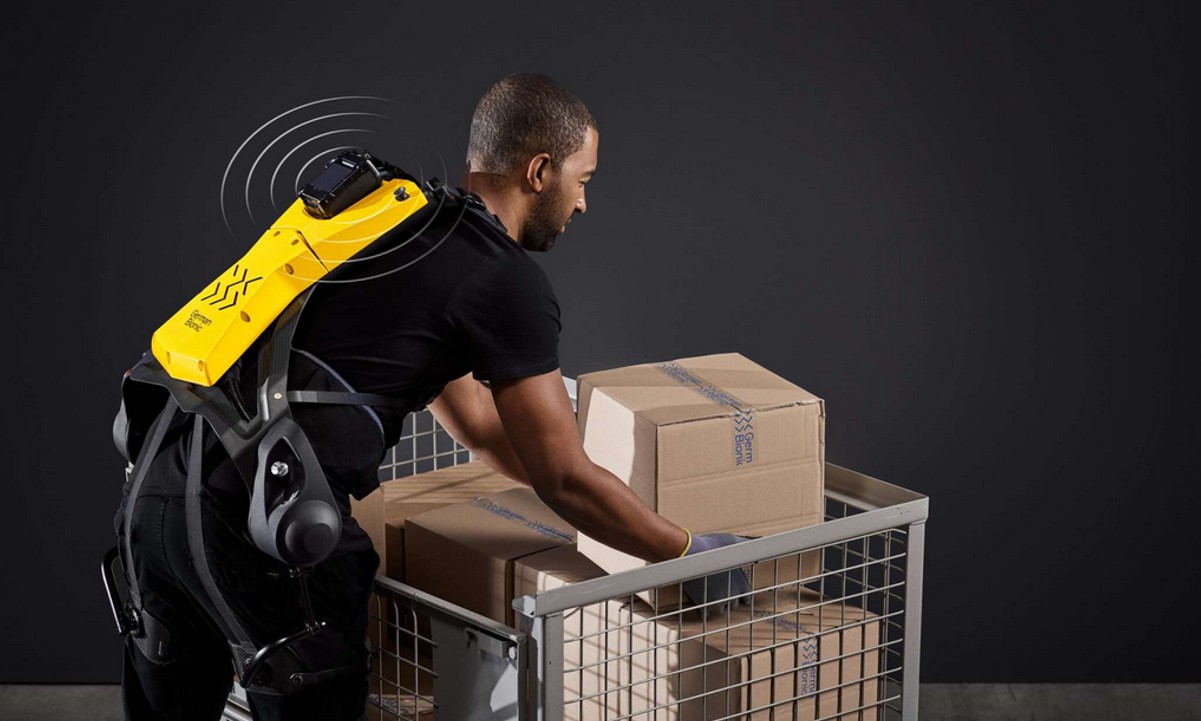 Photo: © German Bionic
Various new workstation systems for modern assembly, logistics, and warehouse operations will be presented by exhibitors in halls 4 and 5. Their characteristics include optimal ergonomics, flexibility, functionality, and an individual, modular design. This allows individual components such as shelves, holders, packing, and work tables to be flexibly and comfortably adapted to different body sizes and processes, and to accommodate retrofitting, expansions, and digital integrations at any time. The result is ergonomically efficient overall systems for future-proof logistics workplaces. New automated packaging solutions offer resource-saving, individualized packaging and reduce the amount of manual labor.
World’s First Fully Mobile Manipulator
In hall 7, world premieres, innovative cable pull and workstation crane systems, and new modular lifting devices for ergonomic, lightweight, and effortless handling will be available for testing. Their modular construction principle for configuration allows for individual device configurations of mobile or stationary lifting technology solutions for employees in industrial work environments. Additional new developments in assistance systems for simplified manual load handling will also be presented in hall 7, such as suction grippers for cartons and bags. Furthermore, the world’s first fully mobile manipulator for handling cartons, packages, containers, and boxes will be showcased.
Among the manufacturers of industrial trucks and attachments in halls 9 and 10, ergonomics primarily focuses on a comfortable forklift workplace and easy-to-handle, multifunctional attachments. Innovations in equipment and assistance systems will be highlighted. As a European premiere, a combined package with location- and event-based functions for forklifts will be introduced in a live demonstration at LogiMAT. It is designed to automatically detect and avoid hazards for people, vehicles, and loads, providing increased safety and driving comfort. Additionally, new concepts for improved human-machine interaction and machine learning in the use of autonomous devices will be presented. Moreover, a new Eurobin tugger can be viewed in hall 9. This ergonomic lifting and transport solution allows employees to move Eurobins weighing up to 300 kilograms electrically in an optimal, upright working position, significantly reducing physical strain.
Vision Picking Solution for Digitalization
In hall 8, several software developers will showcase new functionalities and applications of their systems, demonstrating the contribution of IT solutions to the ergonomic planning and design of facility layouts and process sequences. The integration of state-of-the-art technology into ergonomically optimized process sequences will also be presented in hall 8 with a vision picking solution for digitalization in warehouse logistics via data glasses.
The adjacent hall 6 offers current device developments for collaborative workflows at the human/machine interface with driverless transport systems (FTS) and robotics, such as new cobots, stationary industrial robots, mobile picking robots, and autonomous mobile (transport) robots (AMR). Here, sensor-based safety and ergonomic workplace design, particularly at transfer points and along route peripheries, are the focus. Additionally, sensor technology and comfort-oriented identification solutions shape the product and service offerings of new developments in the AutoID sector, which are concentrated in hall 2 this year. Around labeling and data capture, smart labels, whose data can be read and modified with stationary and mobile readers, as well as cloud apps with automated interfaces and direct printing functions, relieve employees by reducing travel effort.
Solution Options for Ergonomic Workstations
“Ergonomics in intralogistics ensures health preservation and prevention, prevents physical overload of employees, and thus secures the continuity and efficiency of process flows,” summarizes trade fair director Michael Ruchty. “With their exhibits at LogiMAT 2024, exhibitors are showcasing numerous modern solution options for ergonomically optimized workstations. By integrating modern technologies, the use of this offering improves working conditions in intralogistics. This can positively influence the image of logistics-related professions.”
Photo: © LogiMAT