DHL and Formula 1 Extend Their Longstanding Partnership
27. February 2024
MOSOLF and APCOA Announce Partnership for City Logistics
29. February 2024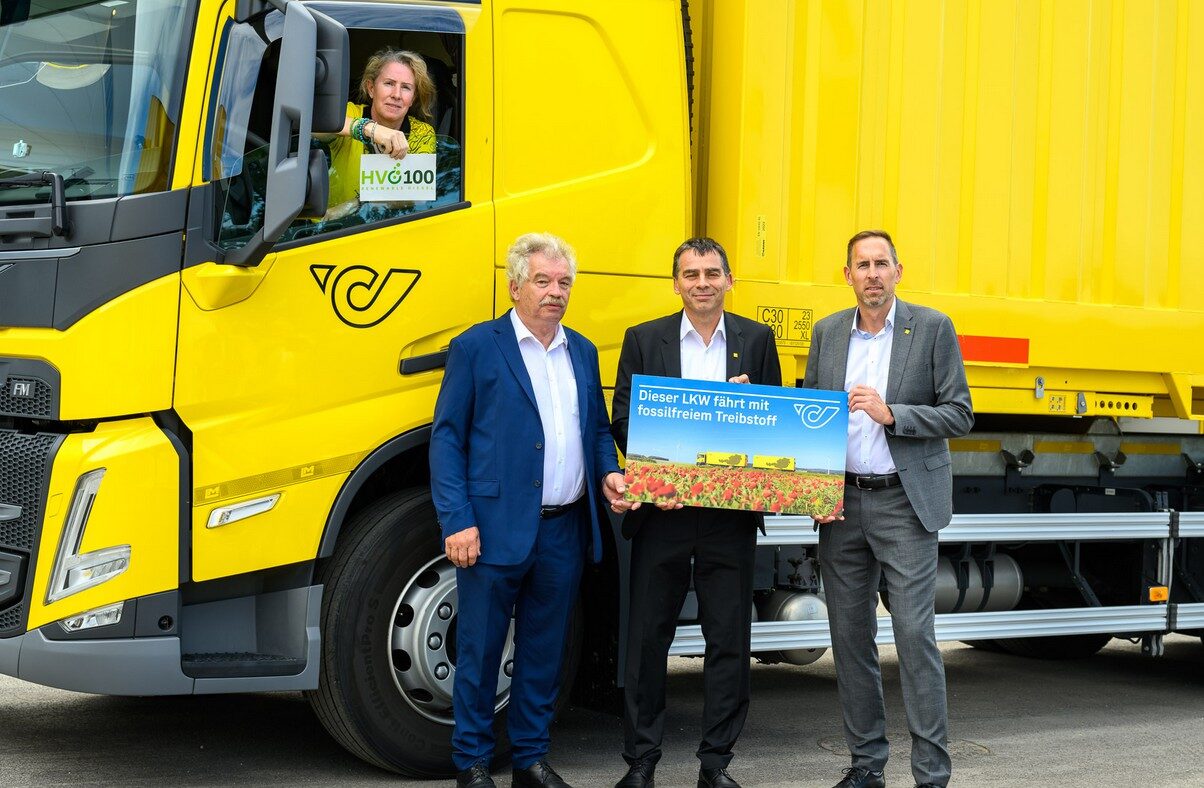
After a successful test operation last year, the Austrian Post will completely convert its truck fleet from diesel to Hydrotreated Vegetable Oils (HVO) in the first half of 2024. This is a renewable fuel that can be produced from waste, fats, plant residues, and vegetable oils.
(Wien) According to the manufacturer, up to 90 percent of CO2 emissions can be saved over the product lifecycle compared to fossil diesel. With an annual consumption of around six million liters of diesel, the Post has a significant lever to reduce emissions in heavy-duty transport.
“With the use of HVO, we are ushering in the next phase of the yellow-green future. After the successful test operation, we have decided to refuel all our 180 trucks with this renewable fuel in the first half of 2024. HVO is an important bridging technology and a tremendous lever with which we can save several thousand tons of CO2 per year,” explains Peter Umundum, Executive Director for Parcel & Logistics, Austrian Post AG.
Advantage: No Technical Retrofitting Required
HVO can be used in modern diesel engines without technical retrofitting and has already been approved for use by all truck manufacturers in the Post fleet – Iveco, MAN, Volvo – enabling rapid implementation. Since the beginning of the year, the first 60 Post trucks have already been refueled with HVO, and by the end of March, around 120 are expected to be converted. By the end of the first half of the year, the entire fleet of 180 trucks is to be fully converted to HVO.
In the ramp-up phase of 2024, about four million liters of diesel will be replaced by HVO, and in full operation, it will be around six million liters of diesel per year. The HVO fuel will be sourced through the fuel station partners Eni, MMM, OMV, and Turmöl. Through long-term supply contracts and a tie to the diesel price, the Post expects no significant additional costs from the conversion.
The HVO fuel used by the Post is subject to the EU directive for renewable energies (RED II). It aims to ensure that biofuels do not have negative impacts on food production, the environment, or social sustainability.
 Test Operation Between July and September
The Post was able to record the test operation between July and September 2023 in the two metropolitan areas of Vienna and Graz as a complete success. The trucks were used on their daily postal routes between logistics centers, delivery bases, and post offices, transporting packages, advertising mail, letters, and print media. Important experiences were gained in daily use: the trucks do not consume more fuel, and the driving behavior and performance are the same as when operating with diesel. The refueling process is simple, and there is no smell of vegetable oils or fats.
Electric Trucks and Hydrogen on the Starting Blocks
On the way to emission-free heavy-duty transport, the Post aims to bring and test further future technologies on the roads as quickly as possible. By the end of the first half of the year, two electric trucks will be put into operation, which will then shuttle between the logistics center in Vienna-Inzersdorf and Vienna-Schwechat Airport. Two fast charging stations will be established on the premises of the logistics center to get the vehicles back on the road in the shortest possible time.
The situation with hydrogen trucks is somewhat more challenging. Currently, there are only a few truck models in small series on the market, and the availability of green hydrogen – produced with renewable energies – is still very limited in Austria. Depending on availability, the Post aims to test a hydrogen truck in 2024 or 2025.
Photo: © Austrian Post