






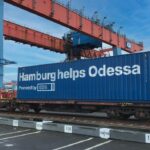
“Port Bridge Hamburg-Odessa” Sends Aid Shipment
2. April 2024
DB Cargo: Digital Automatic Coupler Goes into Series Production
2. April 2024
A circle of over 100 guests from the Basel shipping and logistics industry was welcomed by the Dutch ambassador to Switzerland, Karin Mössenlechner, at the networking event of the Port of Rotterdam in the renowned Basel Safranzunft, together with Hedi Visscher, director of the Rotterdam Port Promotion Council (RPPC).
(Basel) It is remarkable how many interests the Alpine Republic of Switzerland and the Kingdom of the Netherlands, a country that has reclaimed one-fifth of its land from the sea, have in common. A stable mutual trade volume that has exceeded the mark of 12 billion EUR annually since 2021 is just one part of these commonalities, as the Dutch ambassador in Bern, Karin Mössenlechner, explained on March 27, 2024, in Basel.
Matthijs van Doorn, Vice President Commercial, explained the latest figures from Europe’s largest seaport. “2023 brought quite a few red numbers,” he explained, among other things, the last year’s decline in container volume by 7% to 13.5 million TEU. However, he also made it clear that in the future, “the focus will be less on volumes.” Rather, the selection of goods, especially energy transports, will become more relevant. “Magic words” like hydrogen or CO2 storage are at the forefront, representing the “Twin Transition” of the present, alongside the trend towards digitalization. “The growth of the future must be green,” van Doorn emphasized the port’s credo. The host country Switzerland, as the origin and beginning of the navigable Rhine, “will become increasingly important for us, especially for energy transports.”
Well-attended Panel Discussion
The subsequent panel discussion particularly referred to the Rhine corridor, featuring van Doorn, as well as Florian Röthlingshöfer, CEO of the Port of Switzerland in Basel, and Lars Nennhaus, board member of Dusibruger Hafen AG and COO/CTO of Duisport. Röthlingshöfer explained that it is still about bringing all players together digitally on the Rhine, from inland ports and shipping companies to shippers. “That’s why we have expanded the ‘Rhine Ports Information System (RPIS)’ as a neutral platform with the factor ‘Planning’,” he explained. When moderator Mels Dees (RPPC) asked about the current reach of the system, Nennhaus stated that the millions invested four years ago have paid off: “We currently have many observers who want to join the RPIS.” The intention to establish a digital and sustainably operating Rhine corridor corresponds to the participatory character of the RPIS, Röthlingshöfer emphasized at the end of the panel.
Stimulating Discussion Rounds
Two stimulating discussion rounds at the green table and ample networking opportunities rounded off the successful event, to which Howard Lamb, as Rotterdam Regional Representative in Switzerland and Austria, had contributed significantly in terms of organization.
Photo: © Loginfo24


