Hans-Peter Hadorn Appointed to the Board of Directors of Birsterminal AG
14. May 2024
Construction Work for KV Terminal Straubing-Sand Begins
16. May 2024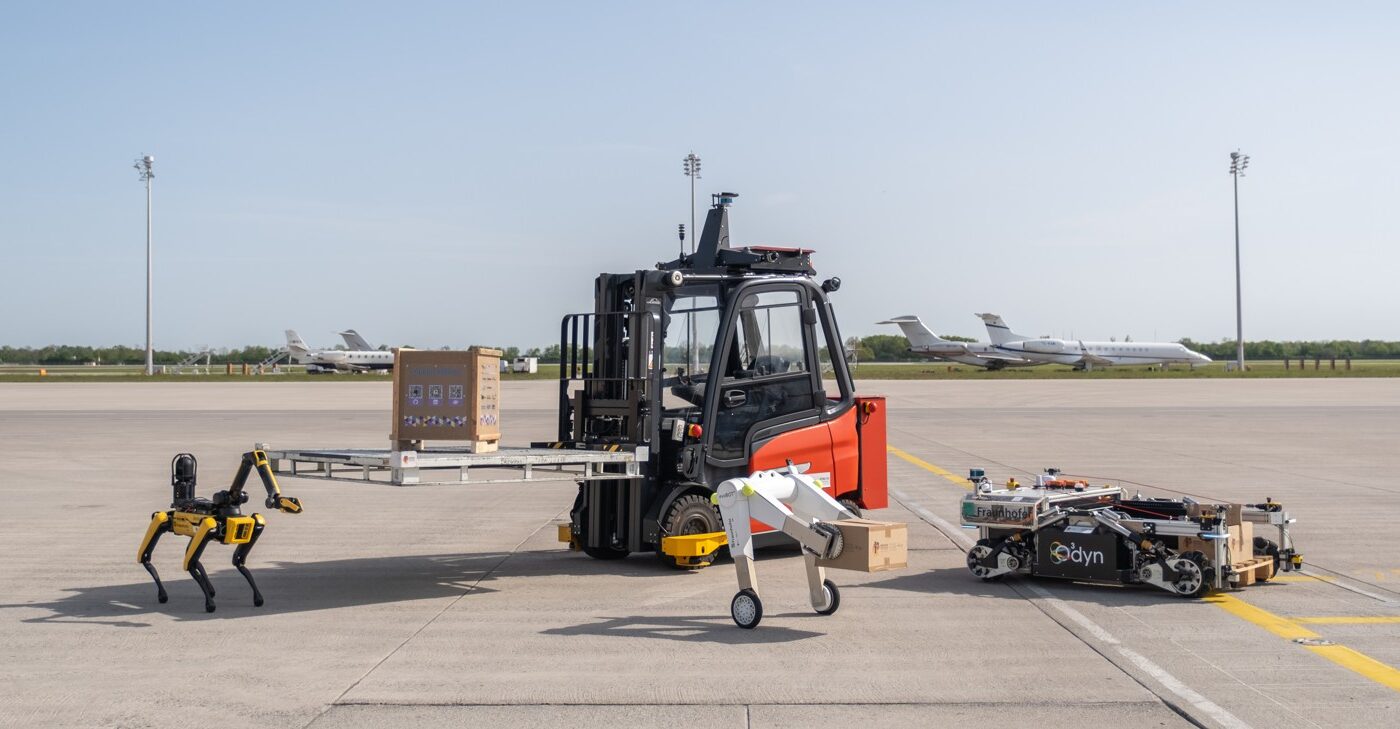
In front of numerous high-ranking representatives from politics, industry, administration, and media, researchers from the Fraunhofer Institute for Material Flow and Logistics IML demonstrated initial results of the research project “Digital Testbed Air Cargo” (DTAC) on May 13 at Munich Airport – a groundbreaking presentation of solutions that optimally utilize the potential of digital technologies and actively shape the future of air freight.
(Dortmund/Munich) A “robot dog” that autonomously patrols the warehouse looking for free storage spaces, a highly dynamic transport robot that automatically delivers pallets to their storage destination, and a very flexible “Segway robot” that places packages from Euro pallets onto a conveyor belt: Does this sound like science fiction? It is not, as researchers from Fraunhofer IML recently demonstrated to the public for the first time at Munich Airport. Together with the Frankfurt University of Applied Sciences, KRAVAG Insurance, and industry partners at Munich Airport (Cargogate, CHI, Sovereign Speed, and DB Schenker), they showcased initial concrete results of the research project “Digital Testbed Air Cargo” (DTAC).
“That was a convincing demonstration that shows we are very well prepared for current and future challenges. This is particularly important in the air freight sector. The industry must balance the labor shortage on one side and high throughput rates on the other. This will only succeed if we incorporate all available technological developments for process optimization,” emphasized Christian Bernreiter, Bavarian State Minister for Housing, Construction, and Transport.
Dr. Jan-Henrik Andersson, Chief Commercial Officer & Chief Security Officer of Munich Airport GmbH, also expressed positive views on the research results so far: “The cooperation between Fraunhofer IML and Munich Airport is forward-looking. Given the increasing air freight volume and the challenges in personnel recruitment, digitization and robotics will help us make cargo and baggage handling more efficient and the jobs in these areas more attractive in the near future.”
 Funding by the Federal Ministry
The project DTAC, funded by the Federal Ministry for Digital and Transport with around 7 million euros and running until September 2024, investigates how to optimize the efficiency and performance of the air freight transport chain. This is to be achieved through better networking and digitization of processes. During the project presentation in Munich, several autonomous and automated devices were successfully deployed to either completely take over some very labor-intensive and repetitive steps at relevant interfaces in handling or to assist employees in their physically demanding work.
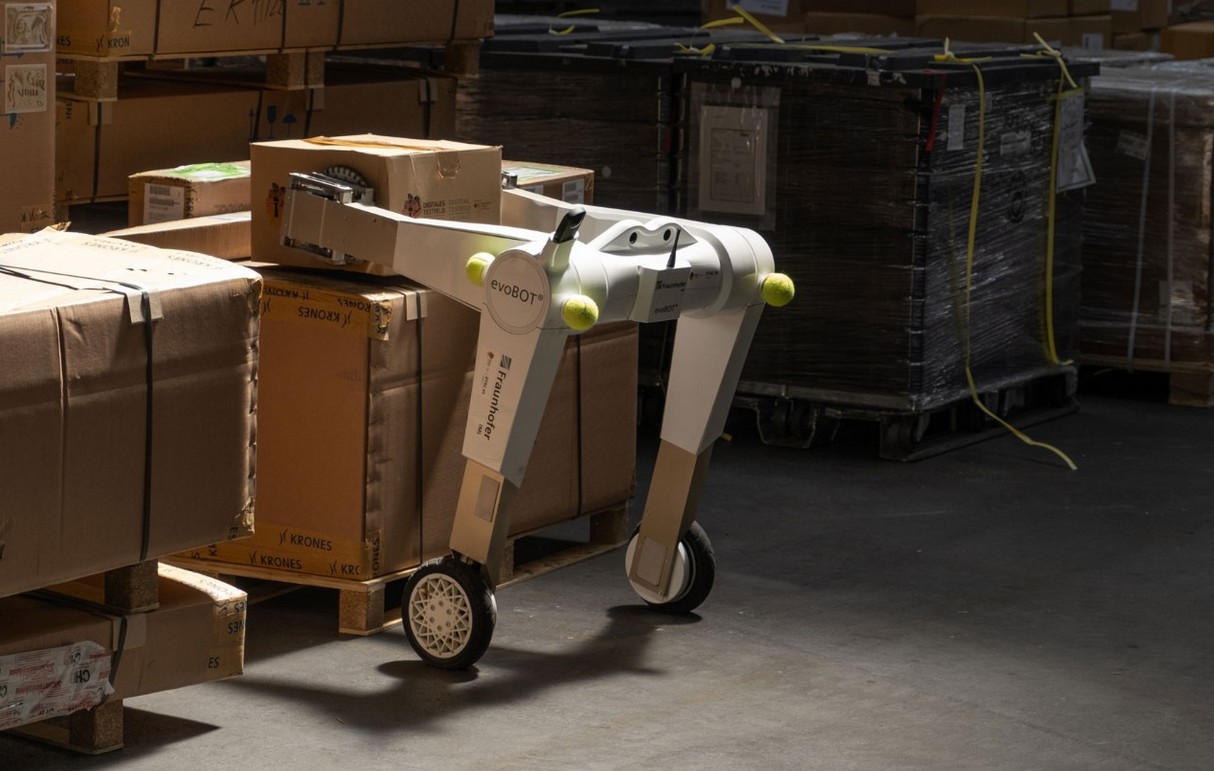
Key roles were played by very differently working robots. The “robot dog” Spot, equipped with a scanner and 4K camera from the American manufacturer Boston Dynamics, autonomously patrolled the warehouse and identified large storage pallets ready for storage and corresponding storage spaces. An autonomously operating forklift took over the intermediate transport to the automatically operating high-bay warehouse, and the omnidirectional, highly dynamic robot O³dyn developed by Fraunhofer IML was responsible for transporting Euro pallets to the adjacent warehouse. The evoBOT, also developed by the Dortmund researchers – a dynamically stable system with two robotic arms based on the principle of an inverted pendulum that does not require external counterweights – placed packages from a Euro pallet onto the conveyor belt of an X-ray machine and returned them to the pallet after the X-ray process. The processes were controlled via the Fraunhofer control system software “openTCS” – an accessible tool for coordinating driverless transport vehicles (FTF).
The Degree of Automation in Air Freight Handling Will Increase Rapidly
Although not all process steps were fully autonomous during the demonstration at Munich Airport and some operations were manually controlled, researchers believe that the degree of automation in air freight handling will increase significantly very quickly. “On the hardware side, as today’s demonstration clearly showed, we are already very advanced. In the future, artificial intelligence will assist us in coordinating and controlling the vehicles. It provides the necessary tools and algorithms with which we can predict the paths of autonomous robots and safely avoid collisions. Ultimately, we will soon have fully autonomous systems that will prepare the air freight industry for the future,” summarized Prof. Michael Henke, managing director of the Fraunhofer IML.
Photo: ©