Combined Transport and MBOX Terminals Cooperate in Niš
25. May 2024
Open Logistics Foundation Presents the Logistics Report v.1.0
25. May 2024
Thirty years ago, the then “Deutsche Bundespost POSTDIENST” began construction of 33 identical “freight parcel centers” for its “freight” division (now the parcel business), located in strategically advantageous locations and equipped with state-of-the-art distribution technology. This marked the birth of modern high-tech parcel logistics in Germany.
(Bonn) On May 26, 1994, the first of these highly automated parcel centers in Hagen-Fley commenced operations, followed by 32 more by June 1995. For this massive undertaking, the Post invested a total of 4 billion DM at the time. The effort paid off: the new sorting centers ensured that 2.5 million parcels could be transported and delivered daily faster and more economically than ever before.
To this day, all 33 parcel centers are in operation. Together with five additional locations that were established much later, they currently handle the sorting of 6.3 million parcels daily, and during the pre-Christmas season, even nearly double that amount. While the freight sector was a case for restructuring 30 years ago, the parcel business today is the growth engine in the Post & Parcel Germany division of the DHL Group, with revenues exceeding 6.7 billion euros and a market share of over 40 percent, serving as a hub for parcel shipments from all over Europe and the world in the rapidly growing e-commerce sector.
The 38 parcel centers are now interconnected thanks to digital technology and modern processes, operating in the best European sense – as e-commerce is also growing across Europe. Since this spring, the Post & Parcel Germany division has been operating its first sorting center in Poznań, Poland, in collaboration with other DHL divisions. Post & Parcel Germany is increasingly connecting merchants and consumers across European borders.
Parcel Centers as the Backbone of Supply
Marc Hitschfeld, Chief Operations Officer of the German Post and Parcel division, states: “For 30 years, our parcel centers have formed the backbone of supply for German households – both in urban areas and in rural regions. This impressively demonstrates how pioneering and forward-thinking the decision to establish a comprehensive new sorting and distribution network was, and how sensible the billion-euro investments at the time were. Thanks to this milestone in our centuries-old history, customers today still receive most parcels by the next working day, despite the enormous parcel growth in recent years, and have transparency about the delivery route.”
A core component of the “freight parcel” concept was the establishment of 33 largely identical “freight parcel centers”: similarly sized plots, single-story buildings constructed in a U-shape, and loading ramps and gates of equal height for comparably sized vehicles. The new freight centers replaced the parcel offices that had previously been located in city centers, often in close proximity to train stations. The Post commissioned Siemens to install the technology. They delivered the systems turnkey for all 33 freight centers, ensuring that identical technology was used everywhere. The new freight network ensured that each parcel was only handled twice instead of up to seven times as before. In addition to improved efficiency and reduced costs, the new network had two other significant advantages: speed and reduced environmental impact. Parcels now largely reached recipients the day after they were dropped off. Furthermore, optimizing transport between the freight parcel centers improved vehicle utilization and correspondingly reduced the number of trips.
The First Location was Hagen
The freight center in Hagen was the first of the 33 locations to commence operations in May, followed in this order by Börnicke, Rüdersdorf, Neumark, Bruchsal, Greven-Reckenfeld, Kitzingen, Regensburg, Neumünster, Nohra, Osterweddingen, Ottendorf-Okrilla, Neustrelitz, Neuwied, Staufenberg, Hamburg, Bremen Hemelingen, Lahr, Radefeld, Augsburg, Dorsten, Saulheim, Cologne, Feucht, Speyer, Günzburg, Köngen, Eutingen, Krefeld, Hanover, Rodgau, and Aschheim. The last parcel center from this initiative went into operation in Bielefeld in June 1995.
Only decades later was the national parcel network significantly modernized in light of increasing shipment volumes, and the sorting capacity of the 33 existing locations was increased to 32,000 shipments per hour. Additionally, five new large locations were added: Obertshausen (2016), Bremen GVZ (2018), Bochum (2019), Ludwigsfelde (2022), and Aschheim II (2023), which even have a sorting capacity of up to 50,000 shipments per hour. And just this March, DHL launched one of the largest and most modern parcel sorting and logistics centers in Europe in Poznań, Poland. Thus, DHL – under this brand, the German parcel business has operated since 2003 – currently operates 38 parcel centers throughout Germany and one in Poland.
Rates Based on Weight and No Longer on Distance
In order for the sorting centers to realize their full potential, parcels had to be machine-readable and computer-readable. For this purpose, the previously confusing product range consisting of 119 shipment types was streamlined, and the new standard product “Post-Paket” was born. From then on, parcels were labeled with barcodes that enabled computer-based shipment tracking. Furthermore, the pricing was structured based on weight rather than distance.
However, these were not the only measures taken to restructure the Deutsche Bundespost POSTDIENST in the 1990s. The letter sector was also to be modernized: a concept called “Brief 2000” essentially provided for the construction of 83 highly automated letter centers, with the first two – Straubing and Münster – going online at the end of 1994. A new, clear letter product range was also approved by management. Additionally, the five-digit postal code, which had already been introduced in 1993, simplified workflows.
New branch concepts were also promoted during this time: Post agencies gradually replaced self-operated branches, contributing to significantly more customer-friendly opening hours, and “Open Service” ensured that customers were served at open counters rather than behind bulletproof glass.
Numbers, Data, and Facts
- 670 million freight parcel shipments were transported by the Deutsche Bundespost POSTDIENST in 1993; its market share was 26 percent.
- 4 billion DM was invested by the Deutsche Bundespost POSTDIENST in its new freight/parcel network.
- 2 instead of 7: Before 1994, parcels passed through seven stations between the sender’s drop-off point and the recipient’s delivery base; after the automated new freight parcel concept, it was only two.
- 8 out of 33: Eight of the 33 parcel centers were established in East Germany, significantly more than would correspond to the share of the then “new federal states” in the total population. This was primarily due to two reasons: The East German states accounted for about one-third of Germany’s area. And the capacities were geared towards increasing cooperation with Eastern European neighbors, especially Poland and the Czech Republic.
- With 23,000 square kilometers, the parcel center in Neustrelitz (Mecklenburg-Vorpommern) had the largest supply area in Germany.
- In terms of population, the freight center in Dorsten in the Ruhr area had the largest supply area to serve, with 3.9 million inhabitants.
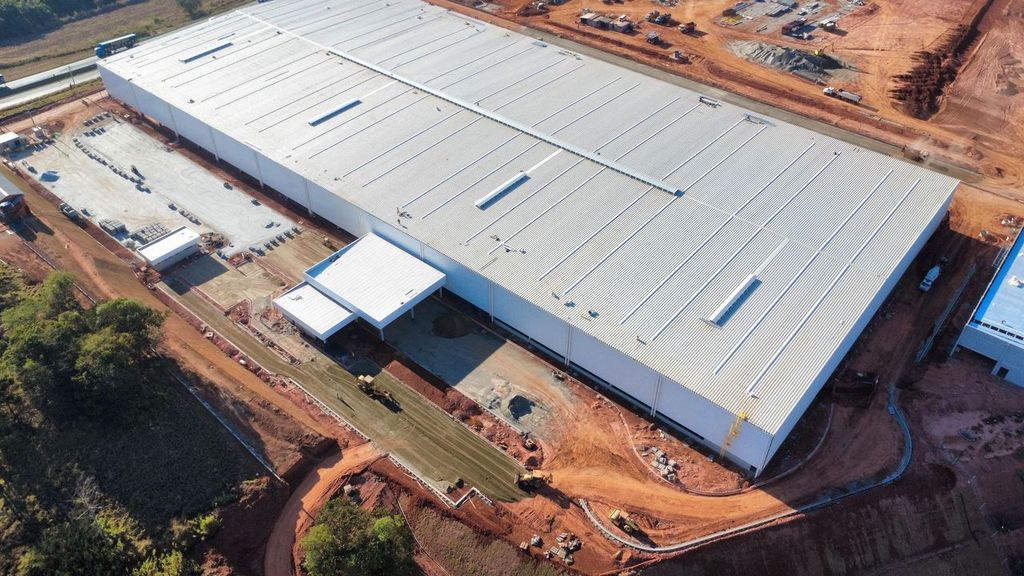
Photo: © DHL / Image Caption: Parcel Center Börnicke